
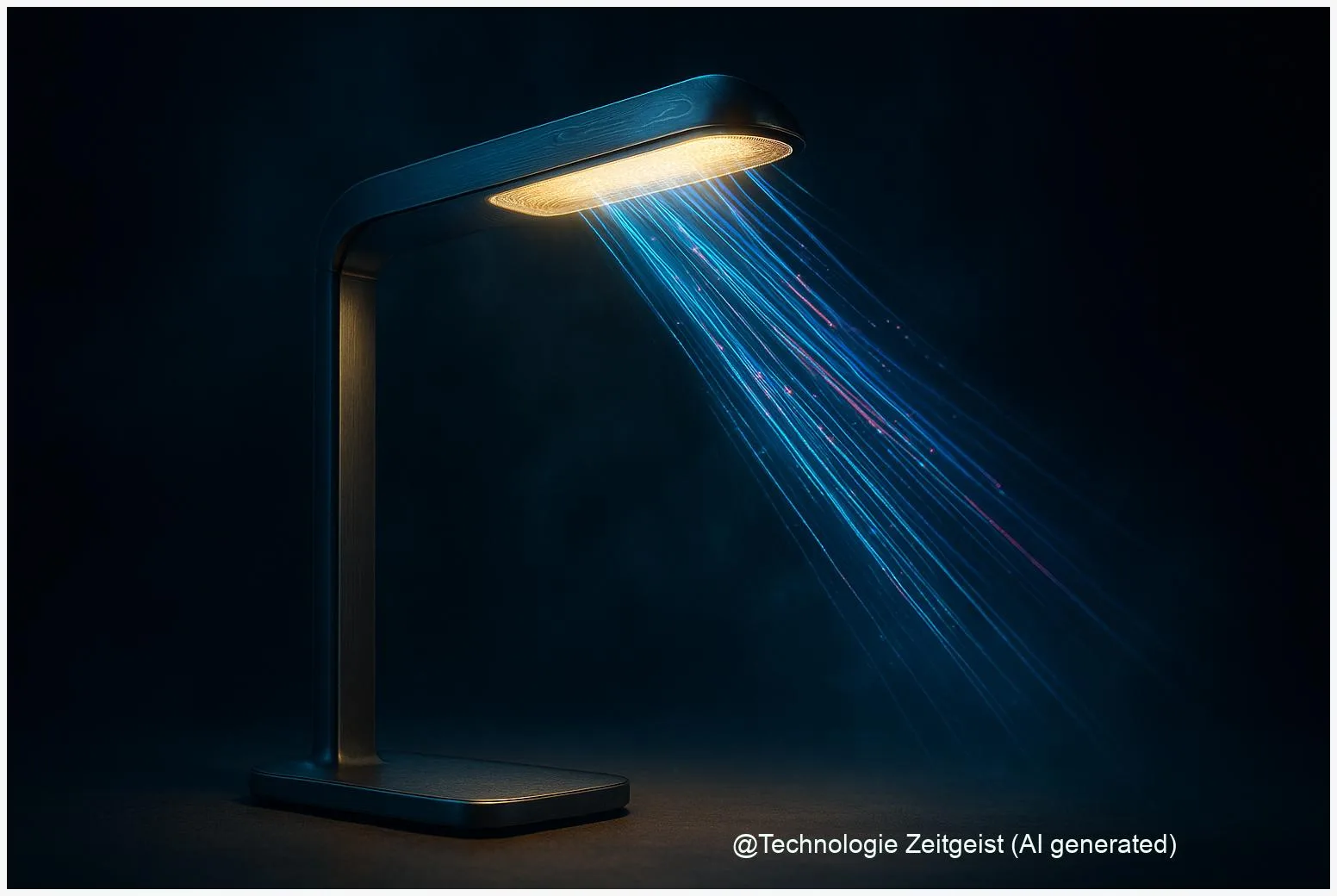
Li‑Fi brings internet over visible light: a lamp or LED transmits data by changing its intensity so fast the eye does not notice. The technology offers a new spectrum, immunity to radio interference and strong isolation in environments that need RF‑free links. This article shows practical benefits and limits of Li‑Fi, how Li‑Fi works at a basic level, and which everyday use cases and safety or deployment issues matter for pilots and early buyers.
Introduction
Many buildings and devices rely increasingly on Wi‑Fi, but radio congestion, sensitive environments and latency outliers still cause problems. Light‑based wireless, commonly called Li‑Fi, approaches the same goal from another angle: it uses visible or near‑infrared light to carry digital signals. That opens a huge, largely unlicensed portion of the spectrum and creates physical separation between neighbouring links, because light does not pass through walls.
In practice, Li‑Fi is not a drop‑in replacement for Wi‑Fi. It is a complementary tool whose strengths—very high local capacity, immunity to radio interference and natural containment inside a room—fit specific needs such as secure local networks, industrial halls where radio is restricted, or dense indoor hotspots. The following sections explain the underlying mechanics, practical examples, regulatory and safety constraints, and realistic timelines for pilots and early deployments.
Li‑Fi fundamentals: how Li‑Fi works
At its core Li‑Fi is simple: a light source (an LED or a laser diode) varies its brightness very quickly to encode data, and a photodetector (a light sensor) converts those tiny intensity changes back into electrical signals. The technique is called intensity modulation with direct detection (IM/DD). Because the human eye cannot follow the rapid flicker, the same lamp still lights a room while also carrying data.
Some technical terms that help understanding:
Modulation — the process of encoding bits in the light. Modern Li‑Fi uses forms of orthogonal frequency‑division multiplexing (OFDM), the same family of techniques that gave us broadband radio links, but adapted for light’s specific constraints.
PHY and MAC — these are layers in a communications stack. PHY (physical) concerns the optical signals and modulation. MAC (medium access control) deals with sharing a light channel between devices and with supporting dimming and flicker constraints that matter for illumination.
Line‑of‑sight (LOS) and blockages — light travels straight. Li‑Fi links work best with a direct path between lamp and sensor. If a hand or object blocks the path, the link can degrade quickly; practical systems use dense lamps, multiple receivers or hybrid fallbacks to radio to maintain connectivity.
Laboratory demonstrations show very high aggregate rates: research teams have reported aggregated WDM (wavelength division multiplexing) Li‑Fi links exceeding 100 Gbit/s in controlled setups, while single white‑light laser transmitters achieved tens of Gbit/s in peer‑reviewed work. Those peak numbers rely on advanced optics and parallel channels; real‑world indoor access rates will be lower because of reflections, ambient light, safety limits and cost constraints (sources: academic demonstrations and recent preprints).
To compare at a glance, the table below lists the practical focus of Wi‑Fi and Li‑Fi rather than peak metrics.
| Characteristic | Wi‑Fi (typical) | Li‑Fi (typical) |
|---|---|---|
| Propagation | Penetrates walls, broad coverage per AP | Contained indoors, room‑level isolation |
| Interference | Subject to RF congestion and cross‑talk | Immune to RF; optical interference limited to direct illumination overlap |
| Mobility | Smoother roaming today | Challenging if LOS is broken; hybrid solutions help |
In short: Li‑Fi opens a new medium with distinct trade‑offs. Where light can be shaped and contained, it adds capacity and isolation; where mobility and through‑wall coverage matter, radio remains preferable.
Where Li‑Fi is useful today
Real deployments so far are targeted rather than general‑purpose. Li‑Fi’s combination of room confinement and RF immunity makes it attractive where radio is limited or where data must not radiate outside a room. Typical early use cases include:
— Healthcare settings. Operating theatres, intensive care units and some imaging labs restrict or disadvantage radio equipment. A light‑based uplink can carry patient monitoring or device telemetry while keeping radio‑critical equipment separate.
— Secure facilities. Environments where data exfiltration risk must be minimised benefit from light’s physical containment: signals do not pass through walls, making eavesdropping from outside harder compared with radio unless windows are exposed.
— Dense indoor hotspots. Lecture halls, museum exhibits and factory floors with heavy machine‑to‑machine radio traffic can offload local high‑rate links onto light, reducing RF congestion and increasing per‑user capacity.
— Industrial automation and positioning. Li‑Fi can provide precise indoor positioning by measuring which lamp a device sees, and it can carry deterministic short‑range control loops where radio jitter is a problem.
Concrete examples are emerging: manufacturers and start‑ups have produced lamp‑based access points, window‑mount bridges and modules intended for integration into lighting fixtures. Several prominent firms published pilot installations and product announcements in 2023–2024; however, broad public rollouts are still limited. Market reports show varying estimates for adoption and revenue, reflecting different definitions and the early stage of deployments.
For everyday consumers the experience will usually be hybrid: devices connect over Li‑Fi when in view of a compatible lamp and fall back to Wi‑Fi or cellular when they move out of sight. That hybrid model is already familiar from combined Wi‑Fi/5G setups and reduces the user impact of light’s line‑of‑sight constraint.
Opportunities and tensions
Li‑Fi has clear advantages, but also real tensions that affect whether it will be useful in a given project.
Opportunities:
— Extra spectrum and capacity: visible and near‑IR light offer enormous bandwidth compared with crowded radio bands. That can raise local capacity for high‑density scenarios without adding RF noise.
— Natural containment: for privacy‑sensitive or regulated spaces the fact that light is contained by walls and blinds becomes a security control in itself.
— Coexistence with lighting: using LED drivers already present in buildings allows incremental upgrades where lighting is replaced by Li‑Fi‑capable fixtures.
Tensions and risks:
— Line‑of‑sight and mobility. Human bodies and furniture can block links. Practical systems therefore either increase lamp density, add multiple photodetectors, or integrate a radio fallback. That increases system complexity and cost.
— Eye‑safety and standards. High‑power laser‑based transmitters can deliver very high rates but require strict eye‑safety engineering and compliance with optical safety standards. Any large‑scale rollout needs tested compliance and certified measurements.
— Interoperability and standards maturity. IEEE work on visible light standards (for example IEEE 802.15.7 and later task group activity) provides a technical baseline, but products have historically mixed proprietary features. Ensuring devices from different vendors interoperate and update reliably is essential for wider adoption.
— Cost and installation effort. Retrofitting luminaires, cabling for PoE (Power over Ethernet) or adding ceiling‑mounted access points is more invasive than replacing a single Wi‑Fi router for whole‑home coverage. That favors selective commercial or institutional pilots at first.
Balancing these elements means Li‑Fi is best viewed as a specialised tool for places where its containment, capacity or RF‑free character solves a concrete problem—rather than a universal replacement for Wi‑Fi.
What to expect next
Looking ahead two to three years, practical progress will come from four areas:
1) Standardisation and certification. Projects must lock down eye‑safety tests, interoperability profiles and MAC behaviours that handle dimming and flicker. Industry standards and test reports reduce vendor lock‑in and simplify procurement.
2) Hybrid deployments. The most common pattern will be Li‑Fi as a complementary layer to Wi‑Fi: localized, high‑capacity zones that hand clients to radio networks when they move between rooms. That approach reduces the installation risk while letting organisations trial benefits.
3) Component cost and integration. As laser‑SMDs, micro‑LEDs and compact photodetectors scale, installers will get smaller, cheaper modules that integrate with standard lighting. That makes retrofit projects less invasive.
4) Real‑world validation. Independent field tests that measure sustained throughput, link recovery under partial occlusion and eye‑safety compliance will be decisive. Lab peak rates are interesting, but practical rollout decisions rest on reproducible field results and clear ROI for installation and maintenance.
For organisations evaluating pilots today, a recommended approach is: (a) define the problem concretely—RF restriction, secure room, or local capacity—(b) run a short controlled trial with hybrid fallback to Wi‑Fi, and (c) require vendors to document standards compliance and a firmware/update policy. TechZeitGeist coverage of adjacent topics such as Wi‑Fi 8 and AI‑PC networking helps to compare the timing and integration effort; see our pieces on Wi‑Fi 8 at CES and AI PCs at CES for examples of how standards and silicon sometimes appear in products before final norms are settled.
Conclusion
Li‑Fi brings useful properties—RF immunity, room confinement and very high local capacity—that address particular problems where Wi‑Fi struggles. It is not a universal Wi‑Fi replacement because light requires line‑of‑sight, careful safety engineering and different installation patterns. The current phase is early commercialisation: lab demos and first products show the technical potential, while pilot projects are needed to prove reliability and value in real environments.
For practical decisions, prefer hybrid proof‑of‑concepts that combine Li‑Fi fixtures with proven Wi‑Fi fallback, insist on eye‑safety documentation and interoperability commitments from suppliers, and demand independent field measurements rather than marketing peak numbers. Done that way, Li‑Fi can become a powerful complement to radio, particularly in healthcare, secure facilities and dense indoor hotspots.
Share your experience with Li‑Fi pilots or questions about hybrid deployments — comments and tips welcome.




Leave a Reply