
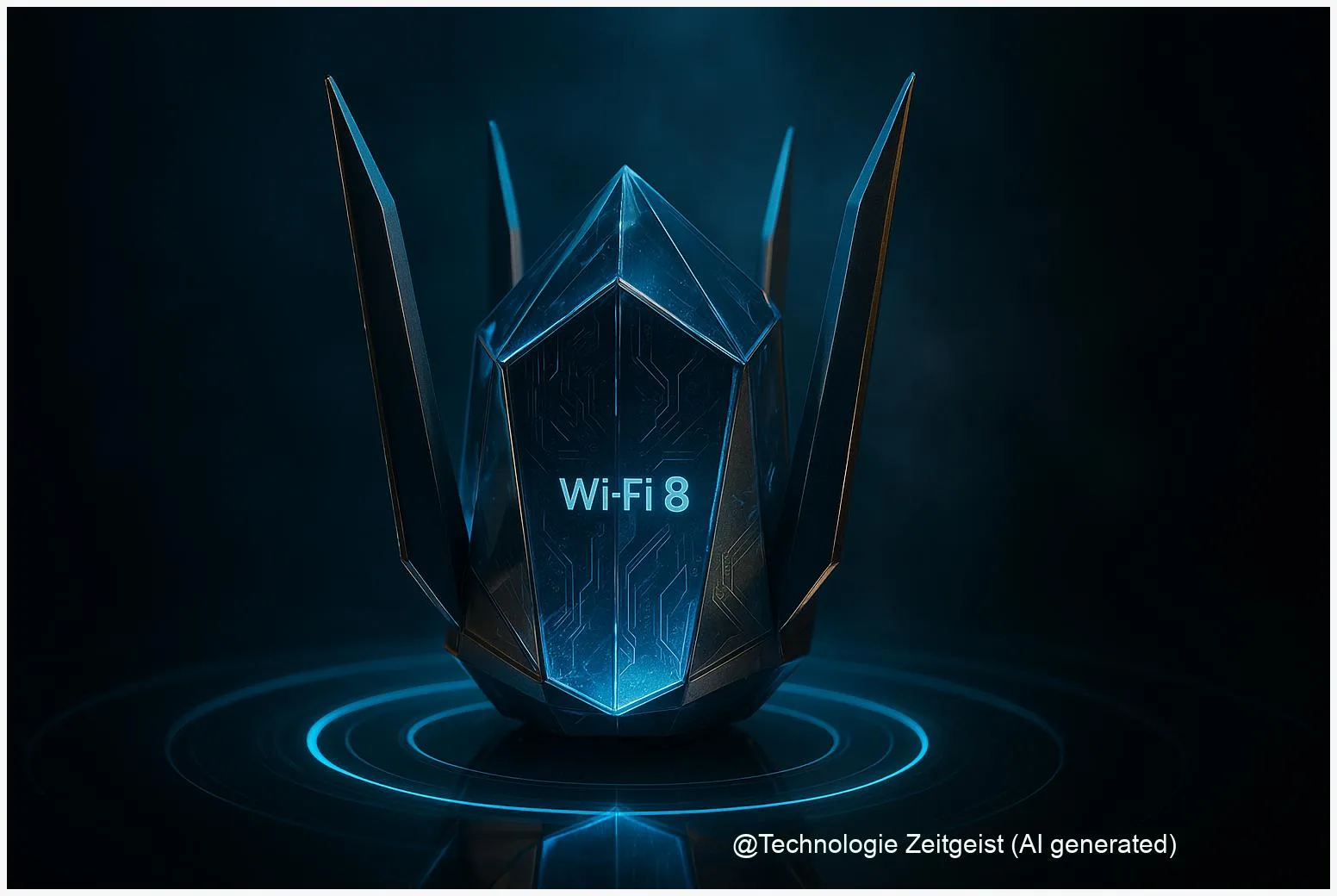
CES 2026 brought early Wi‑Fi 8 hardware and bold vendor claims. The main question for buyers is whether Wi‑Fi 8’s focus on lower latency and stronger multi‑access coordination matters more than the mature speeds of Wi‑Fi 7 today. This article outlines what Wi‑Fi 8 promises, why the final IEEE standard is still pending, and which practical factors should influence a decision to buy a Wi‑Fi 7 router now or wait for Wi‑Fi 8 devices to mature.
Introduction
At CES 2026 several chipmakers and router makers displayed Wi‑Fi 8 silicon and demo systems, often emphasising reliability and bounded latency rather than raw top speed. That matters because most home and small‑office Wi‑Fi use is not about absolute peak rates but about stable connections for video calls, cloud gaming, XR headsets and many smart devices at once.
Buyers considering a Wi‑Fi 7 router now face a timing question: Wi‑Fi 7 is widely available and delivers very high throughput; Wi‑Fi 8 promises better multi‑AP coordination and lower worst‑case latency, but the IEEE standard (802.11bn) was still in draft stages at the start of 2026. The difference between a marketing demo and broadly compatible, field‑tested gear is important. Below are the technical points, everyday effects, and a clear approach for whether to buy or wait.
What Wi‑Fi 8 actually changes
Wi‑Fi 8 shifts the engineering emphasis away from chasing headline peaks to making wireless connections more predictable. Several CES announcements named features that recur across vendor materials: multi‑AP coordination, mechanisms to reduce packet delay variation, dynamic subband operation to improve spectrum sharing, and better coexistence with other radio technologies in the same device.
Vendors at CES framed Wi‑Fi 8 as “reliability‑first”: fewer late packets, quicker recovery, and smoother behaviour under heavy load.
Those terms need short explanations:
– Multi‑AP coordination means neighbouring access points cooperate instead of interfering, which can improve coverage and handovers in homes with mesh systems or in dense apartment blocks.
– Bounded latency and P99 improvements mean fewer extreme delays for interactive applications; the 99th‑percentile latency (P99) is the time below which 99 % of packets arrive.
– Dynamic subband operation and non‑primary channel access are tools to use available spectrum more flexibly while sharing it with other users.
To keep this concrete, the table below compares the practical focus of Wi‑Fi 7 and Wi‑Fi 8 as described by vendors and analysts in early 2026.
| Feature | Description | Practical effect (early 2026) |
|---|---|---|
| Peak throughput | Maximum raw data rate under ideal conditions | Wi‑Fi 7: very high; Wi‑Fi 8: modest gains vs. focus on reliability |
| Latency & P99 | Typical and worst‑case packet delays | Wi‑Fi 8 targets substantial P99 reduction in vendor demos |
| Multi‑AP behaviour | Coordinated transmissions and roaming | Wi‑Fi 8 adds coordination features intended to stabilize mesh networks |
Importantly, the standardisation timeline matters. IEEE P802.11bn (the working name for Wi‑Fi 8) had active draft work in 2025; industry samples and demos in 2026 show silicon moving ahead of a final standard. That approach speeds market testing but can create early compatibility wrinkles if vendors ship Draft‑based devices that later require firmware updates to match a final 802.11bn specification.
Sources for these technical trends include manufacturer press material and reporting from trade media at CES 2026, as well as IEEE TGbn activity which still showed open ballots and comment resolution into late 2025.
How those changes affect everyday use
Most households care about three user‑visible effects: fewer dropped video calls, smoother cloud gaming or streaming under load, and better handling of many smart devices. If a router can reduce the number of very slow packets, users notice more reliable video and less stutter during interactive sessions.
Examples that matter in practice:
– In apartments with many neighbours, multi‑AP coordination can lower local interference so a laptop streaming a video does not suddenly lose quality when someone else starts a large upload.
– For cloud gaming and real‑time XR, improvements in P99 latency (the long tail) reduce visible lag spikes. Vendors at CES described scenarios where Wi‑Fi 8 demos showed far fewer latency outliers than comparable Wi‑Fi 7 drafts in the same environment—claims that need independent validation.
– Mesh systems benefit when access points cooperate; a mesh that hands devices between nodes with less packet loss gives smoother roaming for phones and TV streaming sticks.
That said, absolute throughput still matters for large file transfers and multiple simultaneous 4K streams. Wi‑Fi 7 already delivers very high rates for those tasks. So the practical gain from Wi‑Fi 8 comes when network load, interference or latency sensitivity are the limiting factors rather than raw bandwidth.
Two more points for everyday users: first, device compatibility—clients (phones, laptops) must support the new features for them to be effective; second, regional spectrum rules and 6‑GHz availability affect which Wi‑Fi 8 features can be used in specific countries.
Opportunities, uncertainties and risks
Wi‑Fi 8 presents clear opportunities: more predictable latency for interactive services, improved mesh performance, and better coexistence with co‑located radios. For businesses running local XR labs or multiroom AV setups, these traits can be valuable. For home users they can translate into fewer frustrating freezes during video calls or gaming sessions.
At the same time, several uncertainties are relevant when deciding whether to delay an upgrade:
– Standard finalisation and vendor claims: the IEEE working group was still processing draft comments through late 2025 and early 2026. Manufacturers showed silicon and demo systems at CES 2026, but products based on Draft specifications sometimes require firmware updates after the standard is finalised. That creates a window where interoperability may be vendor‑dependent.
– Independent validation is limited at first. Early CES numbers are useful to watch, but they are typically vendor tests under selected conditions. Independent lab benchmarks and real‑world tests reveal how much of the promise holds in noisy apartment blocks or mixed vendor environments.
– Regulatory and spectrum constraints. Some Wi‑Fi 8 features assume wide, contiguous channels in bands such as 6 GHz; regional regulators differ on how much spectrum they make available. That affects effective speed and the usefulness of certain coexistence mechanisms.
– Device ecosystem and update policy. Useful Wi‑Fi 8 experiences depend on client devices and router firmware being kept up to date. Buyers should look for manufacturers that commit to firmware and security support, and that document compatibility with older clients.
Overall, the risk is not that Wi‑Fi 8 will fail, but that early adopters may face vendor specific behaviour and a period of firmware churn before a stable, standards‑aligned ecosystem appears.
Practical buying guidance
Deciding whether to buy a Wi‑Fi 7 router now or wait a few months for Wi‑Fi 8 kit depends on your priorities and environment. Use these practical heuristics:
– Buy now if: you need more immediate bandwidth for multiple simultaneous streams, large file transfers, or a work‑from‑home setup where Wi‑Fi 7 already solves your issues. Wi‑Fi 7 routers are mature, widely reviewed and likely to receive firmware updates for some advanced features.
– Consider waiting if: you run latency‑sensitive setups (cloud gaming, XR, real‑time audio production), live in a dense wireless environment, or plan a mesh deployment where improved AP coordination would help. Early Wi‑Fi 8 devices may show clear user benefits in these settings once independent tests confirm vendor claims.
– Procurement checklist for early Wi‑Fi 8 purchases: insist on a clear firmware and interoperability policy; check if the vendor documents the device’s support for Draft vs final 802.11bn features; and look for early independent benchmarks that measure sustained P99 latency and coordinated mesh behaviour rather than only peak throughput.
– Hybrid approach: another sensible path is to buy a strong Wi‑Fi 7 router now and plan a small migration when Wi‑Fi 8 access points are proven. Many households upgrade incrementally; buying a high‑quality Wi‑Fi 7 mesh system now preserves good performance and lets you evaluate Wi‑Fi 8 in the field before a full swap.
Finally, if you follow CES coverage, remember to treat vendor demos as useful early indicators and not as final proof. For context across CES product waves, see our coverage of other device classes at CES 2026 such as AI‑capable laptops, which illustrate how silicon and software often ship before standards are finalised: AI PCs at CES: What on‑device AI changes in 2026.
Conclusion
Wi‑Fi 8 is primarily about stronger reliability and tighter latency tails rather than dramatically higher peak rates. CES 2026 made that emphasis visible: manufacturers shipped early silicon and demo systems highlighting multi‑AP coordination and P99 improvements. However, the formal IEEE 802.11bn standard was still being finalised at the start of 2026, and vendor devices may initially follow Draft specs—so expect a period of firmware updates and independent testing before the full promise is realised.
For most home users a high‑quality Wi‑Fi 7 router remains a sound purchase today; if your setup is particularly latency‑sensitive or you run a dense multi‑AP environment, it is reasonable to wait for validated Wi‑Fi 8 gear or to buy Wi‑Fi 7 now and plan an incremental upgrade. In all cases prefer vendors that publish clear firmware‑update policies and that allow easy interoperability testing.
Share your experiences and questions about home networking—comments and tips welcome.

Leave a Reply