
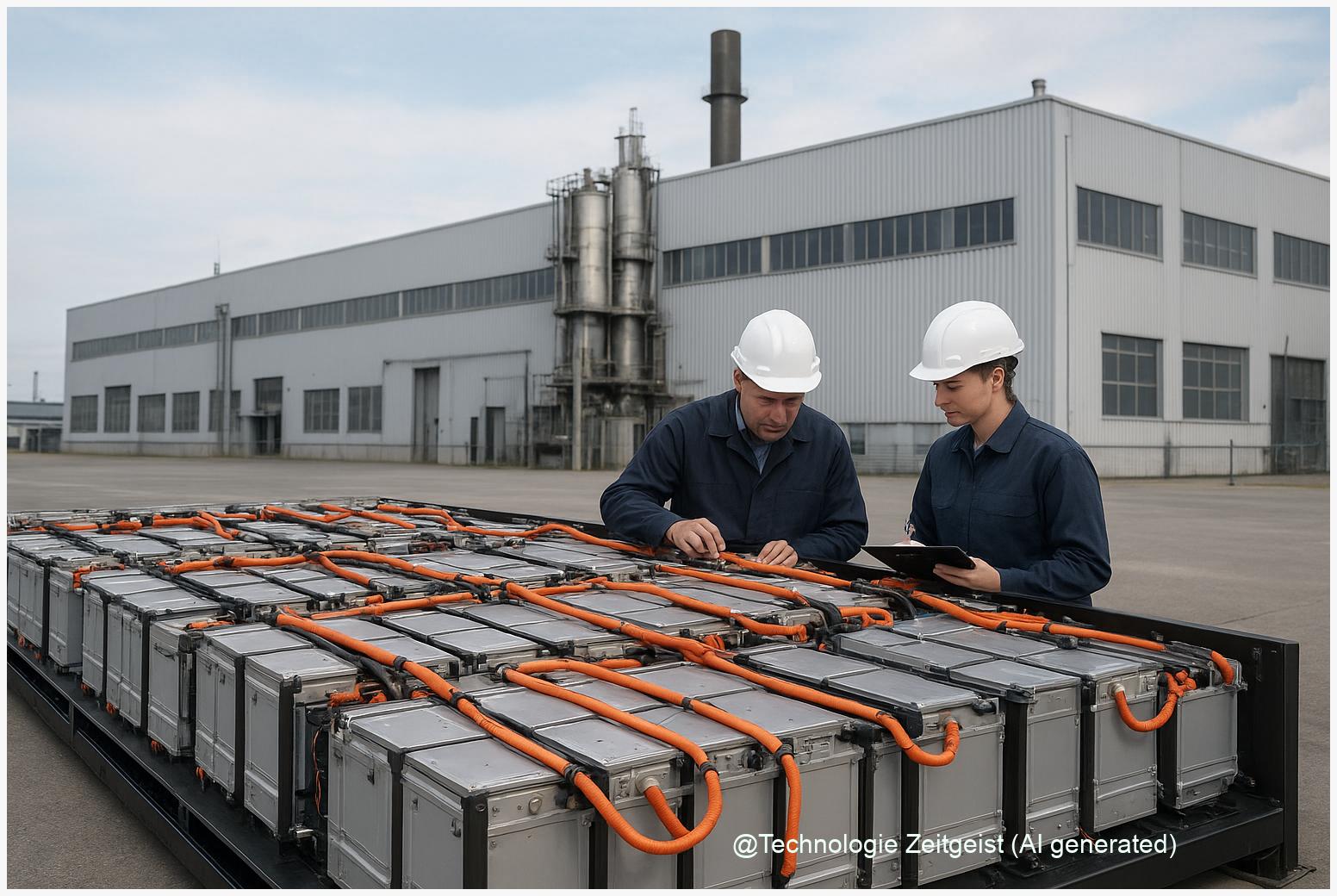
Many carmakers now test second-life EV batteries as a cheaper way to run factory power systems and cut emissions. Second-life EV batteries are used battery packs that still hold usable capacity for stationary tasks such as peak‑shaving, short backup power or charging buffers. The practical benefit is lower upfront costs and an extended lifecycle for battery materials — while the main challenges are safety, testing and clear rules for liability and certification.
Introduction
When an electric car battery no longer meets automakers’ strict performance limits, the cells do not suddenly become useless. Companies face a practical question: can used EV packs supply reliable energy to factories at lower cost and with a smaller carbon footprint than buying new stationary batteries or paying for grid upgrades? Industrial sites need steady power, sometimes quickly and briefly — those are the exact tasks many used batteries can still do.
The shift from vehicle to stationary use is not automatic. Batteries arrive with different histories, they require new control electronics and safety checks, and regulators are still closing gaps. Still, tests and pilot projects in Europe and beyond now show that repurposed packs can cut peak electricity costs and add short-term resilience. The central trade-offs are economic and technical: how much refurbishment is worth the saved expense, and how to guarantee safety over extra years of use.
How second-life EV batteries work
When people talk about second-life EV batteries they mean battery packs that have reached the end of their automotive warranty or no longer meet vehicle range requirements but still retain significant stored energy. A typical threshold is when a battery drops below about 70–80 % of its original capacity; below that level carmakers often retire the pack for performance and warranty reasons.
Key technical concepts are state of health (SoH) and a battery management system (BMS). SoH is a simple way to say how much of the original capacity and life remains; a lower SoH usually means fewer useful cycles. The BMS is the electronic controller that measures voltage, temperature and current and protects the pack. For second‑life use, engineers usually add an additional control layer that adapts the pack to stationary tasks and to different safety rules than mobile use.
Manufacturers and research institutes report that reused EV cells often deliver 30–80 % of their original capacity for stationary applications, depending on history and testing standards.
Refurbishment steps commonly include disassembling the pack or module, measuring SoH at cell and module level, replacing damaged components, reassembling with updated electronics and running standardized safety tests. If packs are aggregated into a larger system, software coordinates charging and discharging so that no single module is overstressed.
If numbers help, the short table below shows typical categories and what they mean in practice for a factory considering reused packs.
| Feature | Description | Value |
|---|---|---|
| State of Health (SoH) | Remaining capacity relative to new | ~30–80 % |
| Common use cases | Peak shaving, short backup, charging buffer | 100s kWh–few MWh |
What factories actually use them for
Factory energy needs vary across sites: administrative buildings need little, while modern production lines can have large short-term power draws when machines start. Repurposed EV batteries are best suited to services that demand short bursts or shifting energy in time rather than continuous base load.
Common applications in pilots and early commercial sites include:
- Peak shaving — the battery supplies power during periods of high grid tariffs, lowering the plant’s billed peak demand.
- Backup power and short black‑start support — the system bridges seconds to minutes when the grid falters, keeping critical control systems alive.
- Charging management for electric fleets — batteries smooth the load of vehicle charging so the grid connection is not overloaded.
Scale in practice ranges from small pilot units of a few hundred kWh to multi‑MWh arrays for larger campuses. Many pilots combine onsite solar with second‑life storage so midday solar surges can be stored and used for evening peaks — a pattern that improves utilisation without requiring new cells.
From an operator standpoint, the attraction is often a lower capital outlay compared with purchasing new stationary batteries, plus the PR and material‑efficiency benefit of giving packs a longer life. Contract models vary: some automakers lend or lease packs to their own plants; others sell refurbished systems through specialist vendors. How the contract handles maintenance, warranty and eventual recycling matters greatly for the plant’s risk profile.
Opportunities and risks
Using reused EV batteries brings clear opportunities. Environmentally, extending a battery’s service life usually reduces the carbon footprint per kWh delivered across the whole materials chain. Economically, second‑life systems can lower upfront costs and avoid expensive grid reinforcement or higher demand charges.
At the same time, there are notable risks and tensions. Safety is the most discussed: thermal runaway or cell failure is rare but needs rigorous prevention through testing, monitoring and certified enclosure design. For liability, questions remain about who guarantees performance after the move from vehicle to factory — the automaker, a refurbisher or the plant operator.
Standardization is a second tension. Different manufacturers use different cell chemistries, module designs and BMS protocols, which complicates mass reuse. Without common test methods and accepted certification, insurers and grid operators may be reluctant to allow wide deployment. Regulators are starting to act — the European Commission’s battery rules emphasize traceability and lifecycle data — but many implementation details remain to be written into technical standards.
Finally, there is a trade-off with recycling: keeping material in active use delays recycling, which can be beneficial, but it also postpones the recovery of critical raw materials if a battery never becomes viable again for either use. Economic models therefore need to consider long‑term availability of cells for eventual recycling and the shifting value of recovered materials.
Where the idea could scale next
Scaling second‑life solutions from pilots to routine factory infrastructure depends on a few concrete developments. First, standardized test protocols that reliably report SoH and expected remaining cycles would reduce uncertainty for buyers and insurers. Second, clear contractual templates for ownership, maintenance and liability would make commercial deals simpler and cheaper to underwrite.
Market signals also matter. If grid tariffs keep rewarding peak reduction and if incentive programs support circular use of batteries, more factories will see a business case. At the same time, manufacturers can design future vehicle packs with reuse in mind: modular designs, accessible data logs and serviceable modules reduce refurbishment costs and speed redeployment.
For observers and local decision‑makers, watching three indicators gives an early read on momentum: the number of standardized certifications for second‑life systems, published KPI sets from pilot projects (kWh usable, tested cycles, failure rates), and the emergence of multi‑party contracts that balance cost, warranty and end‑of‑life recycling. Each reduces the friction that keeps many projects small today and could allow larger programs across factory networks.
Conclusion
Repurposed vehicle batteries offer a practical middle way between immediate recycling and scrapping: they can serve factories for specific tasks while saving resources and often money. The evidence from pilots points to reliable use for peak shaving, short backup and charging management, provided systems undergo careful testing and are run inside certified enclosures with robust monitoring. The larger questions are not just technical but contractual and regulatory — who guarantees performance, who insures the system, and how to ensure the battery is eventually recycled.
For companies weighing the idea, the sensible path is to start with small, measurable pilots using published KPI standards, insist on independent testing, and clarify long‑term responsibility in contracts. Those steps reduce risk and generate the data policymakers and industry need to scale second‑life approaches sensibly.
Join the conversation: share your experience with industrial storage or post a question below.

Leave a Reply