
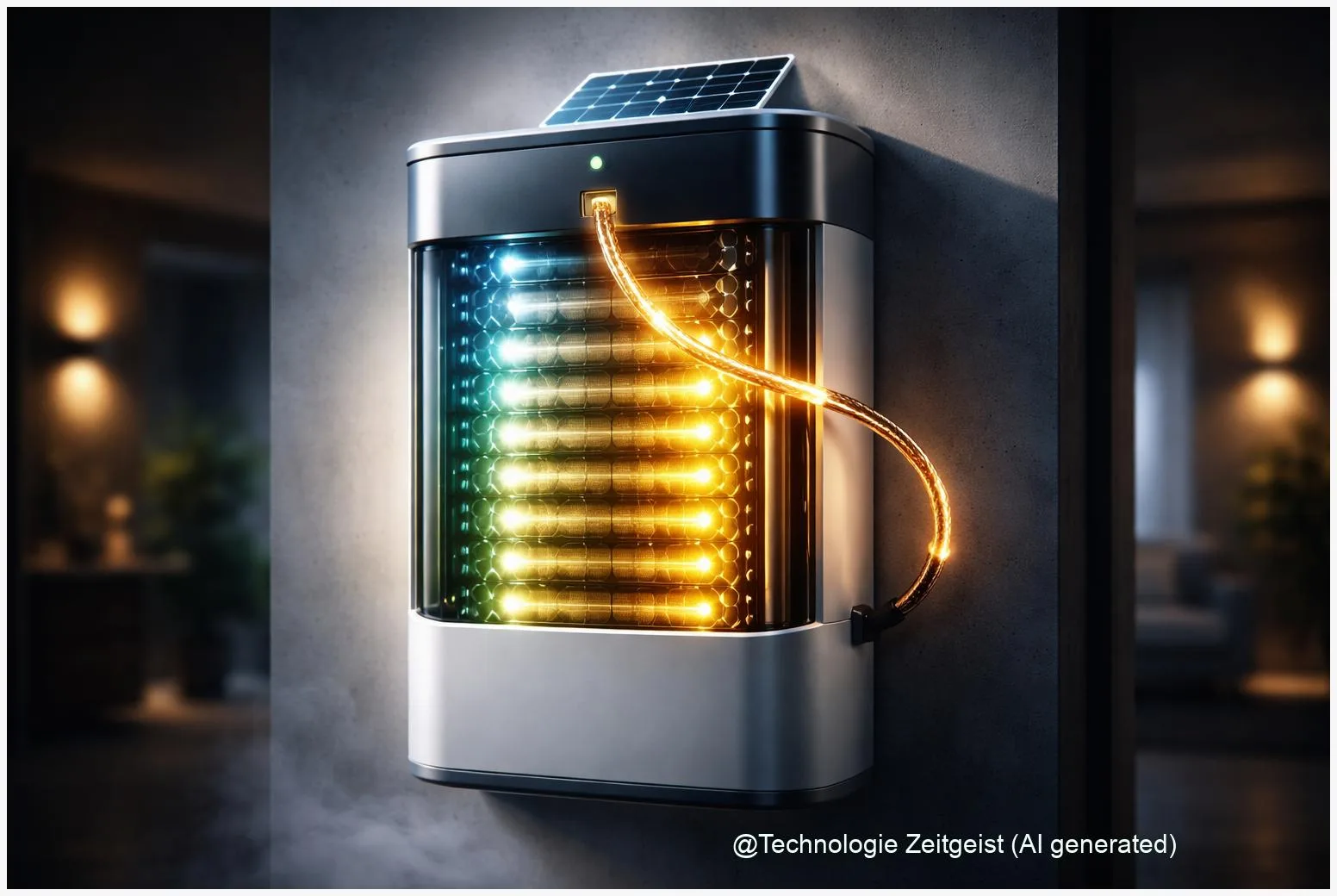
A home solar battery stores electricity from your rooftop panels so you use fewer kilowatt‑hours from the grid and cut your bill. A home solar battery can shift daytime solar output to evening hours, reduce peak charges and provide short backup power. Combined with a simple smart energy control system that decides when to charge and discharge, typical households often reduce grid purchases by a clear margin without changing daily routines. This article shows realistic savings, technical basics and what matters when you consider installing storage at home.
Introduction
Many homeowners with solar panels see power generation peak in the middle of the day while most household use happens in the evening. That timing mismatch is the basic problem a rooftop battery solves: store surplus solar energy when it is produced and use it later when the sun is down or prices are higher. The choice to add a battery no longer depends only on ideal self‑consumption; it now interacts with time‑of‑use tariffs, local grid fees and possible incentives.
The everyday picture helps: charging a battery during bright hours can avoid buying electricity at an expensive evening tariff, smooth sudden demand spikes from appliances or an EV charger, and provide a few hours of blackout resilience. The rest of the article explains the technical building blocks, how smart control increases actual savings, the main economic trade‑offs, and the practical signs that a household will gain financially from storage in the coming years.
How a home solar battery works
A home solar battery is more than a box of cells. The main parts are the battery cells (where energy is stored), a battery management system (BMS) that monitors cell health and temperature, an inverter that converts the battery’s direct current (DC) into alternating current (AC) used in the house, and control software that coordinates charging and discharging. The two practical numbers to know are energy capacity (kWh) — how much the battery can hold — and power rating (kW) — how much it can deliver at once.
Round‑trip efficiency is a useful concept: it describes how much energy you get back compared with what you put in (charging losses and conversion losses reduce the returned amount). A typical modern residential battery has a round‑trip efficiency around 85–95 %, meaning some energy is lost in storage; accounting for that helps set realistic expectations for annual savings.
Installation choices matter. A small battery of 5–10 kWh can cover evening essentials and shave peaks in many homes; a larger system of 10–20 kWh extends autonomy and supports EV charging. The inverter size must match expected household demand and solar output. Many systems are modular, so households can add capacity later if needs change.
The battery’s role is to shift when solar energy is used — the device does not make electricity, it times its use to reduce dependence on the grid.
Safety and warranty are significant practical issues: certified installations, an appropriate enclosure and a modern BMS with thermal protection reduce risks. Many manufacturers publish degradation figures (how capacity falls per year), which should be part of any economic calculation.
Using smart energy control to lower your bill
A home solar battery delivers the most value when paired with smart energy control — software that decides when to charge the battery, when to feed the home, and when to draw from the grid. Smart control systems use simple rules (charge from solar, discharge at high tariff) or optimise based on price signals and forecasts. For many households, the latter approach increases annual savings noticeably.
There are three common control strategies. The first prioritises self‑consumption: store solar energy first and only import from the grid when the battery and panels are empty. The second uses time‑of‑use tariffs: charge when prices are low or solar is abundant, discharge when prices are high. The third is hybrid: it combines self‑consumption, tariff arbitrage and reserve capacity for backup. Smart systems also limit battery cycling to preserve lifespan when tariffs make aggressive cycling uneconomic.
In practice, a household with an evening peak and a common two‑rate tariff often gains most from a hybrid strategy: the battery captures midday solar and discharges in late afternoon, while keeping a small buffer for unexpected grid outages. Connecting smart meters and enabling automated control reduces the need for manual adjustments and increases dwell time on the system — users stop worrying and the system runs optimally.
Smart control can also enable participation in flexibility programs where utilities pay households for controlled discharging during system stress. That revenue stream depends on local rules and aggregator services and can tip borderline economics to positive. On a related subject — larger storage projects and grid‑level issues — see TechZeitGeist’s analysis of grid battery connection challenges.
Second‑life batteries are already tested at industrial scale; they face similar control and safety requirements even if their economics differ. For examples of reuse pilots, TechZeitGeist covered how automakers repurpose EV packs for factories.
What to watch: costs, limits and real savings
Whether a home solar battery pays off depends on several local factors. Most important are your electricity tariff structure (flat vs time‑of‑use), local net metering rules (how exported solar is compensated), available incentives, and how much of your daily use occurs at expensive times. Installation costs, battery capacity, expected degradation and financing rates complete the picture.
A few realistic numbers help anchor expectations. In many European markets, typical household systems (5–10 kWh battery paired with 4–8 kWp of panels) showed reduced grid purchases by around 20–40 % depending on tariff structure and household habits. Exact returns vary: aggressive time‑of‑use pricing and high retail rates favour faster payback, while low retail rates and generous export compensation reduce the relative benefit.
Practical costs to check: total installed price (battery + inverter + installation), permitted export limits, and any network fees applied to storage. Also confirm warranty terms, recommended depth‑of‑discharge and expected yearly capacity loss. Some vendors publish lifetime energy throughput (kWh) guarantees that can be translated into expected usable years.
Risks that reduce savings include poor device efficiency at low loads, higher than expected degradation, or changes in local tariff rules. Research shows that equipment performance at partial loads — for instance, inverter efficiency when the household draws only a few hundred watts — can alter yearly outcomes, so lab and field test results are useful when comparing systems.
Finally, look beyond electricity bills. Batteries provide resilience in outages and allow more local use of rooftop solar, which contributes to decarbonisation. The combined household value is therefore partly financial and partly practical; that mix determines whether the investment feels worthwhile to each family.
Where this technology is heading
Several trends will shape home solar batteries over the next few years. First, smarter grid integration with clearer price signals and local hosting maps will let systems earn more from flexibility. Second, improved system software and aggregators will enable households to sell short services to the grid, opening new revenue streams. Third, second‑life battery pools may lower upfront costs for some installations once standard testing and certification become widespread.
On the hardware side, incremental improvements in cell chemistry and inverter design steadily raise round‑trip efficiency and reduce degradation. That makes replacement less frequent and total lifecycle cost more favorable. Regulators in multiple jurisdictions are already working to harmonise rules that affect storage economics and safety, which should reduce uncertainty for consumers and installers.
For homeowners considering a battery today, sensible choices include: sizing the battery to typical evening demand rather than peak appliance draws; confirming compatibility with your inverter and smart meter; and asking installers for measured partial‑load efficiency figures and realistic degradation projections. Combining an initial modest battery with a system that can be expanded later often gives a good balance between near‑term benefit and long‑term flexibility.
At the systems level, faster rollout of distributed storage depends on standardised interconnection processes and targeted measures to speed critical equipment procurement — issues that are already visible in larger grid projects and industry pilots.
Conclusion
A home solar battery, combined with simple smart energy control, shifts a household’s electricity use from bought grid energy to self‑generated solar power and so reduces bills in many tariff settings. The technology is mature enough for reliable operation, but each household’s outcome depends on tariff design, system efficiency, installation cost and expected degradation. Practical steps — confirming local rules, sizing the battery to evening needs, and insisting on measured performance data — improve the chance of a positive return. As markets and grid rules adapt, storage will become a clearer financial proposition for more households.
Share your experience with home solar batteries or your questions about sizing and costs — we welcome practical tips and discussion.

Leave a Reply