
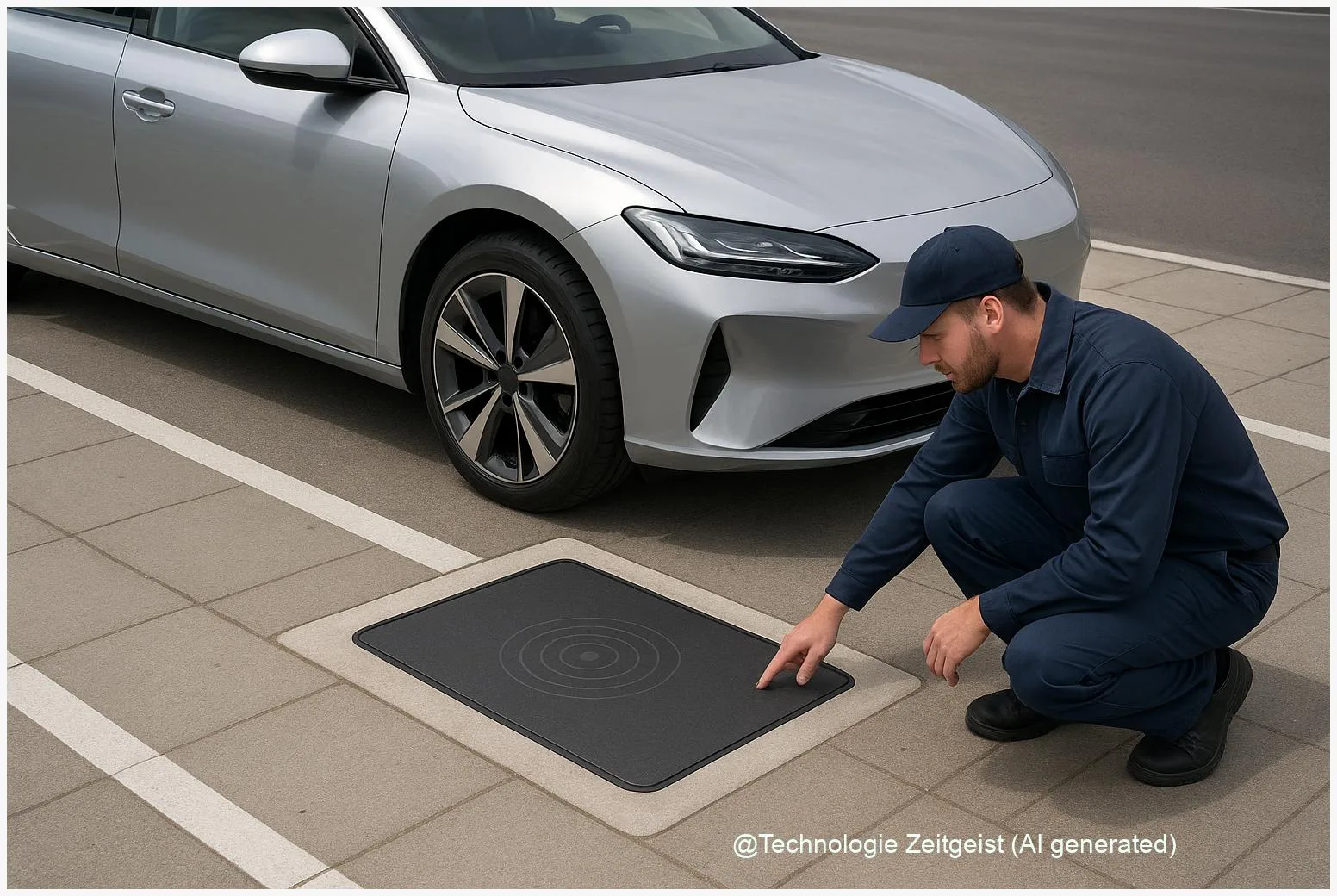
Want to charge an electric car without a cable? Wireless EV charging offers that convenience by using magnetic coupling between a pad in the ground and a receiver under the vehicle. It can work at typical charging powers such as 3.7 kW up to roughly 11 kW for passenger cars, and promises simpler daily use—but technical limits around alignment, efficiency and cost remain. This article looks at how wireless EV charging works, where it already makes sense, and what trade-offs to expect.
Introduction
Most EV owners know the ritual: park, open the flap, plug in. That works well, but it also places a small burden on everyday routines—outdoor sockets, wet connectors, or finding a public stall that fits your plug. Wireless charging promises to remove the physical plug by transferring power across a short air gap. At first glance that sounds like a convenience upgrade. For households with a single vehicle it can be a small luxury; for fleets and public spaces it could change how often and where vehicles top up.
To judge the technology practically, three things matter: how the system transfers energy, how efficient that transfer is compared with a plug, and how much the infrastructure costs. The following chapters explain the underlying physics in plain terms, show concrete everyday examples, evaluate the trade-offs, and conclude with what buyers and planners should check before they invest.
How wireless EV charging works
Wireless charging for cars uses the same basic idea as many wireless phone chargers, but at larger scale and different frequency ranges. A ground unit contains a coil connected to an inverter that creates an alternating magnetic field. A matching coil on the car picks up that field and converts it back into electricity for the vehicle’s onboard charger and battery. This transfer is usually called inductive or resonant inductive charging: “inductive” because coils generate and receive magnetic fields; “resonant” because both coils are tuned to oscillate at the same frequency to improve coupling.
Two short technical points explained simply: alignment and air gap. Alignment means the two coils should lie roughly above each other; misalignment reduces the magnetic coupling and therefore power transfer. The air gap is the physical distance between ground pad and vehicle receiver—usually a few centimetres for passenger cars. Larger gaps make efficient transfer harder, which is why good placement matters.
Standards such as SAE J2954 define alignment zones, communication handshakes, and target power classes to make systems interoperable.
SAE J2954 is a technical standard for light‑duty vehicles that sets typical frequencies around 85 kHz and defines WPT classes such as WPT1, WPT2 and WPT3 for roughly 3.7 kW, 7.7 kW and 11 kW respectively. These numbers are useful orientation points when comparing systems and procurement offers.
If a quick comparison helps: energy flows from the grid into the pad’s inverter, across the air gap via magnetic coupling, into the car’s receiver, then through the onboard power electronics into the battery. Losses occur at each step—power electronics, imperfect coupling, and battery charging conversion—but modern well‑aligned systems can approach plug‑in efficiency in optimal conditions.
If a short table clarifies the main features, here is a compact view:
| Feature | Description | Typical value |
|---|---|---|
| Frequency | Operating frequency used for coupling | ≈85 kHz |
| WPT classes | Standardized power bands for light vehicles | WPT1–WPT3 (≈3.7–11 kW) |
Everyday use: home, fleet and public charging
At home, wireless charging changes the user interaction more than the physics: you park over a marked pad and the system negotiates a handshake with the car to start charging. For many drivers that is purely convenience—no bending, no weather exposure, no cable to plug in. Technically, a home pad sized for WPT1 or WPT2 fits most daily driving needs, because average daily mileage requires only a few kilowatt‑hours of charging.
Fleets and transit services view wireless charging differently. Bus depots and on‑route charging pilots use larger pads and higher power levels. In depot scenarios, automated parking and no‑operator charging reduce turnaround time and labour. Some pilot projects also experiment with short, frequent on‑route top‑ups at stops or layovers; that reduces battery capacity needs and can change fleet economics—but it requires reliable infrastructure and clear operational planning.
Public sites such as curbside parking, taxi ranks or ride‑hail staging areas are attractive because a pad can stay in place and serve multiple vehicles if standards and billing systems support that. Practical deployment requires signage, simple alignment aids, and robust weatherproofing. It also raises questions of availability: an occupied pad is less useful than an available plug in areas with limited parking.
Concrete example: a household that drives 30–50 km per day can recover that range overnight with a WPT2 pad during typical parking times. For a bus operator with scheduled layovers, short high‑power top‑ups may allow a smaller battery per vehicle and lower upfront vehicle cost—but only if chargers are always available and uptime is high.
Opportunities and practical limits
Wireless charging brings clear benefits: convenience, reduced connector maintenance, and new operating models for fleets. It also creates constraints. The most discussed limits are efficiency, cost and electromagnetic compatibility.
Efficiency: manufacturers and independent labs report different numbers because they measure at different points. Some manufacturers state grid‑to‑battery efficiencies near the efficiency of slower plug‑in chargers—figures in the low‑to‑mid 90s are cited for optimised, well‑aligned systems. Independent lab work has shown that at higher power and under ideal test conditions the magnetic transfer stage can be very efficient, but end‑to‑end grid→battery tests tend to be lower depending on measurement definitions. In short: efficiency can be comparable to plug‑in charging when alignment and conditions are good; it drops with misalignment, contamination on pads, or larger air gaps.
Cost and infrastructure: a wireless pad and its control electronics typically cost more than a comparable plug‑in wallbox, and installation can be heavier because the pad must be recessed or mounted and the site prepared. For homes the premium may be acceptable to some buyers. For public projects, the total cost of ownership picture must include maintenance, availability and interoperability so a single vendor does not create lock‑in.
Safety and standards: electromagnetic fields are part of the transfer. Standards such as SAE J2954 and national exposure guidelines set limits and specify detection systems—metal foreign object detection and communication handshakes are essential to prevent heating of nearby objects. Regulatory approval and clear installation practices are therefore crucial before scaling up.
What comes next: standards, pilots and buying choices
Standards work and pilots are the engines of maturity. SAE J2954 provides the baseline for passenger cars, while extensions and related efforts seek higher power and dynamic (in‑road) concepts. Several demonstrators test short in‑route charging for buses or trucks; these projects clarify whether moving infrastructure can be integrated into traffic and the grid without excessive cost.
For consumers and fleet managers considering investment, a few practical checks help reduce uncertainty. First, require systems that declare compliance with SAE J2954 or equivalent test reports. Second, ask vendors for an independent grid‑to‑battery measurement showing which parts of the system were included in the test (inverter losses, WPT losses, onboard charger losses). Third, plan a pilot: install a pad in a real parking position and measure how often cars are misaligned or how weather and dirt affect operation.
Policy makers should require interoperable billing and clear maintenance rules if pads are shared in public spaces. For households, wireless charging is increasingly an option where convenience outweighs the premium. For fleets, the decision is operational: if guaranteed pad availability and short top‑up windows reduce battery costs enough, wireless charging can be attractive; otherwise conventional depot charging remains simpler and cheaper.
Finally, expect incremental rather than overnight change. Stations that meet standards and publish independent performance data will create the evidence base operators and buyers need. Where early pilots report success, the data typically covers efficiency in specific conditions; wider deployment will reveal the full economic picture.
Conclusion
Wireless charging removes the plug and makes daily EV charging easier, especially in repeated parking scenarios. It works by resonant inductive coupling between a ground pad and a vehicle receiver, and standards such as SAE J2954 set common expectations for alignment and safety. In well‑aligned, carefully installed systems, energy transfer efficiency can approach that of conventional plug‑in chargers, but real‑world losses depend on alignment, air gap and the full grid→battery measurement method. Costs remain higher than a simple wallbox, so the technology currently makes most sense where convenience, automated operation or fleet economics offset the premium. Over the next years, more independent, standardized measurements and interoperable installations will determine whether wireless charging becomes routine or stays a niche convenience.
Have experience with wireless charging? Share your observations and questions—discussion is welcome.

Leave a Reply