
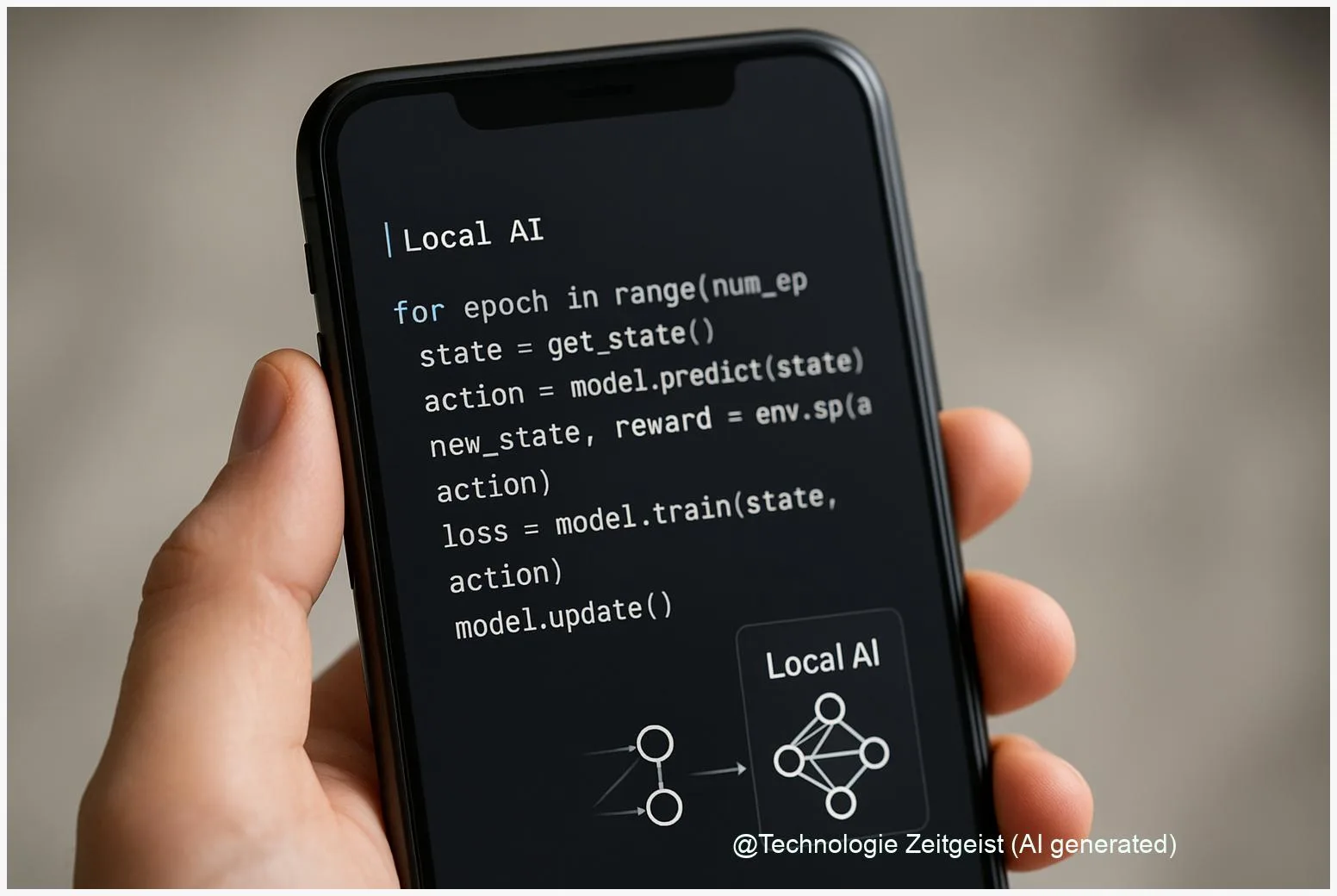
Small, local AI is becoming more useful because model makers are applying reinforcement learning tuning to compact networks. This change helps small language models behave more helpfully and adapt to users while running on-device, preserving response speed and privacy. The core idea is that models already small enough to run on phones can be refined with reward signals and adapters, so they give better answers without sending data to the cloud. The keyword for this article is on-device AI.
Introduction
Phones and small devices now run language models that only a few years ago needed servers. That win brings a new question: can those compact models act more like helpful assistants — not just repeat text, but prefer answers that users actually want? The technical answer arriving in 2024–2025 is reinforcement learning tuning, a way to push small models toward preferred behavior using reward signals, human feedback, or automated critics.
Reinforcement learning tuning is a refinement step where a model receives a score for its outputs and then adapts to increase that score. Think of the score as a simple thumbs-up metric: better replies get higher numbers, and the model slowly shifts to produce more of them. That signal can come from human raters, a separate reward model trained on pairwise preferences, or automated checks for factuality and safety. Early research establishing this approach dates back to experiments such as Christiano et al. (2017) and the InstructGPT work in 2022; both shaped how practitioners apply reward-driven tuning today. Note: the studies from 2017 and 2022 are older than two years but remain relevant because they defined the basic pipeline now used in smaller, on-device systems.
How reinforcement learning tuning works
The technique most readers will encounter is often called RLHF — Reinforcement Learning from Human Feedback — but the broader pattern is: supervised fine-tuning, train a reward model, then apply a policy update step. Supervised fine-tuning gives the model a baseline for following instructions. A reward model learns to score outputs by observing human preferences or curated tests. Finally, a lightweight reinforcement algorithm nudges the model toward higher-scoring outputs while keeping it close to the baseline.
Early experiments showed that learning a reward signal from pairwise human preferences made reinforcement learning feasible on complex tasks with limited human time.
Key components in plain terms:
- Supervised Fine-Tuning (SFT): teach the model basic good behaviour with labeled examples.
- Reward Model (RM): a small model that predicts which of two outputs humans prefer.
- Policy Update (RL step): an algorithm (often PPO or similar) that adjusts the model to maximize the RM score, with a penalty to avoid drifting too far from SFT behaviour.
For small models, the RL step is frequently applied not to the whole parameter set but to compact adapters such as LoRA modules. LoRA adds low-rank weight updates; it holds most parameters fixed and trains a small extra matrix. That keeps compute, memory, and energy costs manageable while still changing behaviour in meaningful ways.
If numbers help orient: foundational laboratory work showed that learning from pairwise preferences could shape behaviours with only a few hundred to a few thousand labels on simulated tasks. Later industry work used tens of thousands of comparisons in large-model settings; both approaches inform the smaller-scale tuning now used on-device.
When RL tuning is done carefully, it increases alignment with human tastes (politeness, helpfulness, brevity). It can also amplify mistakes if the reward model is not calibrated, so validation and adversarial checks are part of the workflow.
If a small table clarifies common roles:
| Component | Role | Typical size |
|---|---|---|
| Backbone model | Generates language; kept mostly fixed for adapter tuning | 1–7B parameters (for on-device) |
| LoRA / adapter | Small learned update; cheap to train and store | Few MBs to hundreds of MBs |
on-device AI in practice: small models on phones
Running a 3‑billion‑parameter model on a modern smartphone became practical after two technical advances: quantization and efficient runtimes. Quantization compresses weights from 16‑ or 32‑bit floating point down to 8‑bit or even 4‑bit representations. Toolchains like GGUF/ggml and runtimes such as llama.cpp convert and run those quantized models on mobile CPUs with reasonable latency.
What that means for a user: a compact, quantized 3B model can occupy roughly 3.5–5 GiB in memory in some community formats, with device-specific variation. Practical tests suggest having at least 4 GiB free is needed and 6–8 GiB gives comfortable headroom for interactive use. Benchmarks also show big differences by SoC and quantization layout, so two phones with similar advertised specs can behave quite differently in real use.
Where RL tuning fits: full RL epochs on-device are still rare because training loops require sustained compute and I/O. The practical and increasingly common pattern is hybrid: train adapters or LoRA updates on a stronger machine (cloud or edge server), then deliver compact adapter files to the device for local inference. Some workflows push calibration steps or small personalization updates locally — for example, a few gradient steps updating a tiny adapter using user-for-consent data — but full PPO loops remain mostly server-side as of late 2025.
Developers working with on-device AI should follow a checklist:
- Start with a quantized GGUF model and measure token/s and peak RAM on the target phone.
- Prefer LoRA adapters for behavior changes; keep adapter files small and signed for integrity.
- Validate reward-model effects with offline tests and small on-device A/B checks before wide rollout.
These patterns allow personalized and private assistants that respond quickly without sending every interaction to a server, while keeping the heavier RL optimization steps off-device.
Benefits and risks of RL tuning at the edge
Benefits are practical and human-centred. On-device AI with adapter-based RL tuning can reduce latency, keep sensitive data local, and let models adapt to personal language and preferences. For people who value privacy or live with poor connectivity, that local adaptability is a clear gain. For product teams, smaller adapters enable frequent updates without shipping entire models.
Yet the same approaches create tensions. A reward model optimized to match annotator preferences may encourage plausible but incorrect answers (hallucinations). Industry analyses around large-model RLHF noted that preference alignment and factual accuracy do not always move together: a model that looks better to raters can still be less faithful to external facts.
Operational risks include:
- Resource strain: on-device personalization that uses gradient updates can exhaust battery or trigger thermal throttling.
- Security and provenance: small adapters are easy to ship, but they must be authenticated to avoid malicious updates.
- Feedback quality: reward signals based on limited or biased raters can steer behaviour in unwanted directions.
Mitigations are straightforward in principle: rigorous offline validation, multi-annotator calibration for reward models, bounded adapter sizes, clear opt-in for personalization, and signed updates. These measures reduce the chance that a well-intentioned local tuning step produces a strange or unsafe behaviour on user devices.
Where this is heading and what to expect
Over the next few years, hybrid workflows will become the norm: lightweight local models for inference and privacy-sensitive personalization, and stronger edge or cloud nodes for heavier RL tuning. Two promising directions stand out.
First, better reward models that are smaller and cheaper to run will enable more local preference checks. Instead of sending every choice to a human, tiny on-device critics can filter obvious failures and trigger uploads only when human review is needed. Second, federated or split training approaches can collect anonymized signals across many devices to refine reward models without centralizing raw conversations.
For users, the practical implication is clearer controls: allow or deny local personalization, review adapter updates, and prefer apps that publish checksums and changelogs for on-device model files. For developers, the advice is to benchmark on target hardware, use signed adapters, and design reward-model validation suites that check both helpfulness and factuality.
Finally, regulators and standards bodies are likely to focus on provenance and update integrity for on-device models. Signed adapters, public validation logs, and reproducible test suites will become part of best practice — not only for safety but for user trust.
Conclusion
Smaller models running locally are already more capable because developers use reinforcement learning tuning and compact adapters to shape behaviour without moving all data to the cloud. Practical constraints — memory, energy, and the cost of human feedback — mean that hybrid approaches dominate: heavy tuning happens off-device, while inference and occasional personalization run on-device. The result is a clearer trade-off between privacy and capability: you can get faster, private assistants that improve over time, as long as adapters are validated, updates are authenticated, and reward models are calibrated to avoid misleading signals.
Join the conversation: share your experience with on-device assistants or ask about testing model adapters on your phone.

Leave a Reply