
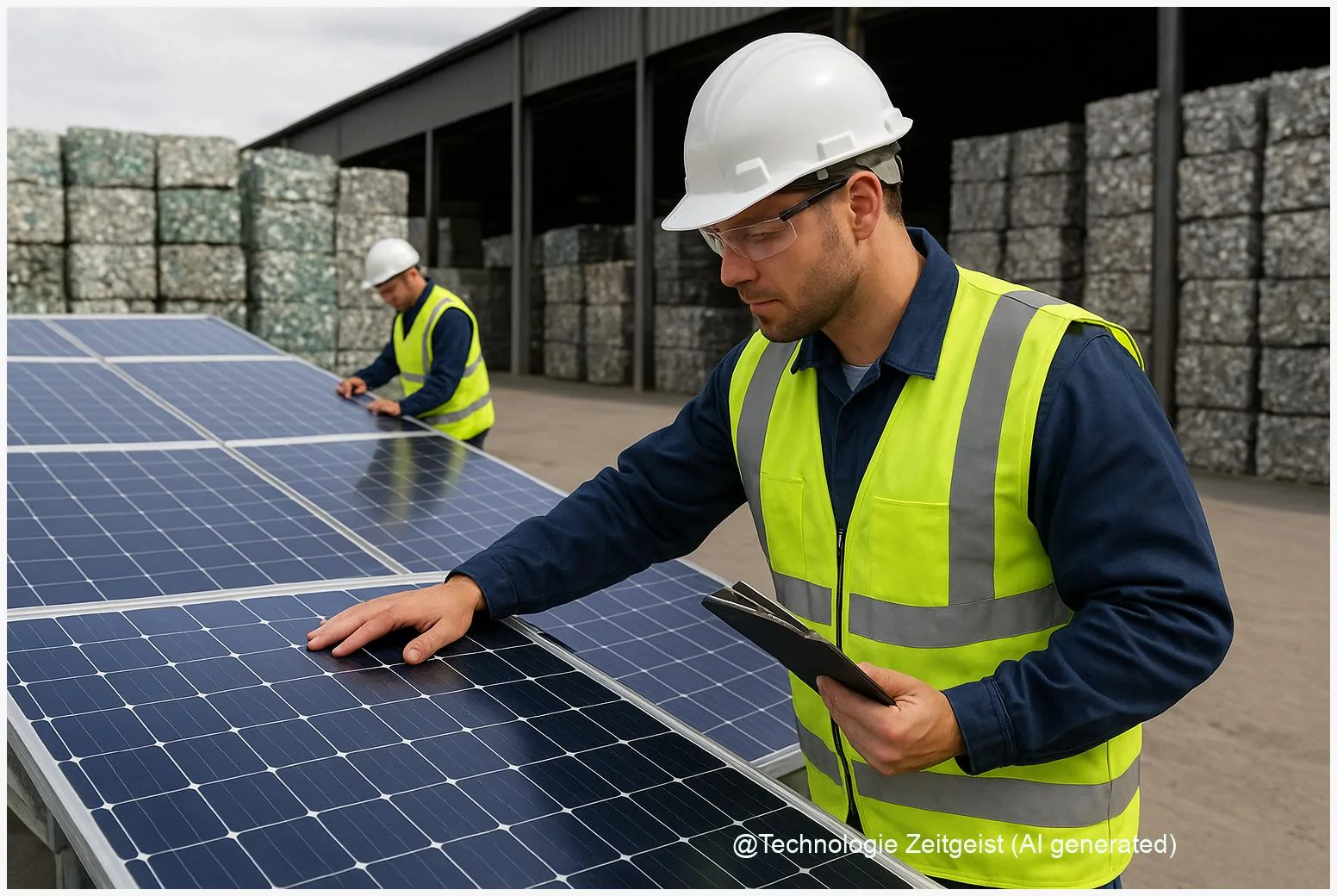
Solar panel recycling is becoming a practical part of the clean‑energy supply chain as the first large cohorts of modules reach end‑of‑life. This article describes how panels and lithium‑ion batteries are taken apart, which materials are worth recovering and why costs and rules matter for a functioning circular economy. It shows what manufacturers, regulators and ordinary owners can expect in the years after 2025.
Introduction
Rooftop arrays and solar farms are now common in many European neighbourhoods and across industry sites. Most modules sold in the 2000s and 2010s still generate electricity, but solar installations have a limited useful life: manufacturers typically quote about 25 to 30 years before output falls substantially. When modules are removed, whole systems and their parts—frames, glass, cells, junction boxes and cabling—enter waste streams that need careful handling.
At the same time, lithium‑ion batteries from electric vehicles and home storage systems are increasingly collected for recycling or second‑life use. That creates an opportunity: recovering glass, aluminium, silicon, copper and critical battery metals reduces the need for freshly mined resources and can lower greenhouse‑gas emissions if the processes are efficient. It also creates challenges: different materials require different methods, and some recovery routes are still small scale or costly.
How solar panel recycling works
Solar panel recycling begins with sorting: intact modules, damaged panels and small off‑cuts follow different paths. A typical silicon‑based panel consists mainly of glass, an aluminium frame, a polymer backsheet, silicon cells, small amounts of silver and copper, and lamination material. The mass share is dominated by glass (about 65–75 %) and the frame (roughly 10–15 %). Recovering glass and aluminium is relatively straightforward; retrieving silicon and silver at high purity is harder and often more costly.
After collection, modules go to an initial pretreatment step. Pretreatment removes easily detachable components: aluminium frames and junction boxes come off, and cables are stripped. Delamination is the technical term for separating the laminated layers—glass, encapsulant and cells. Delamination can be mechanical, thermal or chemical. Mechanical methods crush and sieve; thermal methods heat the laminate to degrade adhesives; chemical or mild solvent processes dissolve binders to free cells and metals.
Successful recycling depends on good sorting, because material mixes determine which downstream method is practical and economical.
After delamination, further separation targets metals and silicon. Mechanical separation gives glass cullet suitable for low‑ to medium‑grade reuse (for example in construction). Chemical and hydrometallurgical treatments dissolve metals such as silver and copper so they can be precipitated or electro‑recovered at higher purity. Silicon recovery at wafer‑ or metallurgical‑grade requires additional purification; many current plants focus on metal recovery first and treat silicon only if a clear market exists for recycled silicon.
If the numbers help to compare options, a simple table shows typical material shares and the usual recovery outlook:
| Component | Typical share (mass) | Recovery outlook |
|---|---|---|
| Glass | 65–75 % | High recovery for construction‑grade cullet |
| Aluminium frame | 10–15 % | High; commodity value |
| Silicon cells and silver | small fraction (by mass) | Technically recoverable; high‑purity Si is costly |
Standards and certification are still catching up. Differences in module design—especially backsheets and encapsulants—affect which delamination method is least energy‑intensive. Newer panels designed with recycling in mind, for instance with reversible clips or fewer adhesive layers, are easier to treat, but widespread ecodesign requirements were only starting to take effect by the mid‑2020s.
Battery recycling and renewable energy
Lithium‑ion battery recycling and solar panel recycling share a common goal: keep valuable materials in use and avoid environmental harm from uncontrolled disposal. For batteries the critical materials are lithium, nickel, cobalt and manganese, while panels contain large volumes of glass and smaller but strategically important amounts of silver and silicon.
Three main technical routes dominate battery recycling. Pyrometallurgy uses high heat to recover metals into an alloy; it is robust but energy‑intensive and tends to lose lithium. Hydrometallurgy dissolves metals in acids or other solutions and selectively precipitates them; this route is increasingly preferred in Europe because it can yield battery‑grade salts. Direct recycling aims to restore or reuse the cathode material chemically—potentially the most material‑efficient option—but most direct methods are still at pilot scale. “Black mass” is the powder produced after mechanical pretreatment of batteries; it contains the valuable metals targeted by downstream processes.
Regulation is shaping practice. The EU Batteries Regulation introduced mandatory traceability (a digital battery passport) and stepped targets for recycled content in new batteries. That legal framework increases demand for reliable secondary supplies inside the region and discourages uncontrolled exports of black mass. From a climate perspective, several life‑cycle analyses show that recycling can reduce emissions compared with primary mining and processing, especially when recycling plants use low‑carbon electricity and efficient processes.
There is a practical link to the electricity system as a whole: recycled metals can reduce Europe’s dependence on distant supply chains, and reused EV batteries can serve as stationary storage before recycling. But the economics remain sensitive to metal prices and to the scale of recycling operations; larger, integrated hubs that combine pretreatment and hydrometallurgy tend to be more economical.
Collection, logistics and economics
Collecting end‑of‑life panels and spent batteries is the logistical backbone of recycling. For panels, major flows come from commercial projects and distributed rooftop systems. Owners rarely bring panels to municipal collection points; instead, collection is organised through installers, manufacturers under extended producer responsibility (EPR) schemes, or specialised waste handlers. For batteries, collection networks include vehicle dismantlers, retailers, and take‑back points for small batteries.
Costs are uneven. Treating frames and glass is low cost and often yields a small profit. Recovering silver or high‑purity silicon requires chemical steps and energy; those processes can be expensive unless plants operate at scale and feedstock quality is consistent. For lithium‑ion batteries, pretreatment to make safe black mass is a necessary cost and must be handled under strict safety rules to prevent fires. The so‑called “pretreatment spokes and hub” model is emerging: many local pretreatment sites produce black mass, which is then shipped to fewer, larger hydrometallurgical hubs for refining. This reduces transport of bulky, low‑value material while concentrating valuable streams for efficient processing.
Regulatory drivers change the economics. The EU and some national laws require take‑back and reporting, and the Batteries Regulation sets minimum recycled content targets for certain metals. Those rules create a predictable demand for secondary materials and can improve the business case for investment. Still, reported official collection numbers can lag behind real flows; exports, unreported disposal and differing national reporting practices make precise totals hard to pin down. Researchers estimate that PV waste volumes in Europe will grow notably after 2030 as early panels reach their nominal lifetimes, so investment in collection and pretreatment now avoids bottlenecks later.
Policy, innovation and practical choices
Policy is the clearest lever to speed circular supply chains. Several measures are proving effective: clearer product information (ideally machine‑readable tags that show module materials), stronger EPR rules so producers cover end‑of‑life costs, incentives for local pretreatment capacity and funding for technologies that produce high‑quality recycled silicon or battery salts. Harmonised quality standards and so‑called end‑of‑waste criteria make secondary materials easier to trade.
On the innovation side, pilots in delamination and advanced hydrometallurgy aim to lower energy use and raise purity. For silicon in panels, research focuses on milder delamination and purification routes that avoid destroying the crystalline structure; for batteries, several direct‑recycling processes try to keep cathode structures intact so they can be reused with minimal reprocessing. These approaches promise better material use but require demonstration at industrial scale.
For consumers and small installers, practical choices matter. Ask installers whether they will remove and dispose of old panels responsibly; check whether battery vendors offer take‑back or certified recycling. Choosing products with clear end‑of‑life information or designs that are easier to disassemble tends to reduce downstream costs. For policymakers and investors, tight coordination between collection networks and downstream hubs is a priority: good logistics make the technology economically viable.
Conclusion
Solar panel recycling and lithium‑ion battery recycling have moved from niche pilots to industrial pathways that can supply valuable secondary materials. Glass and aluminium from panels are already recycled at scale; recovering high‑purity silicon and some rare metals is technically possible but often limited by costs and market structures. For batteries, hydrometallurgy and integrated pretreatment have become the preferred route in Europe, while direct‑recycling methods are promising but still maturing.
Policy measures that improve traceability, require recycled content and support regional hubs will determine whether recycling stays a marginal activity or becomes a reliable source of materials. For owners and installers, responsible removal and verified take‑back schemes are practical steps that help the system work. Over the next decade, expanding pretreatment capacity, standardising material reporting and scaling promising purification technologies will be crucial to close material loops in a credible, low‑carbon way.
Join the discussion and share practical experiences about recycling panels or batteries in your community.




Leave a Reply