
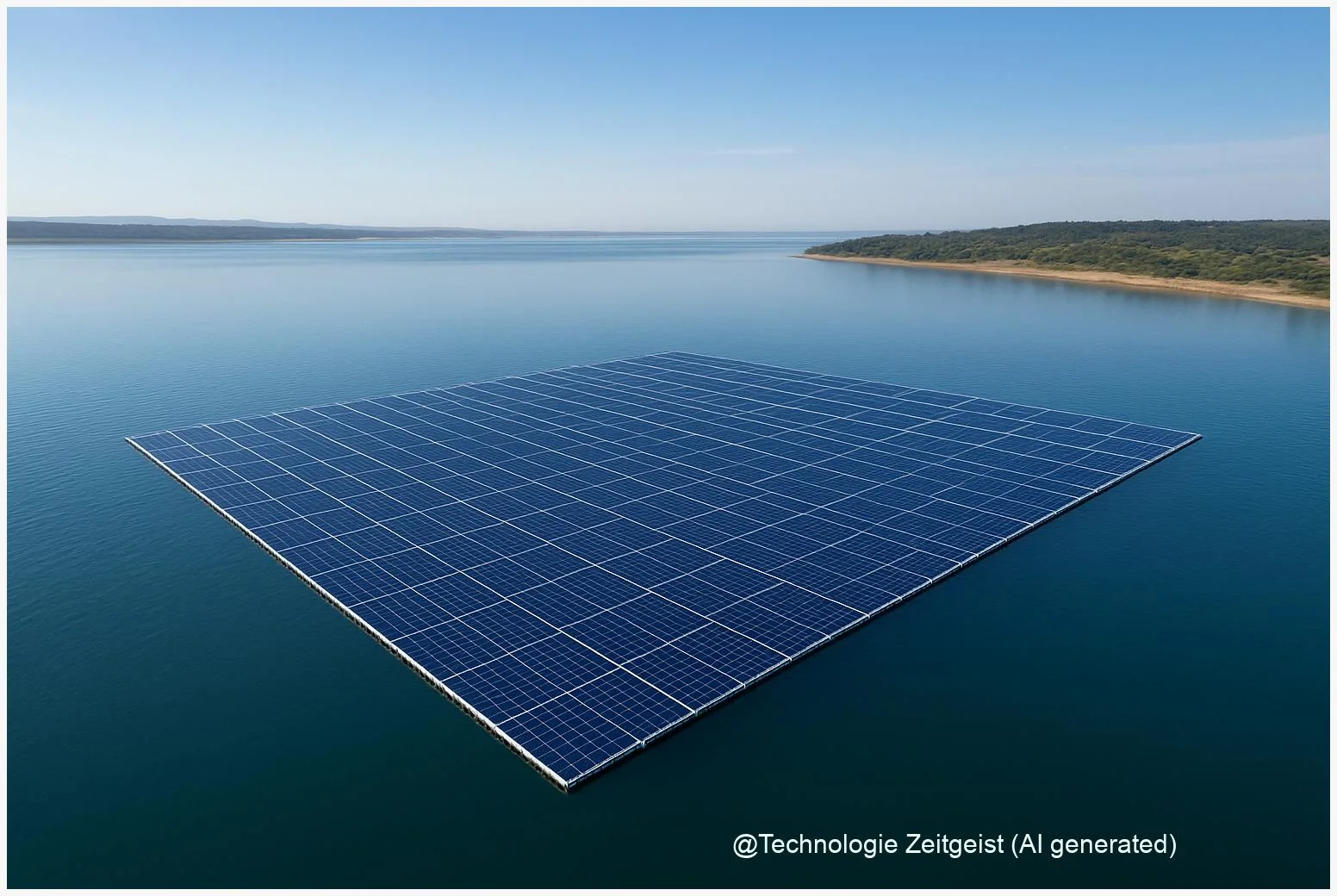
Offshore-Solar is an option for producing electricity on water where land is scarce and grids need flexible supply. The technology includes floating arrays on reservoirs and nearshore systems at sea; it can raise yield slightly compared with ground arrays and save land, but costs and ecological effects vary by site. This article outlines typical costs, where offshore or floating plants make sense, and the trade-offs investors and communities face.
Introduction
Energy planners and towns often run into the same problem: where to put new solar capacity when useful land is limited or costly. Floating solar — placed on lakes, reservoirs or close to shore — offers an alternative that uses water surfaces instead of farmland or urban space. It is not a single, uniform technology but a set of approaches with different technical and economic demands.
For households and local authorities, the immediate question is practical: can floating or offshore plants deliver cheaper and reliable electricity and at what environmental cost? For investors and grid operators the focus is slightly different: what are the extra capital and connection costs, and how does a marine or reservoir setting change maintenance and lifetime? The next sections break these questions down into clear comparisons, everyday examples and evidence from recent studies so readers can judge when Offshore-Solar is a useful option.
How offshore and floating solar work
Floating photovoltaic (FPV) systems consist of the same core components as ground-mounted solar: solar panels, inverters and electrical wiring. The difference lies in the support structure and maritime equipment. Floating arrays sit on pontoons or modular floaters made from plastic (HDPE), steel or composite materials and are anchored with mooring lines or fixed to the bottom in shallow water. Nearshore or open-sea variants may use more robust platforms and engineering similar to offshore wind foundations.
Types of water-based solar at a glance:
Floating PV ranges from small pontoons on reservoirs to large nearshore farms; open‑sea systems require specialized platforms and are still largely experimental.
Two technical points matter for output and cost. First, panels on water often run slightly cooler than on land because of the nearby water and better airflow, which can raise electrical yield by a few percent. Second, the electrical balance-of-system (cables, junctions, protection against corrosion and biofouling) is usually more demanding than for ground arrays, which pushes capital and operating costs up.
If a compact comparison helps, the table below shows common features and typical values from recent analyses.
| Feature | Description | Typical value or effect |
|---|---|---|
| Yield | Panel efficiency benefit from cooling and tilt options | +2–7% annual yield (site dependent) |
| CAPEX drivers | Floaters, mooring, marine-grade electricals, installation vessels | Typical premium vs ground PV: +10–40% (estimate) |
| LCOE range | Strongly dependent on distance to shore and water type | ~28 EUR/MWh (select inland case) to 250–650 EUR/MWh offshore |
These values are aggregate references: research by the International Energy Agency (IEA) and technical institutes shows the same basic trade-offs — inland reservoirs can be cost‑competitive while exposed coastal or open‑sea arrays face much higher LCOE due to cabling, durability needs and maintenance logistics.
Offshore-Solar in practice: sites, grid and examples
Offshore-Solar covers a range of projects from small reservoir installations near hydropower plants to large nearshore farms. Inland reservoirs are often the cheapest option: they already have grid connections, existing permits for energy use and stable water levels. Fraunhofer analyses estimate that artificial water bodies in Germany alone could technically host between roughly 11 and 44 GWp of floating capacity depending on the assumed coverage rate — a theoretical figure that shows potential but not feasibility for every site.
In coastal projects, the major practical cost is the export cable that carries power to land. Each additional kilometre to shore raises CAPEX considerably, and deeper or rougher seas require more robust anchoring and corrosion-resistant materials. Large demonstration projects in Europe have focused on nearshore sheltered areas rather than truly open-ocean installations for this reason.
Grid integration is another practical hurdle. Floating arrays produce electricity intermittently, so operators link them to existing substations, storage or flexible loads. Co-locating FPV with hydropower reservoirs can smooth production: when the sun drops, turbines can compensate if rules and infrastructure allow it. Hybrid concepts pairing floating PV, wind and battery storage on shared platforms are being piloted but remain complex to engineer and permit.
Scale examples help put numbers in perspective: global installed FPV capacity was roughly 7 GW by the end of 2023 according to IEA PVPS reporting, with many European projects still at pilot or early commercial scale. One large European project announced in recent years reached tens of megawatts — meaningful for local supply, but not yet at the multi-gigawatt scale of continental grids.
Opportunities and risks
There are clear benefits to floating and nearshore solar. It reduces competition for land, can increase yield through cooling, and in some cases lowers evaporation from reservoirs — a local benefit in dry regions. For communities near lakes, small floating arrays can provide predictable local income or discounted power to municipalities.
Balancing those benefits are economic and environmental risks. Economically, FPV typically carries higher CAPEX and OPEX than ground PV because of marine-grade components, mooring systems and more challenging maintenance. Recent literature reports offshore nearshore LCOE ranges broadly: best-case southern locations around 250 EUR/MWh up to several hundred euros per MWh in colder, rougher seas; inland reservoir examples in academic studies return single‑digit tens of euros per MWh under favourable conditions. The wide spread underlines how site-specific the economics are.
Ecologically, field research shows measurable local effects on water temperature and stratification. A peer-reviewed study from 2023 found that floating covers can reduce surface temperature and alter day–night temperature swings in lakes; this study is from 2023 and is therefore more than two years old, so it should be read as an important early observation rather than definitive long-term proof. The direction and magnitude of ecological effects depend on coverage fraction, depth, circulation and local biology. Regulators therefore often require environmental monitoring as part of permitting.
Other practical tensions are regulatory and social. Permitting combines water-use rights, conservation law and construction permits, often across multiple agencies. That complexity increases project timelines and perceived investor risk. Finally, supply-chain factors — from specialized floaters to corrosion-resistant cabling — can create bottlenecks and push project timelines out.
What comes next for the technology
Cost reductions are possible if a series of nearshore pilots standardize design and lower installation learning costs. Standardized floater designs, modular mooring systems and clearer permitting could shrink the CAPEX premium. Policy decisions matter: funding pilot projects on reservoirs, requiring transparent CAPEX/OPEX reporting and aligning grid codes for hybrid plants would reduce uncertainty for financiers.
Technical innovation also points to hybrid solutions: coupling floating PV with existing hydroelectric plants, integrating battery storage at the shore, and sharing export infrastructure with offshore wind where ports and grid nodes are common. These hybrids can improve utilization of grid connections and lower per‑MWh costs if engineered well.
From a governance point of view, better monitoring and open data will be crucial. Multi‑site monitoring programs — measuring temperature, oxygen, flow and biodiversity over several years — would build a robust evidence base for regulators and planners. Industry and public research institutes already recommend such monitoring as a condition for wider deployment.
For citizens and local decision makers, the practical implication is simple: floating arrays are already a viable and attractive option in many inland and sheltered coastal settings, but they are not a universal cost‑effective replacement for ground PV. The successful projects of the next five to ten years will be those that combine careful site selection, transparent costing and active ecological monitoring.
Conclusion
Floating and nearshore solar extend the places where we can generate solar electricity, offering particular advantages where land is limited or where reservoirs and coastal sites exist close to demand. Evidence from international agencies and technical institutes shows the potential is real, but costs and environmental impacts depend heavily on location. Inland reservoirs and sheltered nearshore sites often offer the best value today, while true open‑sea farms remain costly and technically demanding. Policymakers can speed learning and lower investment risk by requiring transparent cost reporting, funding pilot demonstrations and insisting on multi-year environmental monitoring. For planners and communities, Offshore-Solar is worth considering as a targeted tool rather than a blanket solution.
We welcome reasoned discussion — share your local FPV experiences or questions in the comments and pass this article to others who follow energy planning.



Leave a Reply