
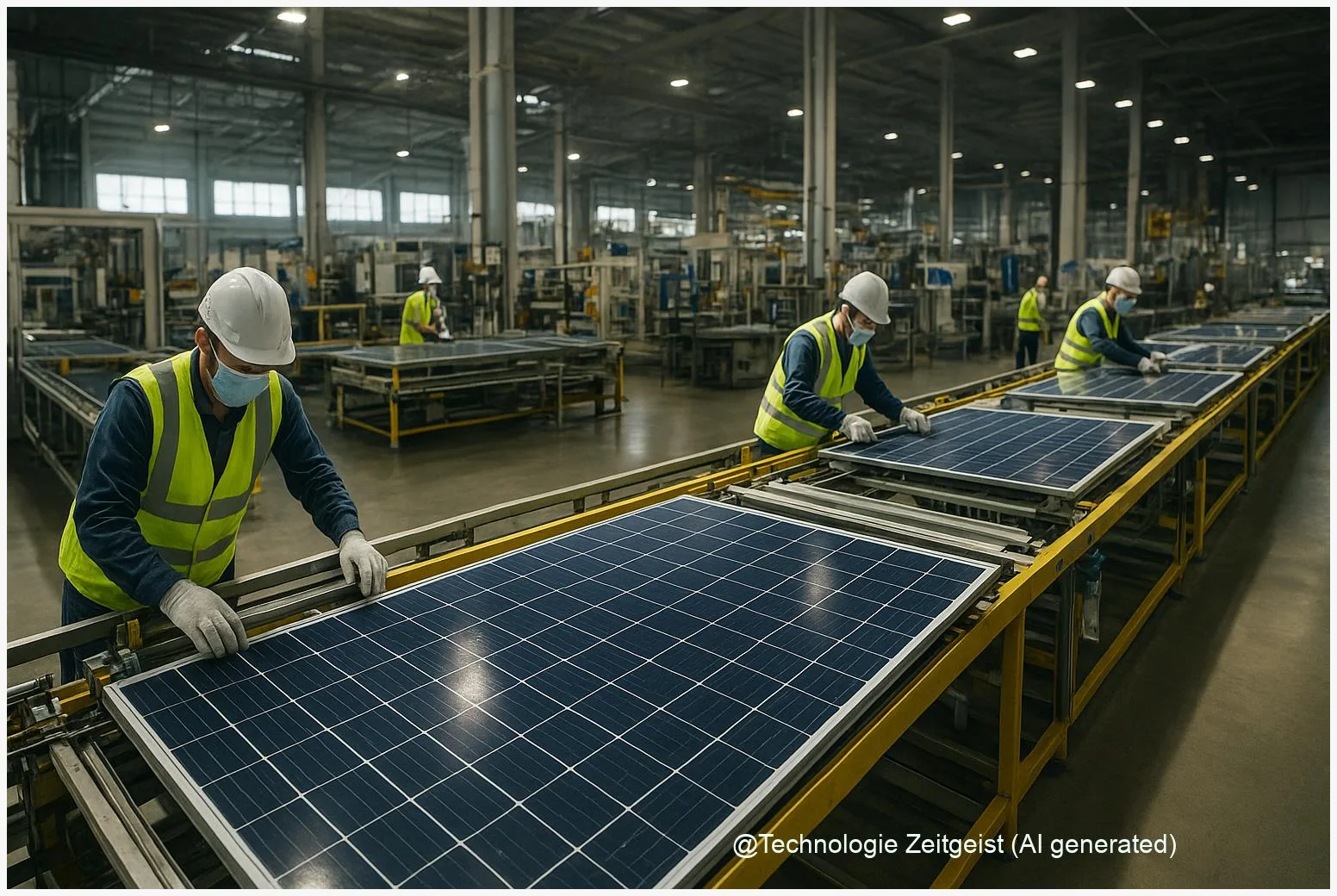
The EU Net‑Zero Industry Act aims to boost production of climate technologies in Europe and to shorten fragile supply chains. For solar manufacturing the law changes the incentives around permits, funding and prioritisation of strategic projects; it therefore matters for where factories are built, how fast they can start and which steps of the supply chain return to Europe. This article looks at realistic effects and what Waaree’s reported interest in Europe would mean in practice.
Introduction
Europe imports the bulk of finished solar modules today; when factories or shipments are delayed, developers and installers face longer lead times and higher prices. Policymakers responded with the EU Net‑Zero Industry Act to encourage more domestic production of technologies seen as essential to reaching net‑zero emissions. The law focuses on speeding permits, signalling priority for certain projects and improving coordination of public support.
At the same time, several global manufacturers have discussed closer ties to Europe or possible investments. Publicly available, verifiable confirmation that any single company has already opened a full-scale wafer‑to‑module factory in Europe can be scarce; announcements, feasibility studies and talks often precede concrete groundworks by months or years. That uncertainty matters for readers who want to understand whether new supply will appear quickly or only over the coming decade.
This piece explains the practical mechanics behind the law, why it changes investment decisions, what it could mean for installers and buyers, and which risks remain — using the industry context around Waaree’s Europe interest as an example of how such plans are assessed (no definitive company‑factory confirmation was found in public corporate filings as of 2025.12.27).
How the EU Net‑Zero Industry Act sets the rules
The Net‑Zero Industry Act creates a policy framework that treats certain low‑carbon technologies as strategic. For solar this means projects can be eligible for faster permitting, coordinated national and EU support, and clearer priority when grid connections or industrial land are limited. The law does not create factories by itself; it reduces some regulatory and administrative barriers that often delay industrial projects.
To make the effect tangible, it helps to follow the main steps of a typical solar value chain: polysilicon production → wafer cutting → cell manufacturing → module assembly → installation and recycling. Each step needs different machinery, skills and suppliers. Europe today has strengths in module assembly and some cell production, while much of the polysilicon and wafer capacity remains concentrated in other regions.
Access to land, grid connections and permits typically determines whether a project starts on time, not only the availability of investment capital.
Faster permitting under the Net‑Zero Industry Act can reduce the calendar risk of projects — the time between investment decision and production start — by months or sometimes more than a year, depending on the country and the local procedures. The act also encourages creating pipelines of priority projects which can be bundled for investors, making large capital expenditures easier to underwrite.
If a manufacturer such as Waaree evaluates Europe, the law changes the checklist: permit time becomes less of a blocker, access to coordinated funding improves the return‑on‑investment calculation, and political priority may ease some infrastructure steps. That makes Europe more attractive at the margin, though it does not remove other constraints like specialised equipment delivery or the availability of key inputs.
If a compact table clarifies differences, these typical features help explain where Europe’s gaps are.
| Feature | Description | Practical effect |
|---|---|---|
| Permitting | Environmental checks, grid permits, building licences | Delays often measured in months; NZIA aims to shorten this |
| Funding | Public loans, guarantees, co‑investment at national/EU level | Improves project bankability and investor appetite |
| Supply chain | Polysilicon, wafers, specialised machines | Bottlenecks can shift upstream even if module plants open |
What this could mean in everyday terms
For homeowners, small businesses and local installers, the consequences are concrete even if they do not follow industry announcements closely. If more production capacity is built in Europe, lead times for module delivery can shorten and price volatility for panels may decline — although those effects usually arrive after factories reach steady output.
Consider a local installer seeking modules for rooftop jobs. Today they may wait several months for shipments during peak seasons, and prices can spike because of shipping constraints or tariffs. A European manufacturing base reduces dependency on long sea‑freight links and can allow distributors to keep more stock nearby. That makes scheduling simpler and projects less exposed to sudden global shocks.
For workers, building a wafer‑to‑module factory creates a range of jobs: equipment installation, production technicians, quality control, logistics and maintenance. These jobs differ from solar installation roles and usually require different training — another reason why governments often combine factory incentives with workforce programmes.
Yet household electricity prices and the pace of household solar adoption depend on many factors beyond module origin: national incentives for rooftop PV, permitting for small systems, grid upgrades to handle distributed generation, and wholesale electricity market design. In short, domestic module production is important, but it is only one piece of the everyday experience of going solar.
Opportunities and tensions
The Net‑Zero Industry Act opens several opportunities. It can attract foreign direct investment by improving project certainty and by packaging national and EU support. It can also stimulate integrated projects that combine several value‑chain steps, which matters because integrated factories are less vulnerable to single‑stage shortages.
However, tensions remain. Trade rules and the question of permissible state aid are sensitive. Measures that explicitly favour domestic industry can be challenged under international trade law, and member states must design support that aligns with EU competition rules. Those legal and diplomatic constraints can shape the size and type of support governments offer.
Another tension is timing. Building advanced cell manufacturing often requires specialized fabrication equipment and skilled engineers. Global supply of some machines is limited, so building several factories in parallel can create new bottlenecks. In other words, increasing European module assembly quickly does not automatically mean upstream stages like wafer production will follow at the same speed.
Environmental and land‑use considerations are also present. Large factories need energy and industrial land; policymakers must weigh the benefit of local manufacturing against other planning priorities. Recycling and circularity measures can reduce long‑term raw‑material risks, but recycling capacity itself needs to be built.
Where things could go next — scenarios
Scenarios range from modest to ambitious. In a modest scenario, the Net‑Zero Industry Act encourages tiered investments: more module assembly and some cell factories appear in several EU countries within a few years, while upstream stages remain partly external. In an ambitious scenario, coordinated funding and industrial planning lead to investments across the full chain, reducing import dependence by the end of the decade.
If a company such as Waaree decides to build a European factory, the most immediate effects would be local job creation and shorter delivery times for regional customers. The larger systemic effect — a durable change in the supply balance — would require parallel moves: other manufacturers following suit, new polysilicon or wafer capacity available, and stable policy support that survives election cycles.
For observers and decision‑makers, useful indicators to watch in the coming months are: confirmed planning permits and groundworks, public funding agreements with clear amounts and timelines, equipment delivery schedules, and whether factories are integrated (cell+module) or only module‑assembly. These signals reveal whether announcements convert into production.
Finally, remember that the Net‑Zero Industry Act is not a single‑shot instrument. Its success depends on how member states implement permitting changes, how financial instruments are designed, and how trade‑legal risks are managed. For readers weighing solar purchases or following industry moves, that means announcements are a first step; delivered capacity and supply‑chain resilience are what ultimately change the market.
Conclusion
The EU Net‑Zero Industry Act shifts incentives and reduces some administrative obstacles that have slowed industrial projects in the past. For solar manufacturing the law improves the investment case for factories in Europe, particularly where permitting and coordinated funding were the main barriers. Still, material and equipment constraints, legal limits on state support and realistic construction timelines mean that increased European production will arrive over years rather than weeks.
Announcements by manufacturers about possible European facilities — including those by global suppliers exploring the market — are important early indicators. They should be read together with follow‑through signals: permits granted, financing closed and machinery on site. Only then do announced plans become reliable sources of new supply for installers and customers across Europe.
Share your perspective or questions below — constructive comments and links to public documents are welcome.



Leave a Reply