
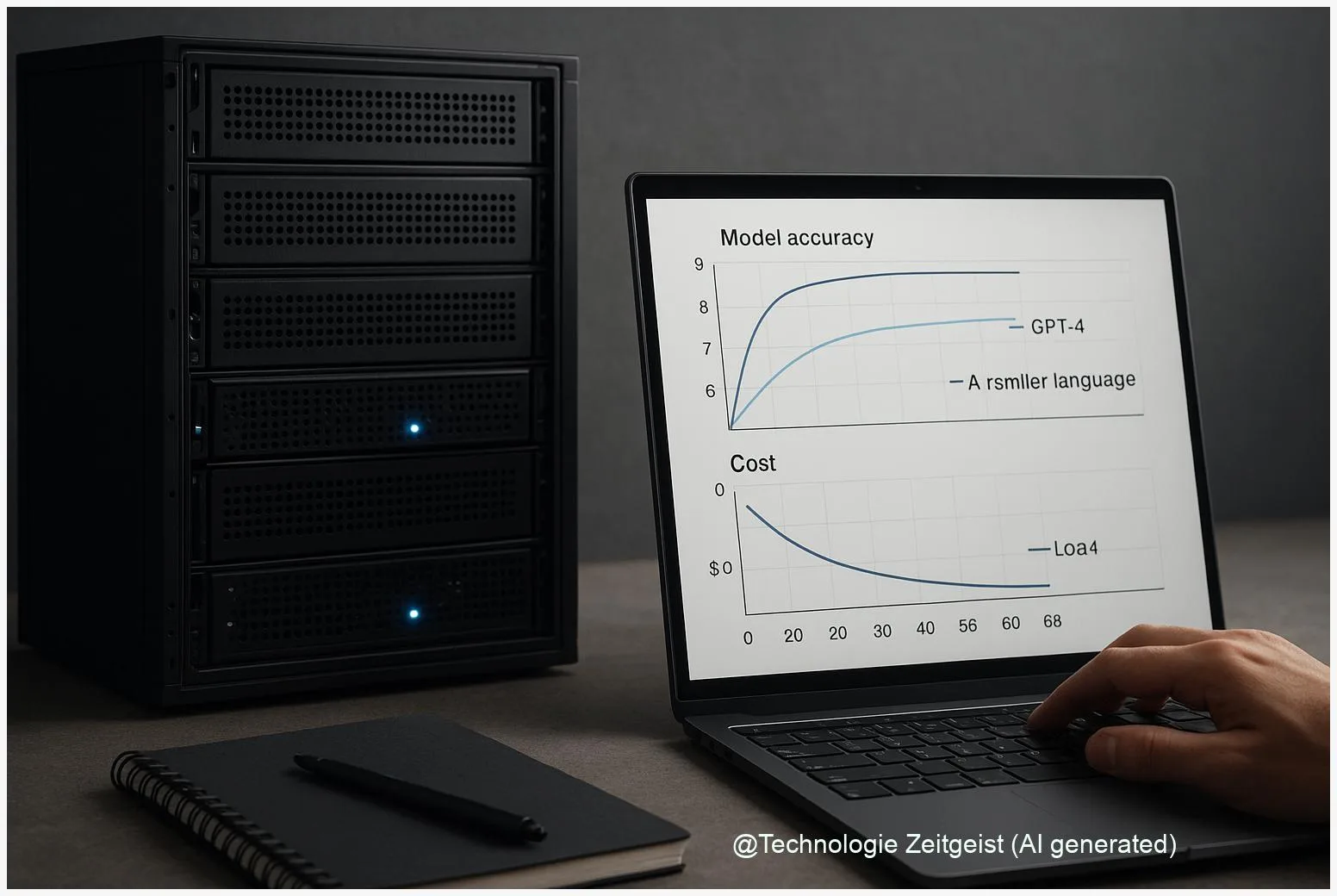
Small language models vs GPT-4 can reduce recurring inference costs dramatically for many practical tasks. In some carefully optimized deployments — for example quantized, distilled models running on cheaper hardware — operators report cost reductions that approach the high end of the range in published comparisons. The decisive trade-offs are latency, factual accuracy and engineering effort; with the right workload and tooling, teams can cut AI spending by roughly 50 % up to around 94 % in best-case scenarios.
Introduction
Many teams face a simple question: should they pay for a large general model such as GPT‑4, or run a smaller model that they host themselves or via a managed vendor? The cost difference appears at two moments: during development, when fine‑tuning or prompt testing creates repeated queries; and in production, when millions of requests add up. For everyday applications — chatbots with scripted flows, content classification, search re‑ranking — smaller models often provide “good enough” performance for a fraction of the price.
At the same time, some tasks still need the deeper reasoning and broader knowledge of a large model. That tension defines most practical decisions: choose lower cost and tighter control, or choose higher capability and lower operational overhead. The sections that follow explain the mechanics behind the cost gap, show concrete examples, and offer a framework to decide when to prefer small language models and when to rely on GPT‑4.
How small language models work and why they cost less
Small language models are versions of the same general neural architectures used in large models but with fewer parameters. A parameter roughly corresponds to one of the numbers the model stores to make predictions; fewer parameters mean less memory, smaller matrix math and less energy per token. Two common techniques make these models especially cheap in production:
Quantization reduces the number of bits used to store model parameters (for instance from 16‑bit floats down to 8‑ or 4‑bit representations). That lowers memory use and allows more tokens to be processed in parallel on the same hardware. Distillation trains a smaller model to mimic a larger one so it keeps much of the behavior while shedding size. Both techniques can be combined with optimized inference libraries to multiply cost savings.
Cost depends less on the “label” of the model and more on three engineering knobs: model size, numeric precision (quantization), and hardware choice.
Two practical consequences follow. First, a quantized small model can often run on a cheaper GPU or even on CPUs with acceptable latency for low‑volume scenarios. Second, cloud vendors and inference marketplaces price deployments differently: some charge per token (typical for hosted large models), others charge per instance or throughput (typical for managed inference of self‑hosted models). That difference means you must normalize metrics — for example $/1M effective tokens or Joules per query — to compare costs fairly.
If a team’s workload permits batching and short sequences, cost per useful output falls further because GPUs reach higher throughput. These effects explain why many papers and vendor notes report multipliers in cost reduction; typical, well‑engineered setups show 2× to 10× lower inference cost, and in aggressive edge or specialized cases the savings can approach the high end reported in community case studies.
| Feature | Description | Value |
|---|---|---|
| Model size | Number of parameters | Small: millions — Large: billions |
| Quantization | Bits per weight | 8‑bit or 4‑bit common |
When to choose small language models vs GPT‑4
Decisions should start with the task requirements and the volume profile. If responses must be factual and cover recent events, or if the prompt requires broad world knowledge and deep reasoning, a large, frequently updated model such as GPT‑4 is usually the safer choice. For tasks that are narrow, repetitive, or can be scaffolded with retrieval and rules, small models often suffice.
Consider three simple decision points: quality tolerance, latency and scale. Quality tolerance asks how much performance loss is acceptable. Latency asks whether responses must be near‑instant. Scale asks how many queries per month you expect. If quality tolerance is high and scale is large, small models are attractive because the per‑request saving multiplies quickly.
Example scenarios where small models are preferable:
- Internal tools that summarize a limited, curated document set where factual correctness can be verified automatically.
- Classification and routing tasks where labels are straightforward and training data is available to fine‑tune a compact model.
- On‑device assistants where connectivity or battery life matters and model size constrains feasibility.
When you need judgement across many domains, creative writing with broad world knowledge, or to minimize hallucination risk without heavy engineering, GPT‑4 or similar large models remain preferable. A common hybrid pattern uses a small model for the bulk of routine requests and routes uncertain or high‑value queries to GPT‑4. This tiered approach preserves most cost savings while keeping a fallback for hard cases.
Concrete use cases and an example cost comparison
Two realistic examples illustrate the arithmetic. First, a customer‑support classifier that reads short transcripts and tags intent: in many tests a distilled 3–7B parameter model with 8‑bit quantization achieves classification accuracy close to a larger model while using a fraction of GPU time. Because classification outputs are short, token generation cost is small and throughput becomes the driver; cheaper instance types and batching produce strong savings.
Second, a summarization pipeline for internal reports that first retrieves relevant documents and then summarizes them. Retrieval reduces the summary prompt size and keeps the small model’s context manageable. With distillation and moderate quantization the small pipeline can handle most reports; only complex or legal documents are escalated to a larger model.
To make costs concrete, compare a token‑priced GPT‑4 call to a self‑hosted quantized small model running on a less expensive GPU. Published vendor comparisons and community benchmarks (see sources) give typical ranges rather than a single number: many practitioners see 2×–10× lower inference cost after optimization. A 10× reduction equals a 90 % saving; reaching ~94 % requires additional optimizations such as aggressive batching, low precision and a high volume that amortizes fixed costs. These are feasible in narrow workloads but not universal.
Practical checklist for a pilot: define the representative query set, measure latency and accuracy against your SLA, apply quantization and distillation, and compute $/1M effective tokens including monitoring and data transfer. Only this normalized metric reveals the true operational savings for your use case.
Opportunities, risks and operational trade-offs
Opportunities are straightforward: lower cloud bills, more control over data, and the possibility to run models closer to users (edge or on‑prem). That control also makes compliance and privacy easier when sensitive data must not leave a corporate network.
Risks and tensions include maintenance costs, monitoring complexity, and the potential for silent degradation in quality. Smaller models may be more brittle on rare or adversarial prompts. They also usually need more engineering to keep knowledge up to date: a hosted GPT‑4 receives provider updates, while a self‑hosted model requires scheduled retraining, knowledge‑injection workflows or retrieval augmentation.
Operational trade‑offs are concrete: a self‑hosted small model requires investment in deployment automation, observability and rollback mechanisms. On the other hand, hosted large models offset that engineering work with predictable API behavior and provider SLAs. For many teams the hybrid pattern — small models for routine volume, large models for exceptions — balances these trade‑offs without committing fully to one approach.
Security and governance add another layer. If a small model is fine‑tuned on proprietary data, access controls and model‑version tracking become essential. Audit trails for decisions and a simple escalation path to a higher‑capability model help contain errors and reduce business risk.
Conclusion
Smaller language models can cut inference costs dramatically when the task is narrow, the volume is high and teams apply compression techniques such as quantization and distillation. Typical engineering programs report twofold to tenfold cost reductions; under best‑case conditions — aggressive quantization, high batching efficiency and self‑hosting — savings near the top of that range are possible, which corresponds to the headline figure in this article. The practical decision depends on acceptable quality loss, latency constraints and how much engineering effort an organization can commit to deployment and monitoring. For many applications a hybrid architecture offers the best balance: save money on routine volume with a compact model and reserve GPT‑4 for the complex, high‑value requests.
Share your experience with small models or GPT‑4 trade‑offs in the comments, and pass this article to colleagues who budget AI projects.


Leave a Reply