
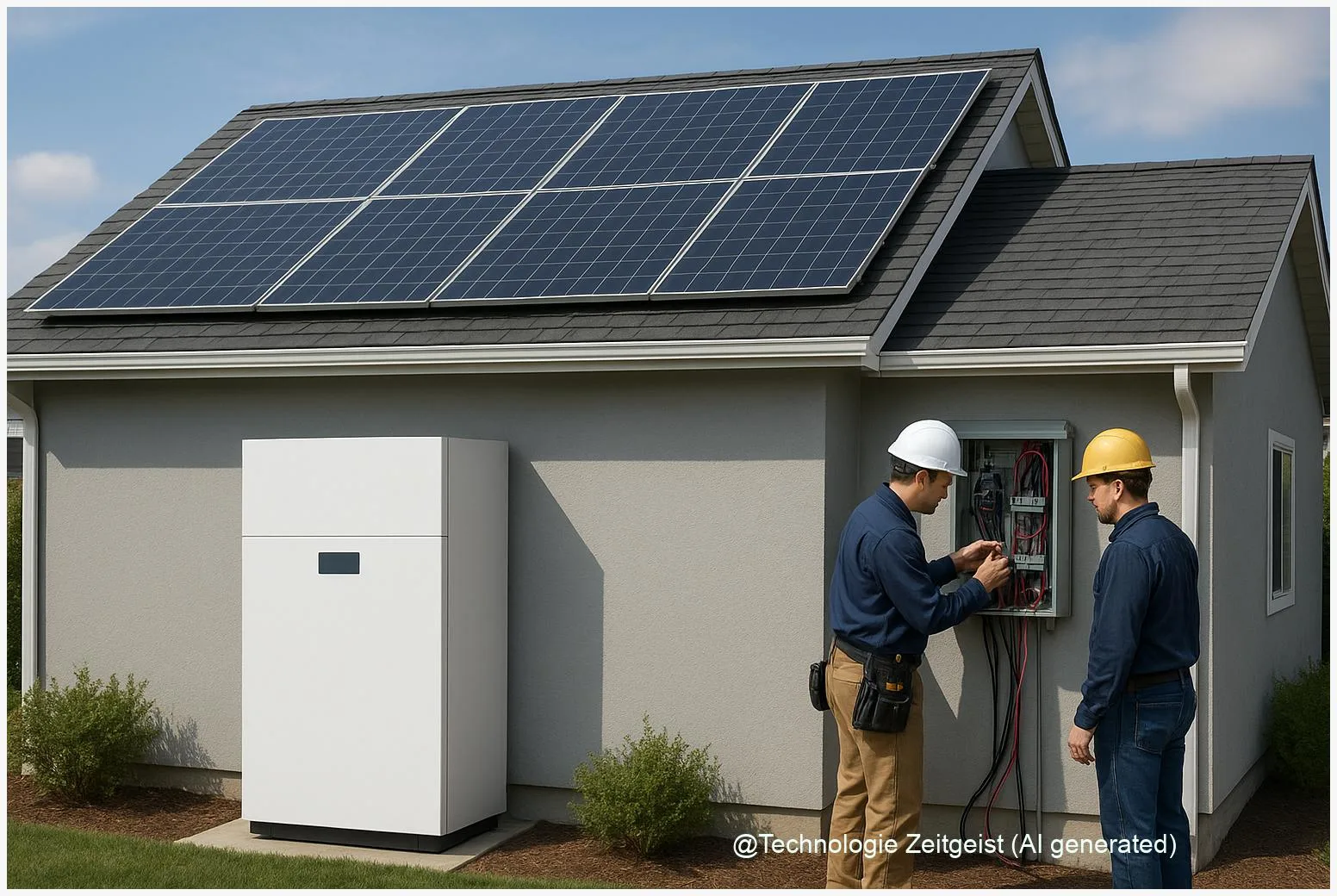
Homeowners curious about retrofit battery options often hear about AC-coupled battery systems and “inverterless” designs. This article compares those approaches and explains what it means when a home battery does not use a separate battery inverter. You will learn how the topology affects installation, efficiency, backup behavior and costs, and what to check with installers and product documentation before a purchase.
Introduction
When a rooftop solar system is already installed, adding a battery can feel complicated. One common choice is an AC-coupled battery system, which connects the battery on the home’s AC side and often uses its own small inverter or the grid-tied inverter’s interface. A different pitch you may see is “inverterless” batteries — a shorthand that usually means there is no separate, dedicated battery inverter inside the cabinet. That phrasing can be confusing because it does not automatically say how the battery behaves when the grid goes down or how the wiring will change.
This article walks through the central differences in plain language: what those topologies look like, how they affect day-to-day use, where efficiency and costs differ, and which questions to ask your installer. The aim is practical: help you decide whether a retrofit AC-coupled option or a more integrated DC-coupled approach better fits your priorities for self-consumption, backup power and long-term value.
How AC-coupled battery systems work
AC-coupled battery systems connect to the house electrical system on the alternating-current (AC) side — the same side as the grid and most household appliances. A simple way to think about an AC-coupled battery: the battery stores DC electricity internally, but to talk to the rest of the house it uses a built-in inverter or the existing grid inverter to convert between DC and AC.
Definition note: an inverter converts direct current (DC) into alternating current (AC). Solar panels produce DC; the grid and most home devices use AC. A separate battery inverter is a device dedicated to converting the battery’s DC to AC for use by the home or for export.
AC coupling is often the practical choice for retrofits because it requires fewer changes to the existing solar system, but it can introduce an extra conversion step when solar energy is stored and later used.
In contrast, a DC-coupled battery sits on the direct current side near the solar strings. When solar power flows directly into the battery, it avoids one DC→AC→DC conversion step, which can slightly increase round-trip efficiency. Round-trip efficiency means how much energy you get back from the battery compared with what you put in; DC-coupled systems commonly show a modest advantage of around 1–5 percentage points in idealized lab figures, though real-world differences depend on specific equipment and usage patterns.
“Inverterless” in marketing terms does not have a single technical standard. Manufacturers sometimes use it to mean the battery has no separate visible battery inverter because inverter functionality is integrated into a compact cabinet, or the system relies on the existing grid-tied inverter for AC/DC conversion. That difference matters: an integrated inverter can behave like a traditional inverter from a performance and safety point of view, while a system that leans on a PV inverter may inherit the PV inverter’s limitations for backup and islanding.
If a table helps, here is a compact comparison:
| Topology | Typical installation | Pros | Cons |
|---|---|---|---|
| AC-coupled | Retrofit to existing PV | Lower retrofit cost, simpler wiring | Extra conversion losses |
| DC-coupled | New build or full-system replacement | Higher round-trip efficiency | More integration work for retrofit |
| “Inverterless” (marketing) | Varies — integrated or PV-dependent | Lower visible component count, potential cost savings | Backup/independence depends on topology |
Key takeaway: AC-coupled systems are common for retrofits and are compatible with many existing installations. Whether a battery truly lacks a separate inverter in a meaningful technical sense must be confirmed from the product documentation and the intended backup behavior.
Practical examples: retrofit, new build and backup
Consider three household scenarios to see how topology affects daily life.
1) Retrofit with a working grid-tied inverter: A homeowner with rooftop panels and a grid-tied inverter wants a battery to reduce grid purchases. Choosing an AC-coupled battery lets installers add the battery without replacing the PV inverter. During daytime, solar can power the home directly; excess solar is converted to AC and then converted back to DC to charge the battery. That extra conversion can slightly reduce savings but may still be the most cost-effective route because installation time and disruption are lower.
2) New build with integrated design: When planners design the PV and battery together, DC coupling can be attractive. Solar DC power can charge the battery directly through a shared DC bus or a combined inverter architecture. The system avoids an additional conversion, improving theoretical efficiency and sometimes lowering component cost in the long run. For homeowners this often translates into a higher fraction of self-consumed solar energy over the system life.
3) Backup during a power cut: Backup capability depends less on the phrase “inverterless” and more on whether the system supports islanding and automatic switching. Islanding is the process of isolating a home’s electrical network from the public grid during an outage so it can be powered locally. Many AC-coupled batteries include or support an internal inverter and a transfer switch to enable seamless backup; other inverterless-leaning setups may not provide a reliable off-grid mode unless additional components are added.
Practical note: if backup is a priority, ask whether the product offers a guaranteed uninterruptible power supply (UPS) function or an automatic transfer switch and whether critical loads are isolated on a separate circuit. These are testable features documented in installation guides and often described in manufacturer spec sheets.
Benefits, limitations and safety considerations
Benefits of AC-coupled or inverter-integrated batteries are clear for many homeowners: simpler retrofit, flexible placement, and a wide range of compatible products. “Inverterless” marketing sometimes reduces upfront cost or visual complexity, but the functional result depends on whether inverter functionality is still present inside the box or delegated to existing equipment.
Limitations include slightly lower theoretical efficiency for AC-coupled systems and potential compatibility issues with older inverters. Efficiency differences are usually modest in practice; independent guides and manufacturer materials suggest figures in the low single-digit percentage points. The exact figure varies by equipment and how the household uses the battery (frequent partial cycles versus occasional deep cycles).
Safety and regulatory compliance matter more than buzzwords. Grid connection rules in many countries require anti-islanding protection, approved disconnects, and certified inverters. For Germany and much of Europe, standards and grid-connection rules (published by grid operators and standards bodies) determine whether an inverter or system configuration is allowed for export or backup. Always ask for the device’s certification and an installer’s experience with local grid rules.
Another risk: warranties and software updates. Some battery makers tie advanced features (backup timing, smart charging) to firmware and to an online service. If a system relies on a PV inverter vendor for control, firmware mismatches or discontinued support can change how the battery performs over time.
Finally, performance in a blackout is not automatic. Evaluate the system by three questions: can it detect a grid failure and isolate the home; which circuits will receive power; and how fast does the switch occur? Those operational behaviors are part of product specs, not a side effect of the word “inverterless.”
Looking ahead: what homeowners should expect
Expect continued variation in how vendors label products. Over time, clearer terminology will help buyers: products will either advertise a certified integrated inverter module or state that they require a specific grid-tied inverter for backup. Until then, the safest approach is to read technical datasheets and ask pointed questions.
Costs will also evolve. For many households, the main cost decision is not the efficiency delta but the installation complexity. In 2025, industry guidance still recommends AC-coupling for many retrofit cases and DC-coupling for tightly integrated new installations. That guidance reflects installation labor and compatibility as much as raw component efficiency.
On the policy side, grid operators and standards bodies may tighten rules for retrofit topologies, especially where safety and anti-islanding behavior are concerned. That could increase the documentation required from manufacturers and installers, which is helpful for consumers but can add time to project approvals.
For homeowners planning a purchase in the near term, useful actions include defining priorities (backup vs savings vs low disruption), requesting the product’s installation manual, and asking the installer to document which circuits will be backed up and which standards the installation follows. These steps clarify whether a so-called inverterless product truly meets the household’s needs.
Conclusion
When a battery is described as lacking a separate inverter, that statement alone does not determine how it will perform for self-consumption or during outages. AC-coupled battery systems often make retrofit simpler and cheaper, while DC-coupling can offer modest efficiency gains when systems are integrated from the start. The decisive factors for homeowners are operational details: whether the product provides islanding and backup, the certification for grid connection, and how the installer implements the wiring and transfer switches. Read the installation manual, confirm backup behavior in writing, and compare total installation costs rather than component lists.
Join the conversation: share your experience with home batteries or questions about retrofit choices.

Leave a Reply