
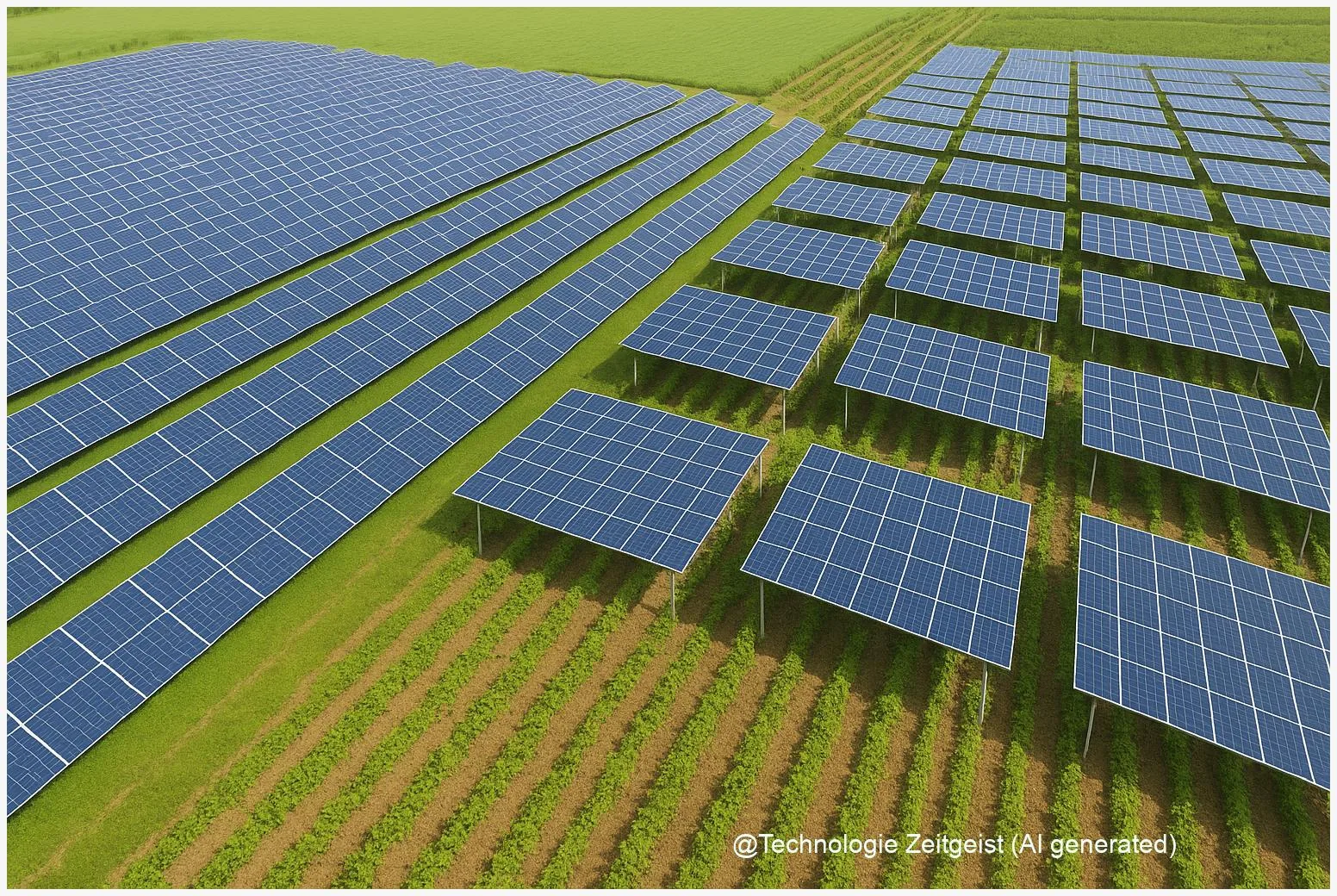
Estimates of Flächenbedarf Photovoltaik vary widely, but they matter for farms, planners and anyone watching energy prices. Modern utility solar typically uses about 1.0 MWp per hectare (≈0.00100 ha/kWp), while agrivoltaic systems and very open layouts can need two to four times more land per kilowatt. Those differences determine whether solar competes with crops or can share fields — and they shape realistic targets for national expansion.
Introduction
Debates about the land needed for solar often start with an image of fields covered in panels. That is part of the story, but numbers and definitions tell the rest. When policy-makers set capacity targets — for example hundreds of gigawatts of photovoltaic (PV) — a simple conversion to hectares is tempting. Yet what those hectares mean in practice depends on technology, panel layout and whether the site includes access roads, substation areas or ecological buffers.
For farmers and local planners the core question is practical: will new solar take land away from crops and pastures, or can systems be designed to share space and income? For national planners the useful question is slightly different: how much realistic area will be needed if, for instance, 215 GWp is installed by 2030 or 400 GWp by 2040? The numbers below use recent institutional findings so you can compare options with a clear sense of uncertainty.
Flächenbedarf Photovoltaik: basic numbers
Several reputable institutions provide reference metrics that planners use to translate capacity into area. A practical, widely cited benchmark for utility-scale ground‑mounted PV is about 1.0 MWp per hectare. That means 1 kWp of capacity occupies roughly 0.00100 ha. This figure reflects modern module efficiencies and reasonably dense layouts, not the absolute minimum possible.
Different layouts change the result dramatically: close-packed fields, raised agrivoltaic rows or wide‑row biodiversity designs each change how many kilowatts fit per hectare.
To show what variation looks like:
| Feature | Description | Value |
|---|---|---|
| Dense utility layout | Typical modern fixed‑tilt or low‑elevation arrays | ≈1.0 MWp/ha (≈0.00100 ha/kWp) |
| Agrivoltaic (raised) | Higher clearance for machinery and crops | ≈0.60 MWp/ha (≈0.00167 ha/kWp) |
| Low‑density / biodiversity design | Wide spacing, ecological buffers | ≈0.25 MWp/ha (≈0.00400 ha/kWp) |
Different international reviews report slightly different units (for example ha/MW rather than MWp/ha). A common European synthesis gives a broader range for utility projects — roughly 1.5–4.0 ha per MW — because some studies include access tracks and other non-panel areas. That is why presenting a single number without context can be misleading.
Key takeaway: a planner using 1.0 MWp/ha will get a useful mid-range estimate, but site design choices can change land demand by factors of two to four.
How solar sits on working farmland
Agrivoltaics means using the same plot for panels and crops or pasture. There are two basic ways this appears in practice: low‑clearance systems that leave much of the ground shaded and high‑clearance systems that allow tractors and many crops to continue under panels. Each approach influences the effective land trade-off.
Examples from pilot projects and guidelines show typical capacity densities for agrivoltaic layouts around 500–800 kWp per hectare (that is 0.00125–0.00200 ha/kWp), but the design must be chosen for the crop type. Vineyards, berries or orchards often accept taller, sparser structures; arable farms may prefer row arrangements that allow field operations. The agronomic side matters because shading changes microclimate, soil moisture and yields — sometimes for the better, sometimes not.
Economics also shapes choices. For many farmers a long‑term lease for a solar park can raise incomes substantially compared with average crop margins. That creates local pressure on land markets and requires clear regulation if preservation of food production or small farms is a public goal.
Operational detail to note: when calculating area impacts, many reports separate gross area (the whole fenced site) from net panel area (actual ground area under modules). For practical planning, net area gives a sense of shading and crop effects; gross area is what counts for regional land accounting and local visual impact.
Tensions, trade-offs and local effects
Numbers alone do not decide public acceptance. Three recurring tensions appear across studies and regional debates: competition with food production, biodiversity and landscape change, and economic pressure on leases and rents.
First, competition with agriculture depends on the type of land. Converting marginal or low‑yield parcels, brownfields or former industrial land has a different public cost than converting high‑quality arable. Leading research institutions therefore propose prioritizing non‑productive or low‑conflict land for utility PV and offering incentives for agrivoltaic solutions where agriculture and energy can coexist.
Second, biodiversity effects are context-dependent. Well-designed solar parks can include flower strips, hedges and nesting habitats that increase local insect and bird diversity compared with uniform monoculture. Conversely, installing panels on peatland or other sensitive habitats causes clear harm. Planning rules that mandate ecological assessments and set aside offset areas change the effective land footprint because they add explicit conservation space.
Third, the local economy shifts. Large solar projects sometimes pay attractive land rents or purchase options that accelerate structural change in rural areas. Without accompanying policies — for example support for small farms, zoning limits, or contractual constraints on selling prime farmland — there is a risk of unintended consolidation of land ownership.
What to expect next and practical choices
National scenario studies give a sense of scale. One prominent modelling exercise shows that meeting higher PV targets while placing a moderate share of capacity on ground‑mounted sites could require on the order of 150,500 ha by 2030 and roughly 280,000 ha by 2040. In relative terms these figures correspond to about 0.9 % and 1.7 % of current agricultural land in the mid and long run under the study’s assumptions. Such numbers make clear that a substantial energy rollout does not automatically mean wholesale loss of farmland — but it does require careful regional planning.
For local planners and farmers the immediate, practical steps are clear: adopt consistent definitions (net vs gross area), pilot agrivoltaic designs for the crops and machinery used locally, and build small‑scale monitoring so yield and biodiversity effects are measured. At a national level, creating prioritized zones for rooftop, brownfield and low‑conflict land reduces pressure on high‑value agricultural soils.
Technology will continue to reduce land per kilowatt: higher module efficiency and bifacial modules increase energy yield for the same footprint. Still, technical change is a gradual contributor — policy and design choices decide much of the outcome in the near term.
Conclusion
Solar’s land needs are smaller than many expect when stated as national percentages, but that does not remove local conflicts. Using about 1.0 MWp per hectare as a mid‑range rule of thumb is useful for rough planning; agrivoltaic and biodiversity‑friendly layouts require more space per kilowatt and thus different trade-offs. The right approach mixes rooftop and brownfield deployment, targeted agrivoltaics where it helps farmers, and clear regional rules that protect valuable soils. With those elements in place, PV can scale while preserving farming choices and local nature.
Share your experience with solar on farmland or your view on balanced land use — conversations help shape better rules.




Leave a Reply