
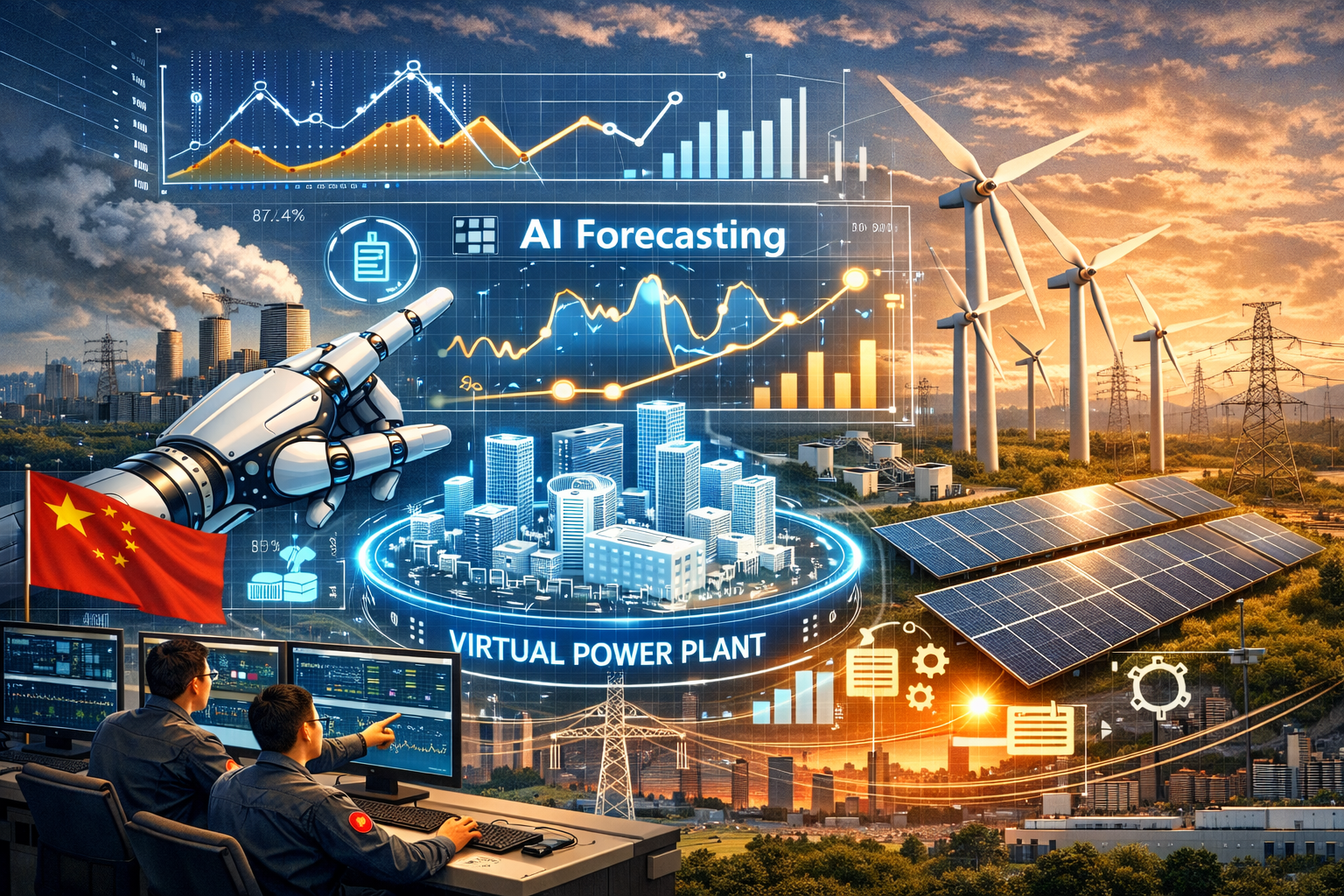
China is applying AI in energy systems to manage variable renewables, coordinate distributed assets and reduce costly manual balancing. This article shows how machine learning, short‑term forecasting and virtual power plants are already used in Chinese grid pilots and what that means for grid stability, emissions and global markets. It highlights practical examples, measurable limits and the policy choices that will determine whether AI mainly improves efficiency or mainly shifts risk.
Introduction
When wind and solar output rises or falls within minutes, grid operators need quick forecasts and immediate decisions. In China, large state utilities are combining data from weather models, rooftop solar, batteries and demand response with algorithms that suggest or carry out those decisions. For many readers this is invisible: the lights stay on or a factory sees its load curbed. Behind that convenience lie new software systems that learn from historical patterns and act in real time.
These systems matter for two reasons. First, they can reduce wasted renewable power and lower system costs by replacing slow manual re‑dispatch with faster, automated coordination. Second, they change who controls grid flexibility: instead of only big power plants, fleets of small assets — batteries, electric buses and rooftop panels — are grouped and steered together. That shift creates technical questions about reliability and social questions about who owns the data and bears the risk.
AI in energy systems: the basics for power grids
“AI in energy systems” refers to using algorithms, most often machine learning models, to aid decisions across the electricity system. A simple example is a model that predicts solar output for the next few hours. Operators use that prediction to decide how much backup generation or battery discharge is needed.
Key elements are: forecasting, optimization and orchestration. Forecasting reduces uncertainty about wind, solar and demand. Optimization uses those forecasts to decide which resources to run and when. Orchestration is the real‑time execution layer: it sends setpoints to many devices so the whole grid behaves as intended.
Algorithms can improve short‑term forecasts and speed up decisions, but they do not remove the need for engineering margins and human oversight.
Below is a small table that contrasts how traditional and AI‑assisted approaches handle three common tasks.
| Feature | Traditional approach | AI‑assisted approach |
|---|---|---|
| Short‑term forecast | Rule‑based or persistence models | Machine learning using weather + telemetry |
| Dispatch decision | Central operator schedules thermal units | Optimization across batteries, demand response, generators |
| Asset coordination | Manual contracts and bilateral controls | Virtual power plant platforms aggregating many small devices |
Technical terms to keep in mind: a virtual power plant, or VPP, is a software layer that aggregates many distributed energy resources (DER) so they can act like one controllable unit. Model predictive control is an optimization method that plans actions over a short horizon and updates as new data arrives. Reinforcement learning is a family of algorithms that learn policies by trial and error in simulation before being tested on real systems; it appears in research but is still cautious in field deployment.
How China deploys AI today — practical examples
China’s large grid companies and provincial utilities have rolled out pilots that link forecasting, VPP orchestration and market participation. State Grid Corporation of China (SGCC) has publicly promoted an “energy internet” concept that layers digital platforms on top of physical networks. That does not mean a single nationwide system; rather, it is a collection of regional pilots, commercial platforms and research projects testing how AI can assist dispatch and reduce curtailment of wind and solar.
Typical pilot setups combine: rooftop and utility‑scale solar, batteries, industrial demand response, and an aggregator that bids flexibility into a local market or directly to system operators. Publicly reported pilot sizes vary: many are small, in the single‑digit megawatt range, while some commercial aggregations reach multiple tens or a few hundred megawatts in aggregate. These ranges are drawn from technical papers and press summaries and therefore should be read as indicative rather than a precise national total.
How it works day to day: the forecasting model updates predicted supply for the next 24 hours; optimization software proposes a schedule that uses batteries and flexible loads to follow that plan; a VPP controller issues real‑time commands to batteries or smart inverters when forecasts change. In some pilots the VPP participates in wholesale or ancillary service markets; in others it provides balancing inside a distribution network to avoid local overloads.
Independent research and conference papers document algorithmic approaches used in Chinese pilots — from improved short‑term solar forecasting to model predictive control for multi‑asset dispatch. Those studies often rely on simulations; fully transparent field data remain relatively scarce. For context, regulators such as the National Energy Administration publish guidance on grid access and market roles, but detailed national statistics on aggregated VPP capacity are not consistently available in public datasets.
Opportunities and risks in plain terms
Opportunities are concrete. Better short‑term forecasting reduces the need to hold expensive spinning reserves. Aggregating many small batteries and flexible loads can delay or avoid infrastructure upgrades. Fewer forced curtailments of solar and wind means more renewable electricity gets used rather than discarded. Economically, faster balancing can lower operational costs, which in theory should reduce overall emissions when compared against running extra fossil units as insurance.
Risks deserve equal attention. First, data and control pathways create new cyber‑exposure: a compromised aggregator could cause destabilizing commands. Second, algorithmic decisions can be opaque; without clear model governance, operators may not understand why a system acted a certain way during an incident. Third, market and regulatory frameworks are still catching up. If compensation for flexibility is unclear, private aggregators may face weak incentives or create perverse outcomes where some consumers bear disproportionate costs.
There is also a measurement problem. Many academic studies report large improvements in simulations. Field validations are fewer and often proprietary, so independent verification is limited. That means claims about national‑scale reductions in redispatch volumes or emissions should be treated cautiously unless supported by transparent operational data.
Mitigations are practical: phased deployment with human‑in‑the‑loop oversight, mandatory logging and auditable decision trails, cybersecurity hardening, and market rules that make aggregator incentives explicit. These are not exotic prescriptions; they are part of normal utility practice adapted to a more software‑driven environment.
Where this could go next
Three plausible developments are visible. One: incremental scaling. Regional pilots mature into broader commercial VPP services that routinely supply balancing services, reducing curtailment in high‑renewable provinces. Two: tighter regulatory integration. Rules evolve to define the aggregator role, data responsibilities and settlement mechanisms so markets reward verifiable flexibility. Three: export of practices. If large Chinese utilities prove reliable platforms for AI‑driven balancing, the technologies and commercial models could be exported to other countries facing rapid renewable growth.
None of these paths is automatic. Success depends on measurable performance — how much forecast error falls, how reliably VPPs deliver when called, and whether market payments cover the cost of batteries and operation. For policymakers and utility managers the immediate task is to define clear KPIs: aggregated VPP capacity (MW), improvement in forecast error (percentage points), and measured reduction in redispatch costs in local currency. Those indicators allow objective assessment rather than headline claims.
For consumers and businesses, the effects will usually be indirect: fewer blackouts, less wasted renewable power, and possibly more dynamic pricing options. For international observers, the key question is not whether China uses AI — it already does — but whether governance, transparency and interoperability standards keep pace with deployment so the technology benefits reliability and decarbonization rather than simply shifting risk around the system.
Conclusion
China’s use of AI in its power system is unfolding as a pragmatic combination of forecasting, optimization and software platforms that group distributed assets. The practical benefits — reduced curtailment, faster balancing and lower operational cost — are plausible and already visible in pilots. At the same time, independent field data remain limited and important issues around cybersecurity, model governance and market design are still unresolved. Whether AI mainly improves system efficiency or mainly reallocates operational risk depends on policy choices and on clear, auditable performance metrics as pilots scale.
Join the conversation: share your questions or experiences with smart meters, rooftop solar or demand response and help the discussion move from headlines to operational detail.


Leave a Reply