
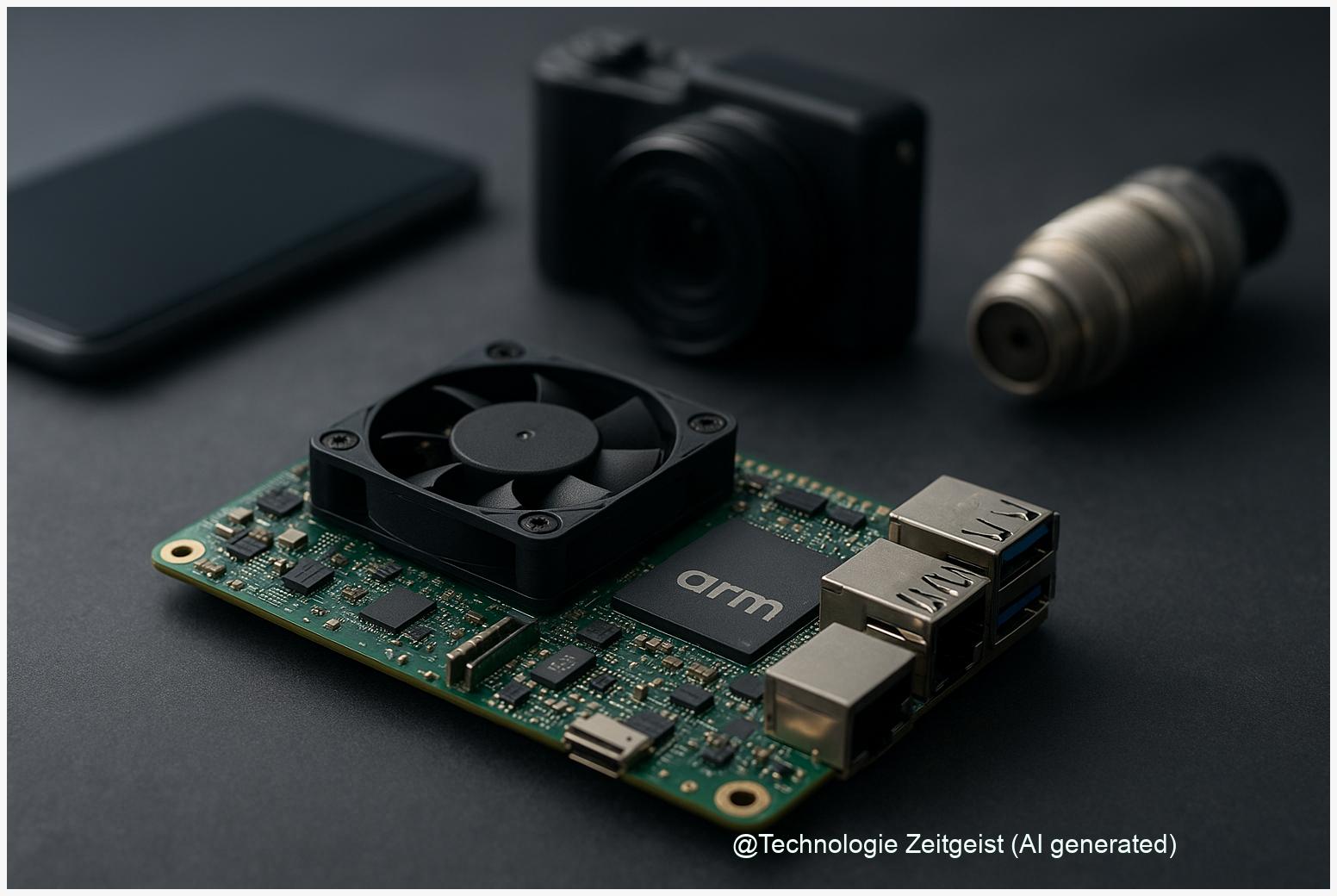
Edge AI explained: running machine learning directly on devices reduces delay, saves bandwidth and can keep sensitive data local. For everyday gadgets — from phones and security cameras to industrial sensors — that shift depends on energy‑lean processors and compact software stacks. This article describes the main technical ideas, how Arm’s Ethos and CPU platforms fit into typical designs, and what engineers and curious readers should watch next.
Introduction
When a camera recognises a face, a smartwatch detects an irregular heartbeat or a factory sensor flags an anomaly, those tasks can run on a distant server or inside the device itself. If the work stays local, the result appears faster, less data leaves the device, and the system uses less network capacity. Yet doing useful machine learning on small hardware is technically demanding: models must be compact, the processor must be efficient, and the software must connect model, hardware and the real world.
That is where edge AI matters: it moves inference — the part of machine learning that makes predictions — close to sensors and users. For manufacturers and developers this requires hardware that balances raw compute with power and thermal limits, plus toolchains that let models be adapted for tiny, energy‑limited environments. The discussion below focuses on these engineering trade‑offs and explains what Arm’s chip building blocks commonly contribute to making edge AI practical today and in the near future.
What edge AI means: edge AI explained
Edge AI refers to running machine‑learning tasks on local hardware such as phones, gateways, cameras, cars or microcontrollers instead of on remote cloud servers. The most common activity put on the edge is inference — taking a trained model and using it to classify images, transcribe audio, or score sensor readings. Training, the heavier process that builds models from large datasets, usually remains in the cloud or on servers because it requires far more compute and data.
Two helpful distinctions make the idea concrete. First, latency and connectivity: if an application requires near‑instant responses or must work when the network is poor, local inference is a practical necessity. Second, privacy and data volume: when raw sensor data is sensitive or large (video, high‑rate telemetry), keeping it on the device reduces exposure and bandwidth costs.
On the hardware side, edge AI relies on tailored processors. A central processing unit (CPU) runs general code; a neural processing unit (NPU) is a specialised accelerator for common ML math (matrix multiplies, convolutions) and is far more energy‑efficient per operation. Vendors also use DSPs or GPU slices for some workloads. To run a modern neural network efficiently on the edge, developers use techniques such as quantization (reducing numeric precision, e.g., from 32‑bit floats to 8‑bit integers) and model pruning (removing less useful parts of a network). These change a large model into a compact version that fits the device’s memory and power budget.
This combination — small, optimized models plus specialised low‑power accelerators — is the practical core of edge AI.
Standards for measuring real edge performance are emerging; MLPerf provides a family of benchmarks that includes edge workloads, and they help compare devices on realistic tasks rather than idealised lab numbers.
How Arm’s chips make edge AI practical
Arm supplies processor building blocks used by many chip designers, and several parts of its portfolio are relevant for edge AI. The Ethos family refers to NPU intellectual property that SoC makers can license and integrate into their designs; these IP blocks are optimised for compact, energy‑efficient inference. On the CPU side, Arm’s Cortex‑class cores include SIMD and vector extensions (often branded Helium or SVE in different contexts) that accelerate ML math when a dedicated NPU is not present.
Arm also frames these pieces under a broader label such as Project Trillium: an umbrella that links NPUs, CPU features and the software stack so partners can deliver end‑to‑end ML capabilities. Practically, that means a chip designer can pair an Ethos NPU with Cortex cores and ship a device whose workload balance is clear: sensor handling on the CPU, heavy matrix ops on the NPU, and power‑sensitive control loops on microcontrollers.
Software makes the hardware usable. Toolchains like TensorFlow Lite, Arm NN and vendor SDKs help convert and optimise models for the target hardware. A typical flow reduces a trained model with quantization and graph transformations, then compiles it into instructions the NPU or CPU vector units run efficiently. The maturity of these tools affects real‑world performance more than raw TOPS numbers: a chip can have high theoretical throughput, but without stable drivers and compilers that map models correctly, actual results lag.
Examples clarify the trade‑space. A security camera using an Ethos‑class NPU can run real‑time person detection on battery or via modest power budgets; a wearable can run always‑on wake‑word detection by shifting basic filtering to the microcontroller and bursts of recognition to a low‑power NPU. In automotive or industrial contexts, Arm‑based cores and accelerators are used in gateways and domain controllers where power, safety certification and long product life are priorities.
When assessing an Arm‑based design, look for three things: the claimed TOPS and TOPS/Watt as a starting metric, published MLPerf or similar benchmark runs for comparable workloads, and the availability of an SDK or integration notes that match the frameworks you use. Vendor papers sometimes list idealised numbers; independent benchmarks provide needed reality checks.
Benefits, limits and trade‑offs at the edge
Edge AI brings clear benefits: lower latency, less network traffic, and improved privacy because raw data can stay on the device. It also helps business cases by reducing cloud costs and making services available with intermittent connectivity. For consumers, that can mean faster voice assistants, cameras that alert without sending footage to a server, or phones that apply portrait filters instantly without network delay.
However, the edge imposes constraints. Power and thermal budgets limit sustained throughput. Memory is scarce compared with servers, so models must be compact. Security updates and model management across millions of devices create operational overhead. Another tension is fragmentation: many different NPUs, CPU extensions and software stacks exist, which complicates deploying a single, portable model across devices.
Benchmarks help but can mislead. Vendors report TOPS (trillions of operations per second) and efficiency figures, but those values depend heavily on the workload, model precision and the memory system. Independent suites such as MLPerf’s edge programs aim to standardise tests; using them makes comparisons fairer. Still, real application performance is influenced by integration details: memory bandwidth, thermal throttling, the specific model, and how well the toolchain maps that model to hardware.
Policy and privacy considerations add another layer. Running inference locally reduces the volume of data sent to cloud providers, but it does not eliminate the need for secure storage, encrypted firmware updates, and transparent data‑handling policies. For regulated industries, certification and explainability of models can be decisive factors when choosing hardware and software.
Where edge AI may go next
Over the next few years a few clear trends are likely to determine how broadly edge AI spreads. Increasingly capable NPUs and better compiler toolchains will allow larger models or multi‑modal tasks (for example audio plus vision) on the same device. Model‑centric advances such as more efficient transformer variants and progress in on‑device personalization (small updates to a base model) will push more functions to the edge without huge compute increases.
Hardware vendors are also improving software ecosystems. Better support for common frameworks, clearer SDKs and reproducible benchmark runs (for example MLPerf submissions) lower the integration risk for device makers. Standardising runtimes and drivers reduces fragmentation and makes it simpler for developers to target multiple devices with one model build pipeline.
Readers who follow this space should watch for three practical signs: published, independently measured benchmark results for workloads similar to yours; evidence of an active SDK and driver stack (frequent updates, sample projects, and community support); and real product examples from reliable partners that show the technology in production. For hobbyists and students, inexpensive developer boards that combine Arm CPUs with small NPUs are a good place to experiment; for product teams, ask vendors for MLPerf or similar validated runs and for detailed integration guides.
Finally, the rise of specialised small models and better tooling makes edge AI accessible to more developers. That means more devices will do more on‑device inference over the next several years — not because every task moves off the cloud, but because designers choose the best split between device and server for responsiveness, privacy and cost.
Conclusion
Edge AI is about bringing inference to the places where data is created, and its value lies in lower latency, lower bandwidth use and stronger local privacy. Making that practical depends on a balance of compact models, efficient accelerators and robust toolchains. Arm’s Ethos NPUs and CPU features are used widely as licensed building blocks for such designs, while software stacks like TensorFlow Lite and vendor SDKs translate models into running systems.
For anyone interested—students, developers or product managers—the most useful signals are reproducible benchmarks, evidence of SDK maturity and real product references. Those markers show whether a chip design works for a specific application rather than relying on theoretical peak numbers. Edge AI will expand where those elements come together: efficient hardware, dependable software and clear performance evidence.
Share your experience or questions about edge AI and Arm‑based boards — we welcome discussion and links to projects.


Leave a Reply