
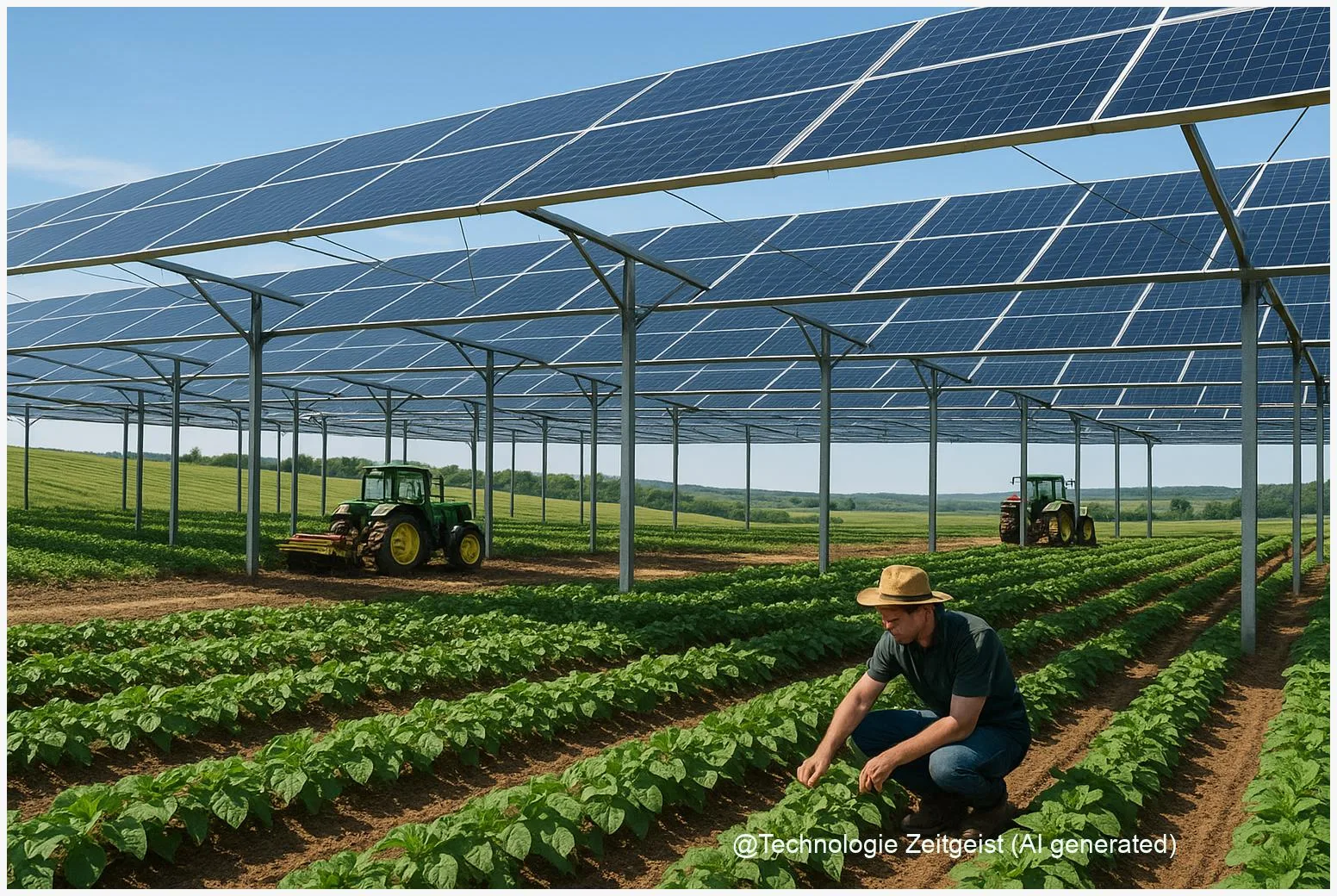
Solar arrays above farmland are not only a way to make electricity but can also alter microclimates and reduce stress on crops. Agri-PV blends photovoltaic technology with food production so the same hectare can deliver power and agricultural output. This article describes practical benefits, typical system designs and the trade-offs that matter for farmers and local planners, using recent studies and standards to show where Agri-PV performs best and where uncertainty remains.
Introduction
Many farmers now face two pressures at once: tighter margins for crops and the need to adapt to hotter, drier summers. At the same time, grid operators and communities seek more local renewable power. Agri-PV, the combined use of land for photovoltaics and agriculture, addresses both goals by placing solar modules above crop rows or pasture so electricity is produced without fully giving up farmland. The idea sounds simple, but the details matter: system height, row spacing, the crop beneath and local climate all change outcomes.
Field trials and guidelines from research institutes and standards bodies provide initial rules of thumb. They show Agri-PV can increase overall land-use efficiency and sometimes stabilise or even improve yields in dry years, while delivering substantial electricity per installed kilowatt. Yet results vary by crop and design. The rest of this article lays out how Agri-PV systems work in practice, what farmers actually build and the trade-offs to weigh when considering it for a real operation.
How Agri-PV works
At its simplest, Agri-PV puts photovoltaic panels above farmland on supports tall enough to allow machinery and crop growth below. The panels convert sunlight into electricity using the same semiconductor physics as standard PV. “Agrivoltaics” is another common name for the approach; it emphasizes the deliberate pairing of agriculture and photovoltaics on the same land area.
Two broad system categories are common. Overhead (or stilted) systems keep a working height greater than about 2.1 m, permitting tractors and many field operations. Interspace systems mount panels lower and work best with low-growing crops or grazing animals. Panel layout, tilt and spacing determine how much direct sunlight reaches plants, and that in turn influences crop photosynthesis and water loss.
Field research shows Agri-PV can raise combined land productivity while the crop response depends strongly on climate and design choices.
Two simple physical effects explain most outcomes. First, panels shade part of the field; shading reduces peak temperatures and limits direct radiation. Second, reduced radiation and lower wind speeds under panels cut evaporation from soil and plants. In hot, dry summers this shading can reduce drought stress; in cool or cloudy years the same shading may lower yields for light-demanding crops.
If numbers help: a public guideline compiled by a leading research institute estimated a theoretical technical potential for overhead Agri-PV in one large European country at about 1,700 GWp. Practical field trials reported specific system yields in the range of about 1,266–1,285 kWh/kWp in some pilot sites — notably above typical ground-mounted averages — while land‑use efficiency gains (combined product per hectare) reached up to about 160–186 % in selected experiments. These values are illustrative and depend on design and location.
If a compact comparison is helpful, the table below summarises a few widely used reference metrics.
| Feature | Description | Value |
|---|---|---|
| Technical potential (example) | Estimated overhead Agri-PV potential in one country | ≈ 1,700 GWp |
| Specific yield (pilot) | Annual electricity per kWp measured at a high-freestanding pilot | ≈ 1,266–1,285 kWh/kWp |
| Land-use efficiency | Combined crop + electricity output compared with cropland only | Up to ≈ 160–186 % |
Sources for these figures include national research guidelines and multi-year pilot measurements. The standards community also stepped in: a technical specification published in 2021 sets planning criteria such as minimum agricultural reference yields and categories for system heights; note that a 2021 standard is now more than two years old and newer field evidence has refined some recommendations.
Everyday setups and farm examples
On real farms, Agri-PV comes in several flavours. Higher overhead systems are often used with arable crops such as cereals, potatoes or legumes because tractors must pass easily beneath the panels. Lower interspace systems fit vineyards, berry plantations and small horticulture where machinery is smaller or operations are more manual.
A common configuration is single-row elevated arrays with enough spacing to maintain sunlight uniformity over the day. Another is east-west oriented rows that give a gentler, more uniform shade pattern than south-facing tilts. Developers may use bifacial panels (capturing light on both sides) to increase electricity yield, especially when panels are elevated and ground reflectance is high.
Practical pilot projects recorded varying crop responses. In some trials, potatoes and other tuber crops yielded more in a dry year under Agri-PV because reduced heat stress and lower evaporation preserved soil moisture. In wetter or cloudier seasons the same shade led to small yield reductions for light-hungry crops. For shade-tolerant leafy vegetables and some berries, moderated temperatures and lower sunburn risk can improve marketable quality.
Farmers considering Agri-PV often run small demonstrations on part of a field first. A pilot plot serves two purposes: it measures local interactions (soil moisture, pest pressure, microclimate) and tests machinery workflows. On mixed farms, grazing sheep under panels is a low‑friction trial: animals trim vegetation, need little adjustment to behaviour, and allow panel cleaning and maintenance without major schedule changes.
Costs matter. Substructures to lift panels increase upfront investment compared with standard ground-mounted PV. But the combined income stream — electricity plus crop sales — and potential savings on irrigation can change the business case. In many jurisdictions, support schemes or special tender windows for dual‑use projects significantly affect whether a farm-level Agri-PV project is financially attractive.
Benefits, limits and tensions
Agri-PV brings clear advantages but also real trade-offs. Key benefits include more productive use of land, additional revenue from electricity, microclimate regulation that can reduce irrigation need and protection from hail or extreme sun. For farms in regions with increasing summer heat and drought, shading can be a risk-reduction measure as much as a source of extra income.
On the other hand, there are limits. Not every crop tolerates shade well. Crops with a high light saturation point — some cereals and oilseeds — may see lower yields when shade is significant. Establishing elevated mounting systems raises capital expenditure and may demand different maintenance routines. Landscape and social acceptance issues also appear: neighbours and local planners sometimes raise concerns about visual change and about whether prime agricultural land should host energy infrastructure.
From a regulatory perspective, successful Agri-PV requires clarity in land-use rules and incentive design. Standards that require a defined percentage of reference crop yield to be maintained help protect food production, but they also introduce measurement demands: who monitors yields, over what baseline and with what transparency? These governance questions shape how quickly projects move from pilots to broader adoption.
Finally, evidence is heterogeneous. Several multi-year trials show both yield increases in dry years and decreases in wetter years. That variability means outcomes must be evaluated site by site. For policymakers, a cautious path is to support pilots with standardised monitoring so planners and farmers can compare apples to apples and improve design choices over time.
Paths ahead for farms and policy
Looking forward, three development directions matter. First, design optimisation: adaptive row spacing, dynamic tracking and semi-transparent modules can tune the light available to crops. These technical tweaks aim to capture more solar energy while keeping enough diffuse light for plants.
Second, evidence and standards. Wider rollout will hinge on robust, standardised monitoring: radiation and PAR (photosynthetically active radiation, the light plants use for photosynthesis), soil moisture, crop yields and water use. PAR is measured in micromoles per square metre per second and gives a clearer picture of usable light than total solar energy; consistent PAR data across pilots would greatly improve crop-specific guidance.
Third, financing and regulation. Policy levers that reduce investment risk — targeted tenders, support for pilot monitoring, or measures that recognise ecosystem services such as erosion protection — can change the business case. Local planning clarity on when an Agri-PV installation counts as agricultural use rather than energy land helps avoid long permitting delays.
For farmers, a reasonable approach is staged experimentation: start small, monitor carefully and choose crops with proven compatibility in the local climate. For regional planners and funders, the priority is comparable data from many microclimates and crop types so policy can be based on patterns, not single-site results. These steps keep options open while building the evidence to scale wisely.
Conclusion
Agri-PV combines solar electricity and agriculture on the same land and can increase total output per hectare while offering protection from heat and water stress for some crops. Research and field pilots show promising results — particularly in sunny, drier conditions — but outcomes depend on system height, spacing, crop type and year-to-year weather. Standards and pilot monitoring are already guiding better designs, but more comparable, long-term data will make economic and agronomic decisions clearer. For farms, the pragmatic route is targeted pilots, careful measurement and designs matched to local crops and climate.
Share your experience or questions about Agri-PV — we welcome practical perspectives and local examples.




Leave a Reply