
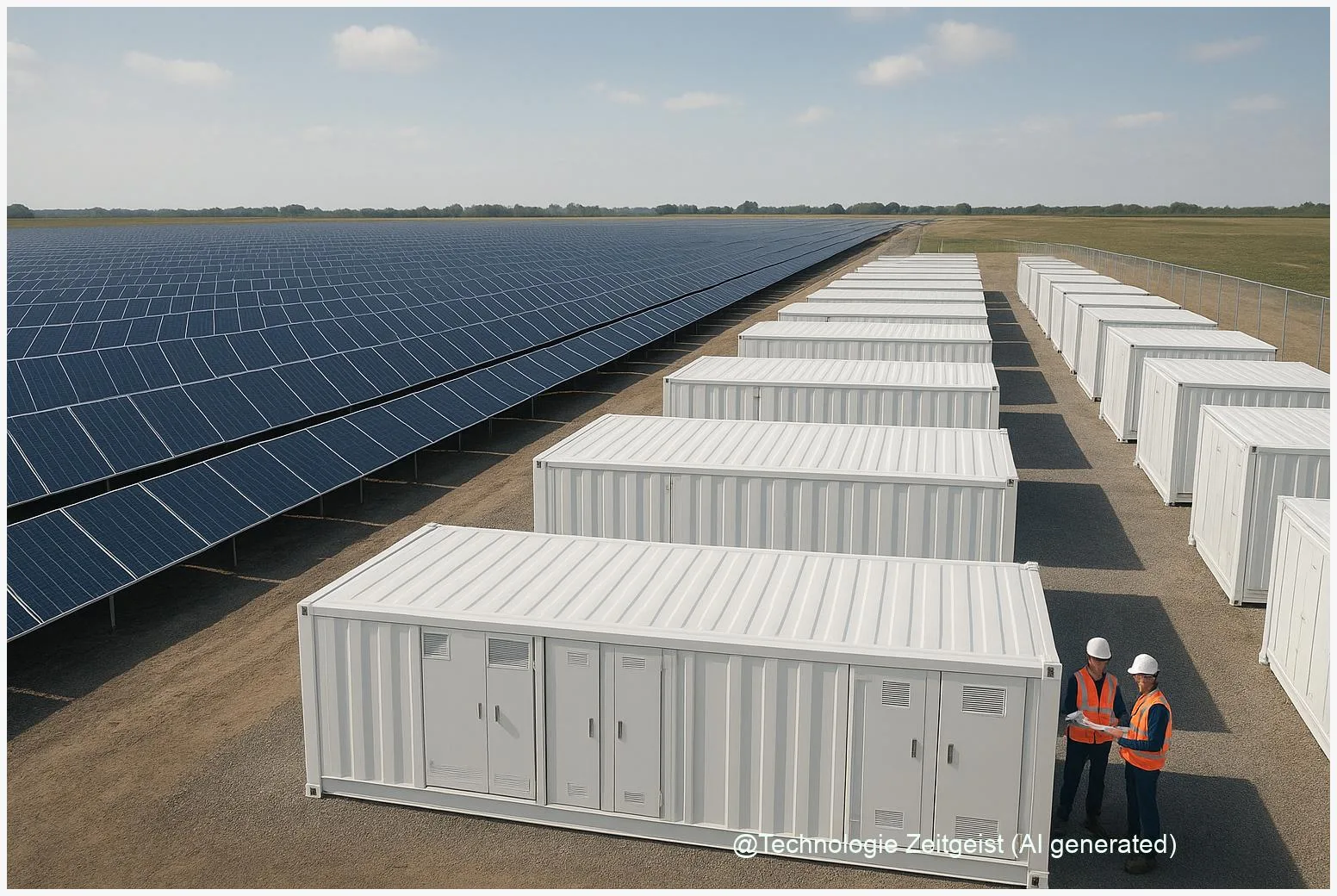
A large-scale shift from fossil fuels to renewables depends not only on panels but on storage. This article examines a single clear question: how a massive solar-plus-storage plant can take over services once provided by coal and gas power plants. It describes what “solar plus storage” does, shows how operators match MW and MWh to replace thermal units, and explains the practical limits and long-term implications for grids and communities.
Introduction
When a coal or gas plant retires, grid operators still need power and a fast response to keep lights on. A combined installation of large solar arrays and batteries aims to provide both energy and stability. At first glance, a block of panels plus a battery may seem like a replacement in principle; the practical question is whether it can deliver the same services at the same times of day and through weather events.
Practical examples help. A utility-scale solar farm rated in the hundreds of megawatts can produce a lot of daytime energy, while a battery rated in megawatt-hours stores that energy for use after sunset. The real test is matching the output profile of a retired coal or gas unit—including steady power during evenings, rapid ramps, and availability during cold snaps. This article uses clear numbers and recent project examples to show how that match is planned and where gaps remain.
How solar plus storage works
Solar plus storage combines two basic parts: solar photovoltaic (PV) arrays that generate electricity when the sun shines, and batteries that store electricity for later use. Two performance measures matter most: power (measured in megawatts, MW) and energy capacity (measured in megawatt-hours, MWh). Power says how much the plant can deliver at one moment; energy capacity says how long it can sustain that delivery.
Example: a 300 MW solar field coupled with 1,200 MWh of batteries can, in principle, deliver 300 MW for four hours or smaller amounts for longer. In practice operators can dispatch that energy in shorter bursts or spread it over many hours, depending on contracts and grid needs.
The combination of MW and MWh is what lets renewables behave more like conventional generators in a grid designed around continuous supply.
Battery chemistry and system design shape safety and performance. Lithium iron phosphate (LFP) cells are now common in many new utility systems because they tolerate heat and many charge cycles better than older chemistries. Other chemistries—nickel manganese cobalt (NMC), flow batteries, and iron‑air designs—offer different trade-offs of cost, energy density and duration. Choice of chemistry influences how long a battery can operate economically, how fast it can charge and discharge, and how it is cooled and housed.
There are also operational layers: inverters (which convert DC electricity from panels and batteries to AC for the grid), controls for charging/discharging, and software that bids capacity into electricity markets. Grid services that a solar-plus-storage plant can provide include time-shifting daytime solar to evening peak, fast frequency response (responding in seconds to stabilize grid frequency), and capacity that is counted toward a utility’s planning obligations.
Because solar output is weather-dependent, storage is essential to firm that generation. Four‑hour batteries are currently the most common duration for delivering evening peaks. Longer durations—tens to hundreds of hours—are needed if the goal is to replace extended coal output or to provide seasonal balance.
Real examples: replacing coal and gas
Projects announced and brought online since 2023 demonstrate how utilities plan to substitute fossil plants with large solar-plus-storage facilities. Two useful examples show different approaches: one repurposes a coal site with a mix of solar and long-duration pilots; another uses very large battery banks to back an extensive solar field.
At one repowering project, a former coal plant site received roughly 700 MW of solar capacity staged over several phases and a long‑duration pilot intended to cover multiple days of demand in extreme cases. The rationale is that the existing transmission access and grid connections from the coal site speed up interconnection for solar arrays and storage, reducing permitting complexity and local infrastructure costs.
Another operational example combines about 750 MW of solar with 300 MW/1,200 MWh of battery storage in two phases. In that design the storage is sized to deliver 300 MW for four hours, which covers typical evening peaks and provides backup during short cloudy periods. Operators use market signals and contracts to shift daytime solar into peak hours and to offer fast-response services that gas plants traditionally supplied.
How does that compare with a coal unit? A single coal plant unit might provide several hundred megawatts continuously and run for days or weeks. Replacing its role therefore requires a portfolio approach: large daytime solar to supply energy and batteries (or alternative long-duration storage) to cover evening demand and brief multi-day shortfalls. Grid planners often pair solar-plus-storage with demand response, flexible gas peakers kept for rare events, and transmission upgrades to create the same level of reliability.
These projects show that replacing coal and gas is technically feasible for many scenarios, provided storage is scaled appropriately and market rules value the services batteries supply. That said, the definition of “replacement” matters: replacing nameplate megawatts is different from matching every hour of energy delivery and the same operational flexibility during extreme weather.
Opportunities and risks
Solar-plus-storage brings clear advantages: it reduces daytime emissions, can lower peak prices, and creates new construction and operations jobs near repowered sites. Batteries respond quickly and can deliver multiple grid services from a single asset, which is attractive to system operators trying to balance short-term variability.
There are risks and tensions to manage. First, duration limits. Most batteries today are four-hour systems; that is effective for evening peaks but not for multi-day or seasonal shortfalls. Long-duration storage technologies are under development, but large commercial deployments are still emerging. Second, supply-chain and environmental considerations: mining for battery materials and end‑of‑life recycling must scale alongside deployment to avoid creating new environmental problems.
Safety and operation are often discussed after high-profile incidents at large battery facilities. Independent investigations and regulators have reviewed causes and recommended changes to design, installation and firefighting protocols. These reviews are essential; they typically lead to tighter standards for enclosure design, fire suppression, monitoring, and emergency response coordination with local fire departments. The industry is adopting standardized test methods and codes to reduce shared risks.
Another tension is market design. Capacity markets and grid planning historically rewarded continuous thermal output. For batteries to replace that value, markets must compensate multi-hour energy availability, fast response, and reliability during rare events. Policymakers and regulators in several regions are adjusting rules and templates so solar-plus-storage assets can compete fairly with conventional plants.
Finally, community impacts matter. Reusing industrial sites can preserve local jobs and tax bases, but project developers need to work with communities on land use, visible infrastructure changes, and long-term maintenance commitments. Clear communication and published monitoring data help build trust.
What may come next
Expect three practical developments in the next years. First, scale-up of duration. Commercial pilots of weeks‑to‑months storage—flow batteries, iron‑air, and other chemistries—aim to cover longer gaps than current four‑hour systems. Success here would make it easier to claim a coal unit is truly replaced for most seasonal needs.
Second, integration and hybridization. Projects increasingly pair solar, storage, and controls with dispatchable resources or hydrogen pilots to provide firm capacity. This hybrid approach reduces single‑technology exposure and spreads risk across asset types.
Third, market and regulatory evolution. Grid operators will refine how they count and procure capacity, paying for availability across hours and seasons rather than raw energy alone. That change will influence project economics and the speed at which solar-plus-storage can substitute for conventional plants.
For readers watching this transition, look for a few signals: published commercial‑operation dates and real dispatch data (how often the battery delivers energy and for how long), transparent environmental monitoring around large sites, and regulator reports on reliability testing. Those items give concrete evidence that a project is meeting its stated goal beyond press statements.
Conclusion
Large solar-plus-storage plants can replace many services previously provided by coal and gas, but doing so requires careful matching of power and energy, expanded storage duration, and market rules that reward reliability. Current projects demonstrate the technical building blocks—solar arrays for daytime energy and batteries for evening peaks—while pilots of long-duration storage aim to fill remaining gaps. The shift is gradual: for utilities and communities, the priority is measurable performance, transparent monitoring, and regulatory frameworks that ensure reliability through all seasons.
Share your thoughts or questions below and pass this article to someone curious about how large-scale clean energy works.

Leave a Reply