
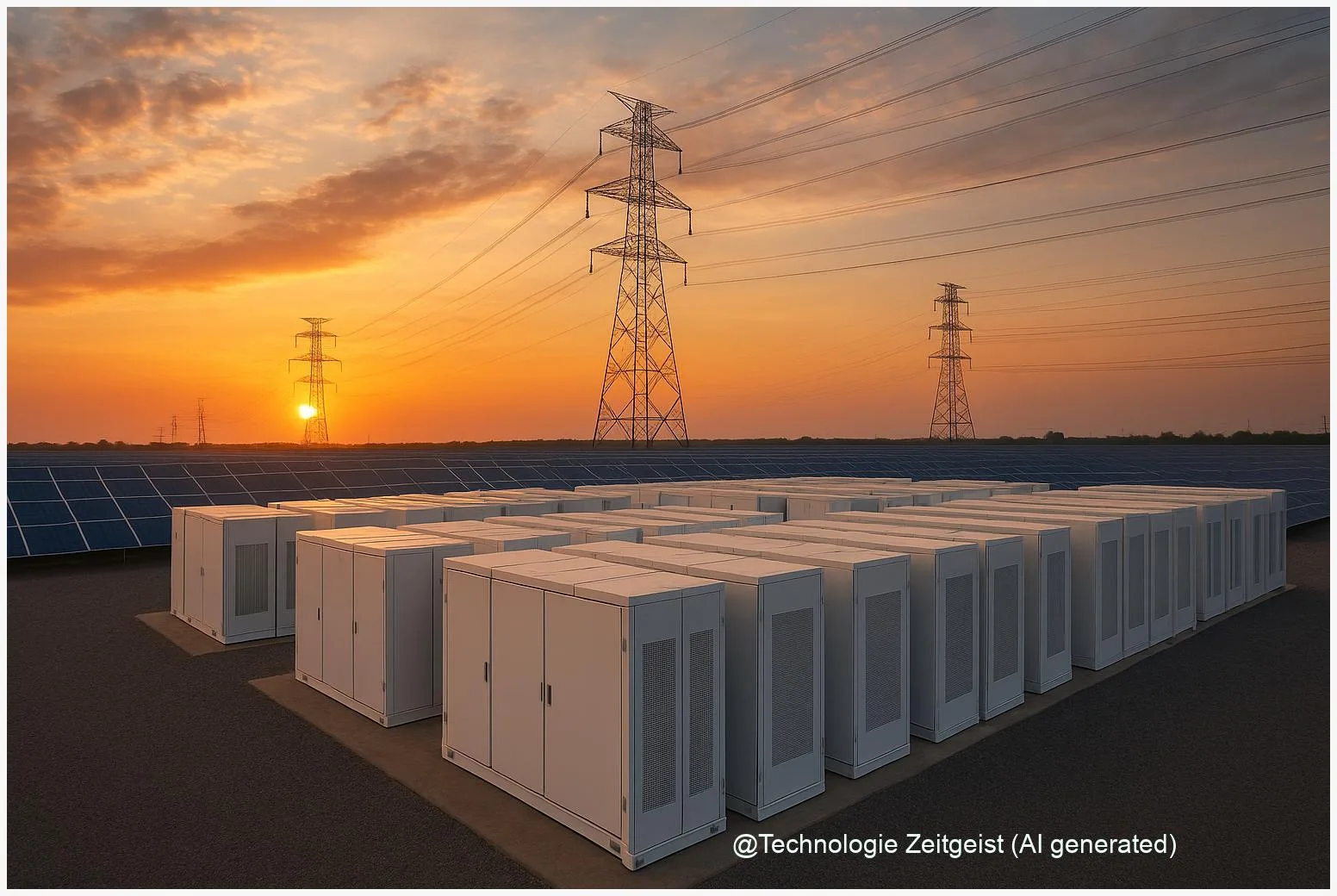
If planners aim for about 230 GWh of grid-scale batteries by 2030, the result would be easier control of peak demand, smoother use of renewable power and fewer emergency blackouts. The figure refers to large batteries connected to the transmission and distribution network that store electricity in gigawatt-hours (GWh). Reaching this scale affects how electricity is bought, when homes and factories draw power, and what grid upgrades are needed. This article looks at practical effects and the choices behind the number.
Introduction
Public discussion sometimes treats storage targets as a single magic number. In reality, “230 GWh by 2030” is shorthand for a system-level requirement driven by more renewables, higher peak loads and growing electric vehicle fleets. That number surfaced in media reports in late 2025 and sits near other published estimates: some studies find a cost-effective range near 218 GWh, while accelerated scenarios reach roughly 260 GWh. The specific meaning depends on assumptions: how many hours each battery must run, how much wind and solar are online, and whether batteries primarily supply short bursts or multi-hour shifts.
Read on to learn what such storage capacity actually does for households and businesses, what trade-offs grid operators face, and why the same headline number can map to very different real-world systems.
How grid-scale batteries work
At its simplest, a grid-scale battery stores electricity when supply exceeds demand and returns it when demand rises. Two key metrics describe a battery project: power, measured in megawatts (MW), and energy capacity, measured in megawatt-hours (MWh) or gigawatt-hours (GWh). Power is how quickly energy can be delivered; energy capacity is how long it can run. A 100 MW / 4 hour battery can deliver 100 MW for four hours, which equals 400 MWh (0.4 GWh).
Batteries give grid operators short‑to‑medium duration flexibility: seconds to hours, not seasonal storage for months.
Most grid batteries today use lithium-ion cells. Other options exist (flow batteries, pumped hydro) but take different space, cost and siting choices. When analysts say 230 GWh they refer to the aggregated energy capacity across many projects. That total could be hundreds of installations of a few MWh each or a smaller number of very large plants. The choice affects where systems are built: nearer to consumers for distribution support, or on the transmission network for bulk balancing.
Below is a small comparison to make the units concrete.
| Feature | Description | Value |
|---|---|---|
| Example single plant | Large utility battery | 100 MW / 4 h = 0.4 GWh |
| Aggregated scale | Many plants totaling | 230 GWh (≈575 such 0.4 GWh plants) |
That arithmetic shows why planners must specify not only total GWh but also the dominant duration (1 h, 4 h, 8 h). A fleet designed for short-duration frequency response looks different from one built to shave multiple evening hours of demand.
What 230 GWh looks like in daily life
For most people, the impact will be subtle but tangible. When you charge a phone or warm a kettle, the grid manages many such small changes across millions of consumers. Batteries at the grid level reduce the times when operators must fire expensive backup plants to meet a sudden evening peak. That can mean lower wholesale prices during expensive hours and fewer sharp price spikes that raise household bills indirectly.
Concrete examples: a cluster of batteries near a city can absorb midday solar output and release it during the evening rush, reducing local congestion on distribution lines. At the transmission level, larger batteries can provide reserve capacity so that a power plant outage does not immediately force rolling blackouts. In regions with high solar, batteries make more of the daytime generation usable at night.
How many homes could 230 GWh serve? Using a simple estimate—an average household using about 10 kWh per day—230 GWh equals roughly 23 million household-days of energy. That number is illustrative, not literal: grid storage does not send energy only to homes; it supports the whole system, including industry, services and EV charging.
Another everyday effect concerns reliability. Fewer emergencies mean businesses face less risk of costly production stops, and hospitals or public transport systems are less likely to need special back-up arrangements. For customers on time-of-use tariffs, more predictable price patterns may encourage shifting consumption to lower-cost hours, which the batteries help create.
Opportunities and tensions
Large-scale battery deployment brings clear benefits: smoother renewable integration, faster grid response and new markets for services such as frequency control. Yet there are trade-offs and risks. The headline number depends on assumptions: a “cost-effective” study may recommend about 218 GWh for certain market rules, while accelerated electrification scenarios push needs to around 260 GWh. The discrepancy matters for planning factories, grid upgrades and finance.
Supply chain constraints are real. Lithium, nickel and other materials are required in volumes that pressure mining, refining and recycling systems. That affects costs and lead times. Policymakers must weigh incentives for domestic cell manufacturing against the time and capital it takes to scale local production.
Another tension is siting. Large batteries need land, grid connection and community acceptance. Urban locations help distribution grids but often come with higher costs and tougher permitting. Rural or industrial sites can be cheaper but require extra transmission investment.
Finally, technology mix matters. Batteries are excellent for hours‑scale flexibility, but seasonal mismatches—long winter lulls or extended cloudy periods—still require other solutions such as pumped hydro, demand response or hydrogen. Relying solely on one technology creates system risks.
What may come next
If decision makers pursue a path toward 230 GWh, several developments are likely. First, project pipelines will expand: sites will be permitted, grid connections allocated and contracts signed that specify power and duration. Second, market rules will be adjusted to allow batteries to earn revenue not just from energy arbitrage but from fast frequency services, reserve markets and capacity auctions.
Manufacturing and recycling will become more central. Companies may plan multi‑GWh annual factory outputs to meet both domestic and export demand. At the same time, scaling recycling reduces dependence on raw mining and improves circularity over a decade.
For households and businesses, a more flexible grid implies different tariff designs and possibly smarter home devices that shift consumption automatically. For policymakers, it will be essential to align planning assumptions—how many hours of storage are needed, where batteries should connect, and how grid codes treat aggregated resources.
Lastly, monitoring and public reporting will matter. Transparent, reproducible estimates that state the assumed hours, the renewable mix and EV forecasts make the headline number meaningful rather than merely rhetorical.
Conclusion
230 GWh of grid batteries by 2030 is a plausible target within published scenarios, but it is shorthand for a set of technical choices: how many hours batteries must run, where they connect, and which markets pay for their services. If implemented with clear rules and attention to supply chains, such capacity can lower price volatility, improve reliability and allow more renewable energy to be used when people need it. The crucial point for planners and the public is not only the gigawatt-hours total, but the mix of durations and locations that turn that total into practical flexibility.
Share your thoughts or local experience with grid upgrades and storage—discussion helps clarify trade-offs and priorities.




Leave a Reply