
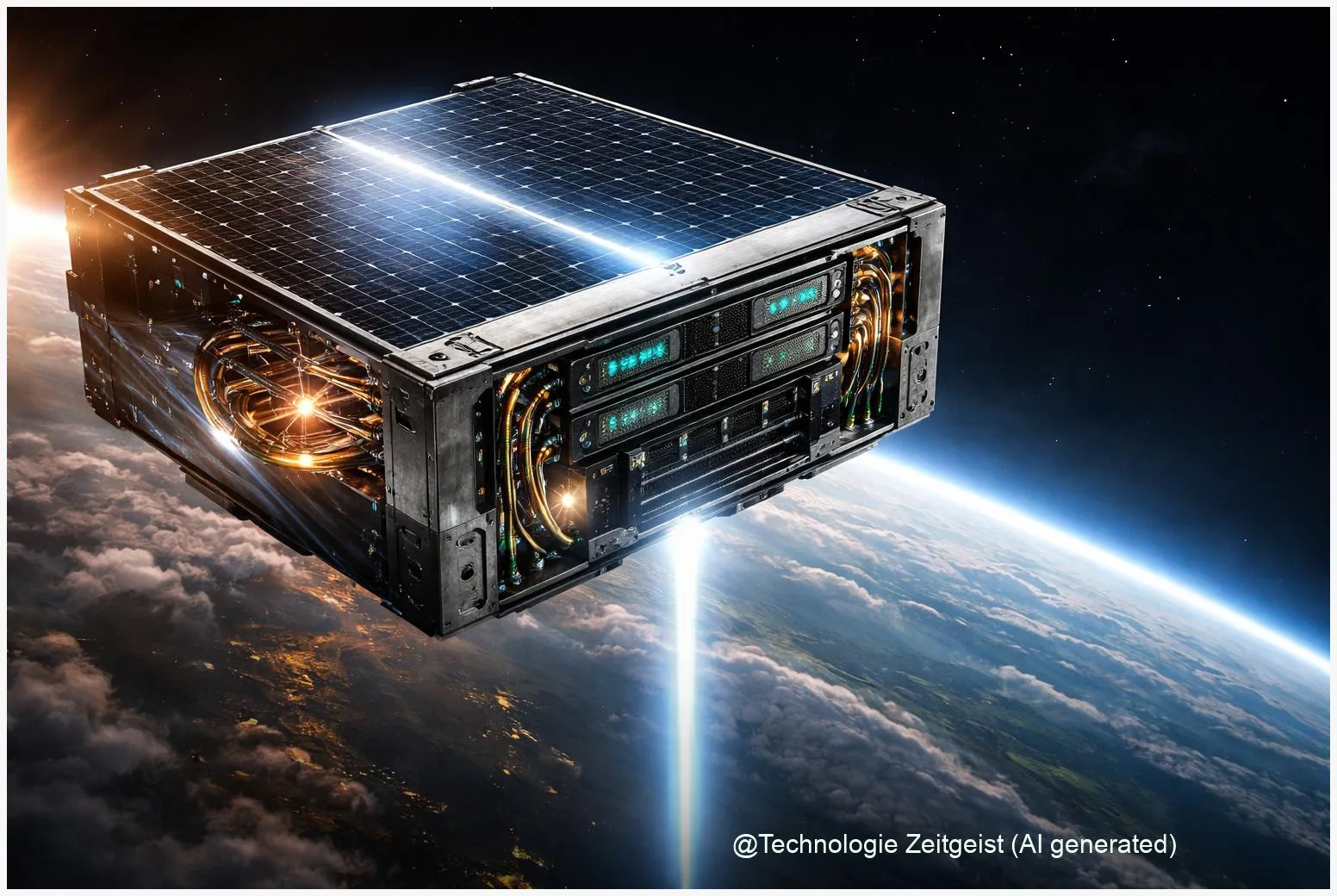
Constant sunlight, near‑zero atmosphere and the prospect of direct solar transmission are driving renewed interest in space data centers. The idea is that servers could draw power from orbital solar farms or run where cooling is simpler, reducing some Earth‑side constraints. Space data centers remain expensive and experimental today, but they pose a different set of trade‑offs for energy, latency and resilience that operators and policy makers are beginning to test.
Introduction
Data centers on Earth are visible to anyone who has walked past a server site: rows of racks, powerful fans and big chillers that hum as they remove heat. That noise is the practical symptom of a larger problem: running computation at scale uses energy and produces heat that must be moved somewhere. The conversation about moving some or all of that work into orbit starts with two concrete observations: sunlight is continuous in space for much of each orbit, and the void above the atmosphere simplifies some cooling choices.
At first glance the idea sounds futuristic, but it asks practical questions that matter for cloud operators and energy planners. Would orbital power reduce dependence on terrestrial grids? Could a satellite‑based archive be more resilient to some types of outages on the ground? And crucially: what does it cost in launch mass, maintenance and regulation to operate compute where repair requires a rocket? Those trade‑offs define whether the concept stays a niche experiment or becomes a long‑term option.
Why space data centers are being considered
Three technical drivers are behind interest in servers beyond Earth. First, energy supply: solar panels in orbit get stronger and more consistent sunlight than at many terrestrial sites, especially if installed in high or geostationary orbits. Second, cooling: in vacuum, heat must be radiated away rather than convected by air, which changes the engineering approach and can reduce some moving‑part overheads. Third, resilience and isolation: for certain secure archives or disaster‑recovery use cases, physical separation can be an asset.
Each driver needs a short technical note. Solar in space still requires power conversion and transmission—so called space‑based solar power (SBSP) designs convert sunlight to microwaves or lasers and beam energy down to receivers on Earth. That beaming step is complex but explains why orbital solar is not simply “free energy”—there are conversion and infrastructure costs. Cooling in vacuum relies on radiation panels and thermal conduction to structures; it removes the need for air fans but not the need for careful thermal design.
Finally, latency matters. A server in low Earth orbit (LEO) can offer surprisingly low round‑trip latencies for some regions, but geostationary orbit (GEO) adds hundreds of milliseconds. For latency‑sensitive applications—real‑time gaming or high‑frequency trading—orbital distance is a real constraint. For bulk storage, archival, or bursty background workloads, latency tolerances are larger and the resilience argument becomes more important.
How a space data center could work in practice
A practical architecture combines three elements: orbital power or local solar arrays, payload modules with compute and cooling hardware, and communications links to ground stations. One straightforward model is a storage‑focused constellation where satellites act as hardened vaults for data. A prominent commercial proposal in this space, announced years ago, suggested a network of satellites offering a physically isolated layer for backups and sensitive data; those vendor claims are public but independent technical detail is limited.
Power choices split into two families. First, satellites with their own solar arrays power onboard compute and store energy in batteries for eclipse periods. This approach is self‑contained but constrained by panel area and battery mass. Second, a hybrid with larger solar farms dedicated to power generation would beam energy to compute platforms; this resembles space‑based solar power concepts studied by space agencies. Agency studies from 2024 show SBSP remains costly compared with terrestrial renewables today, mainly because launch and hardware mass dominate system cost—so the economics currently favours specialized niches rather than wholesale migration of Earth data centers.
Communications and data transfer require design trade‑offs. High throughput needs wideband links and many ground stations; alternatives include storing large datasets in orbit and ferrying them down physically or during scheduled passes. A practical testbed therefore might be: an orbital archive that receives infrequent writes and serves occasional reads, supported by fast downlinks when needed. That reduces continuous bandwidth needs and is consistent with current launch‑and‑maintenance costs.
Maintenance and upgrades remain the biggest operational unknown. Repairing a failed server in orbit today requires either on‑orbit servicing missions, robotic maintenance, or disposable redundancy. Progress in on‑orbit assembly and servicing could make modular repairs routine, but those technologies are still maturing and add schedule and cost risks to any operational rollout.
Opportunities, risks and practical tensions
The opportunities are specific. Space data centers could offer secure, geographically isolated archives that are difficult to tamper with physically. They could run computation while reducing dependence on local grid constraints, and they could host experiments that need continuous solar exposure. For emergency scenarios—where a region’s grid is down—satellite archives could provide an offline restore path for critical data.
The risks are substantial and better understood today than a few years ago. Launch costs, while falling, still scale with mass. Every kilogram of payload increases the price of deployment and replacement. Regulatory complexity is another standing challenge: frequency allocation for high‑capacity links, spectrum sharing, orbital debris mitigation and international coordination on orbital rights are all active policy areas. Operators must satisfy both technical safety and diplomatic requirements before deploying large compute platforms.
Environmental and lifecycle questions raise further tensions. Agency studies that evaluated space solar concepts concluded that, on a lifecycle basis, orbital systems could match low carbon intensity in some scenarios, but they are sensitive to assumptions about launch emissions and component lifetime. In short: moving energy supply into orbit reduces some terrestrial pressures but shifts the environmental accounting upstream to manufacturing and launch.
Business models are also ambiguous. Independent reporting and analysis of early commercial proposals shows enthusiastic pitches but limited public detail on throughput, latency and replacement strategies. That means a prudent approach for buyers: treat claims as experimental until third‑party benchmarks and demonstrators validate sustained performance and cost forecasts.
Where development may go next
Several pathways could make orbital compute more practical. Continued reduction in launch costs and increased use of in‑space manufacturing would lower the mass‑and‑cost penalty. Demonstrations of power beaming that improve end‑to‑end efficiency would change the business case for large solar farms in space. Advances in on‑orbit servicing or modular, robotically‑replaceable payloads would convert today’s single‑use satellites into maintainable infrastructure.
In the nearer term, expect narrow, high‑value use cases to lead. Secure archives, litigation‑grade data escrow, and specialized scientific processing that tolerates higher latency could be the first adopters. Governments and research labs may fund demonstrators that combine an orbital storage module with scheduled data‑downlinks and a ground‑based verification regime to build trust.
For practitioners on Earth, sensible indicators to watch are concrete: (1) independent demonstrations of on‑orbit power beaming or large orbital solar arrays, (2) public benchmarks that measure sustained throughput, not just peaks, and (3) evidence of routine on‑orbit servicing that reduces replacement costs. If those three items move from prototype to operational, the conversation about larger orbital compute deployments will shift from theoretical to practical.
Meanwhile, many readers will find the comparison with terrestrial efficiency worth remembering: space options trade some grid dependence for higher upfront capital and regulatory complexity. That trade remains the central test of whether space data centers become widely used or stay a small, specialised tool.
Conclusion
Space data centers are not an immediate replacement for Earth’s cloud. They respond to concrete problems—constant solar power, different cooling physics and a form of physical isolation—but they bring new costs in launch mass, maintenance and regulation. Agency studies from 2024 and independent reporting show the concept is technically feasible in parts but economically viable only for limited applications today.
The practical path forward looks incremental: small, well‑measured demonstrators; transparent benchmarks for sustained throughput and energy use; and policy work on spectrum, debris and on‑orbit servicing rules. If those elements align, certain niche uses—secure archives, disaster‑resilient backups, and specific scientific workloads—could move into orbit first. For most everyday cloud tasks, terrestrial data centers will remain the efficient choice for the foreseeable future.
Share your thoughts or questions about orbital compute and energy—join the discussion and pass this article on.

Leave a Reply