
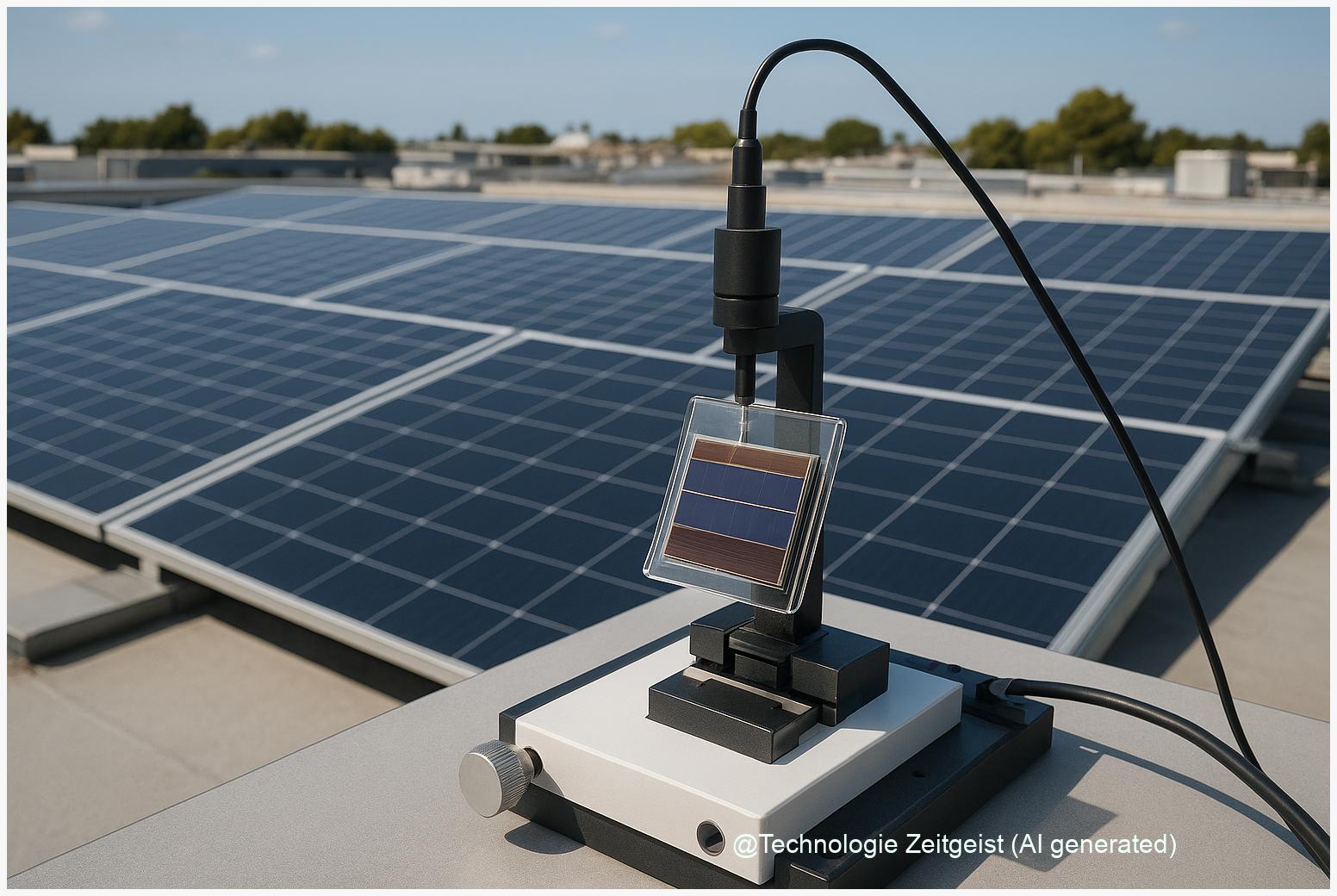
Perovskite silicon tandem solar cell performance has set new laboratory efficiency marks and promises higher electricity yield from the same roof or field. The main advances come from stacking a thin perovskite layer over a conventional silicon cell to capture more of the sun’s spectrum. Higher laboratory efficiencies are only useful if they hold up in certified tests and real life, so durability and standardized measurement are central to judging who really leads the efficiency race.
Introduction
When you look at solar panels on a house or at a field, most of them are silicon‑based. Researchers add a second light‑absorbing layer made of perovskite to create tandem cells that can turn more sunlight into electricity on the same footprint. That combination — a perovskite layer paired with silicon — aims to push efficiencies well beyond what single‑material silicon panels achieve today.
Lab teams have reported perovskite silicon tandem devices with notably higher percentages, but numbers in press releases are not the same as certified records. For households, installers and policymakers the practical questions remain: when will the higher efficiencies be reliably reproduced in certified tests and durable modules, and what will that mean for energy yield, cost, and recycling?
Perovskite silicon tandem solar cell fundamentals
A tandem solar cell stacks two light‑absorbing materials so each layer captures a different slice of the sunlight spectrum. The top layer absorbs high‑energy (blue) photons, the bottom layer handles lower‑energy (red/infrared) photons. In a perovskite silicon tandem the top material is a perovskite‑structured film tuned to a bandgap higher than silicon’s. Bandgap is a term describing how much energy a photon must have to create electricity; a higher bandgap is better for blue light, a lower one for red light.
There are two common architectures: two‑terminal (2T) monolithic tandems, where the layers are electrically in series, and four‑terminal (4T) stacks, where each cell is measured separately. Monolithic 2T designs tend to be more compact and cheaper to produce, but they need careful matching of currents between layers. The perovskite top cell is usually engineered to a bandgap around 1.65–1.75 eV to complement silicon’s ~1.1 eV.
Efficiency gains require both better light management and lower internal losses at interfaces.
Practical efficiency comparisons depend on how the measurement is performed: peak snapshot values often exceed stabilized outputs measured under a maximum power point (MPP) test. Certified efficiency records reported by independent labs are the most reliable metric when comparing technologies.
If a small table helps, here are typical reference values researchers use when comparing technologies:
| Feature | Description | Representative value |
|---|---|---|
| Single‑junction silicon | Commercial rooftop cells | ~20–22 % |
| Perovskite top cell | Tuned bandgap to capture blue light | ~1.65–1.75 eV |
| Tandem lab totals | Reported research cell efficiencies | ~29–33 % (range reported in 2024–2025) |
Everyday uses and where tandems fit
Higher efficiency matters because it increases energy production per square metre. On a roof with limited space, a tandem module that produces 25–40 % more electricity over the same area can reduce the number of panels needed and the balance‑of‑system costs for mounts and wiring. For utility‑scale farms, land use and permitting may improve if fewer panels produce the same energy.
Early commercial introductions do not usually replace all markets at once. New cells tend to appear first in segments where performance premium is easiest to monetise: high‑value rooftops, commercial buildings with strong energy demand, or satellite and portable power where weight and area are critical. For large ground‑mount arrays, module cost per watt must fall before tandems become dominant.
For homeowners, practical signs a tandem product is ready include: certified module‑level efficiency (not just cell numbers), independent durability testing showing limited degradation over hundreds to thousands of hours, and installers offering documented performance guarantees. Investors and buyers should also check whether products carry recognized labels and whether local recycling and hazardous‑material handling are addressed.
Opportunities, trade‑offs and risks
Tandems present clear upsides: a higher theoretical ceiling for single‑module efficiency, potential cost reductions per kWh produced over a system’s lifetime, and flexibility to pair with existing silicon supply chains. They can extend the economic life of solar installations where space is scarce.
At the same time, several tensions must be managed. Perovskite materials often contain lead, which raises recycling and environmental questions; research groups and companies are working on encapsulation and lead‑recovery methods, and regulatory frameworks will influence adoption rates. Stability under real outdoor conditions — heat, moisture, and constant sunlight — is the central technical risk. Some lab cells show high initial efficiency but lose output over months if encapsulation or interfaces are not robust.
Manufacturing at scale introduces additional trade‑offs. Lab processes that yield smooth perovskite films on small samples may not translate directly to large wafers or modules. Yield, uniformity, layer adhesion and thermal budgets during production must be solved for cost‑effective manufacturing. Supply‑chain questions for precursor chemicals and the need for new production equipment also affect rollout speed.
For policymakers and utilities the risk picture includes worker safety standards for new materials, certification programs for module testing, and clear recycling pathways. Companies that can demonstrate third‑party certification and long‑term outdoor test data will carry lower adoption risk.
How the technology might arrive at scale
Expect a phased commercial rollout rather than an instant switch. Typical progression: first, record‑setting lab cells; second, certified cell‑level measurements from independent labs; third, pilot module runs and field testing; fourth, scaled production with quality controls and recycling commitments. During the pilot phase, module‑level certification and multi‑year outdoor testing are critical checkpoints.
Time estimates are uncertain and depend on investment and regulatory alignment. In 2025 analyses showed strong lab momentum; a plausible path to initial commercial modules with reliable warranties stretches over two to five years, while broad market share that displaces a sizeable portion of conventional silicon panels could take longer, depending on cost reductions and supply‑chain scaling.
For governments and utilities, supporting certification labs, funding long‑duration outdoor trials, and clarifying end‑of‑life rules will accelerate responsible deployment. For installers and consumers, watching for IEC/EN module certifications, independent lifetime data (for example MPP tracking under ISOS protocols), and manufacturer recycling plans is the practical way to separate durable products from promising prototypes.
Conclusion
Perovskite‑silicon tandem solar cells raise a clear possibility: more electricity from the same roof or field. Laboratory efficiency gains are promising, but the decisive factors are independent certification and long‑term outdoor performance. The efficiency race matters because certified improvements translate into lower levelised costs of electricity and better use of land and roofs. At the same time, environmental handling, module reliability and manufacturing yields are the technical gatekeepers to real‑world impact. Readers should value certified, stabilized efficiency figures and documented lifetime tests over headline lab numbers when assessing which products to trust.
Share your questions or local experiences with solar installations — it helps clarify what consumers and planners should watch for.




Leave a Reply