
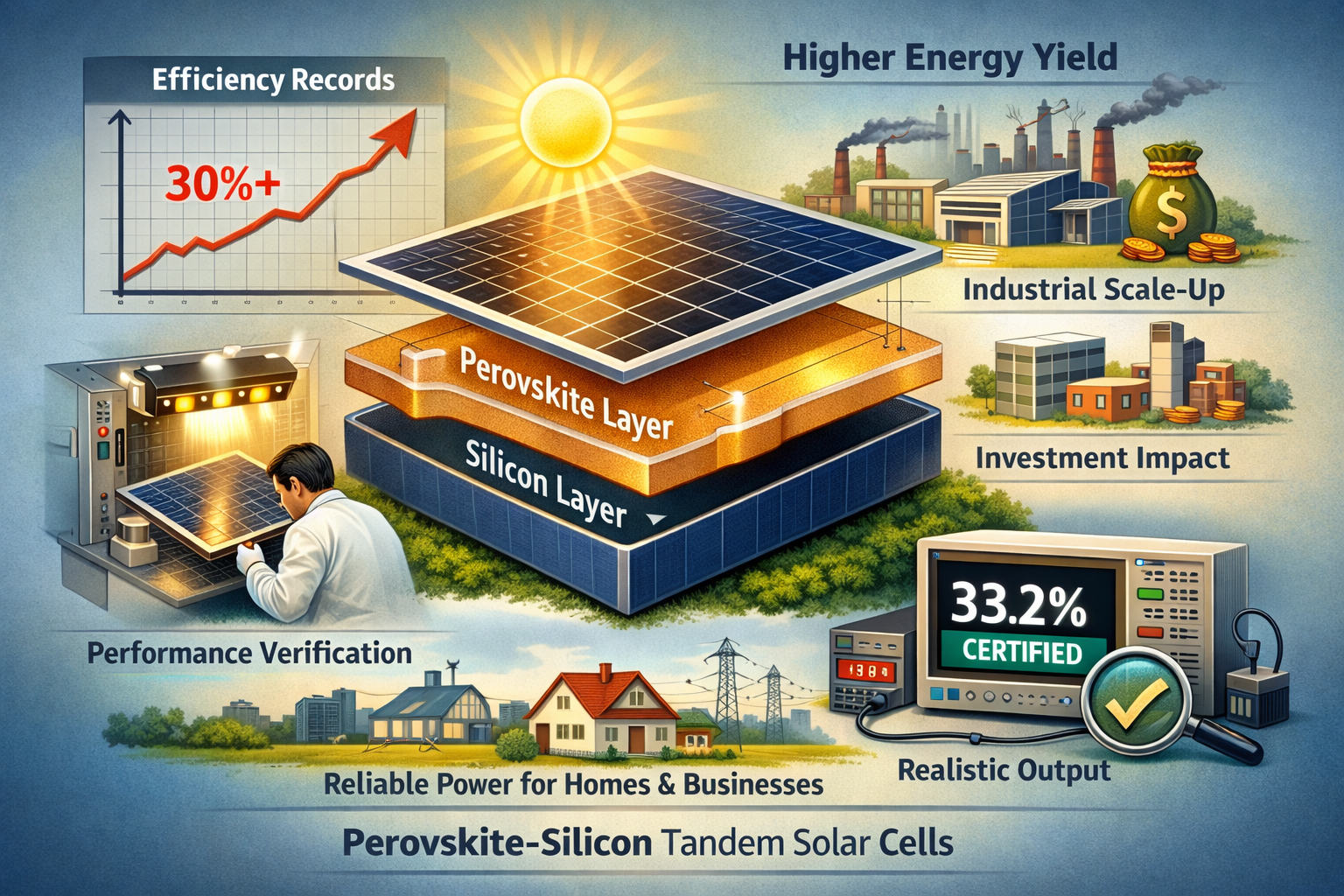
Perovskite–silicon tandem solar cell technology promises higher energy yield per square metre by stacking a thin perovskite top cell on a standard silicon bottom cell. This article explores why public efficiency records for these tandems matter now: they show technical progress, guide industrial scale‑up choices and influence investment in next‑generation solar panels. The focus is on realistic performance, verification practices and what those numbers mean for everyday electricity supply.
Einleitung
Solar panels on a house or at a utility plant are judged by how much sunlight they convert into electricity. For decades, standard silicon cells dominated that measure. Now, laboratories report perovskite‑silicon tandems that push peak efficiency numbers above what single‑junction silicon alone can achieve. Those headline figures attract attention, but the way they are measured and certified matters as much as the number itself. This matters because higher certified efficiency can reduce the number of panels needed, cut balance‑of‑system costs and change where solar becomes the most economical choice.
Efficiency records are therefore not just trophies for researchers. They influence manufacturing choices, lending confidence to investors and informing policy makers who decide where to support demonstration projects. At the same time, differences between lab reports and independent certifications can mislead — and that is why verification practices and stability data are central to assessing whether a new record is meaningful for everyday use.
How a perovskite-silicon tandem solar cell lifts efficiency
At its core, a tandem cell stacks two light‑absorbing layers tuned to different parts of the sunlight spectrum. Silicon is efficient at converting red and near‑infrared light; a perovskite top layer captures higher‑energy blue and green photons that silicon wastes. By splitting the work between two absorbers, the device reduces energy losses that limit single‑junction silicon cells.
A perovskite material is a thin, often solution‑processed semiconductor that can be tuned chemically to absorb specific wavelengths. This tunability is what makes the perovskite‑silicon approach attractive: researchers can optimise a top cell to pair neatly with silicon below. The result, in lab conditions, is a higher open‑circuit voltage and improved current matching between layers, which together raise the measured power conversion efficiency.
Measured peak efficiency is only part of the story; test conditions and independent certification determine whether that peak predicts real performance.
Not all efficiency numbers are directly comparable. Labs may report different active area definitions or use preliminary calibration. The most reliable benchmark used in industry and reporting is a certificate from an independent laboratory — for example the NREL “Best Research‑Cell Efficiencies” record or measurements from accredited test houses. Those certificates specify device area, test spectrum (usually AM1.5g) and whether aperture masking was used. Without that metadata, a headline percentage is hard to convert into expected field output.
Table: simple comparison of typical ranges
| Cell type | Typical lab peak efficiency | Practical rooftop range |
|---|---|---|
| Single‑junction silicon | ~20–26 % | ~15–22 % |
| Perovskite single‑junction | ~18–25 % (lab) | experimental |
| Tandem (perovskite + silicon) | ~28–33 % (lab reports) | ~20–28 % (pilot) |
Real-world examples: panels, roofs and power plants
Practical adoption of tandem cells follows a pattern: first, small‑area devices set records in the lab; next, companies demonstrate larger cells or modules under controlled conditions; finally, pilot production lines and field trials test long‑term behaviour. For end users, the central questions are how many kilowatt hours a panel will deliver over a decade and whether that performance justifies any added cost.
Recently, several firms and research consortia published promising module demonstrations and announced pilot lines aiming to integrate perovskite layers into manufacturing. Those announcements matter because they indicate pathways to scale — for instance layering a perovskite film into an existing silicon module line rather than redesigning the whole process. Even so, reported module efficiencies are generally lower than small‑area cell peaks because scaling introduces non‑idealities: uniformity over large areas, module encapsulation and thermal management become limiting factors.
What does that mean for a household or a commercial rooftop? If a certified tandem module achieves, say, 25 % module efficiency and proves stable over years, the owner needs fewer panels to meet the same energy demand, freeing roof area or reducing installation cost per watt. For utility‑scale projects, higher module efficiency reduces land occupation and can change the economics in regions where land or grid access are constraints.
Opportunities and technical challenges
Higher certified efficiencies open clear opportunities: lower balance‑of‑system costs, smaller arrays for the same output and faster returns on investment in constrained sites. The perovskite top cell also can be made with low‑temperature and potentially low‑cost processes, which is attractive for manufacturers.
At the same time, challenges remain. Stability under heat, humidity and long‑term illumination is the most discussed issue. Perovskite materials can degrade under moisture or high temperature unless properly encapsulated. Encapsulation methods used in silicon modules need adaptation, and accelerated tests (such as IEC damp‑heat or thermal cycling) are required to translate lab lifetime claims into expected field lifetimes.
Manufacturing scale is another hurdle. Lab cells are typically tiny — a few square centimetres. Scaling to full‑size modules requires uniform deposition, defect control and integration with silicon manufacturing steps. Each of these steps can lower the final module efficiency compared with the lab peak.
Finally, measurement and certification protocols must keep pace. Independent laboratories and standards bodies are developing test methods specific to tandems so that comparisons become fair and useful. Without consistent certification, investors and buyers may face unclear risks when a company advertises a headline efficiency that is not independently verified.
What to watch next for the technology
In the near term, follow three signals: certified efficiency updates from independent labs, module‑level demonstrations that pair efficiency with IEC‑style stability tests, and the emergence of pilot production lines that integrate perovskite deposition into existing silicon fabs. Each signal reduces uncertainty from ‘cell‑lab’ claims to usable, bankable product performance.
For policy makers and project planners, the relevant timeline is conservative: expect meaningful module‑level availability and credible long‑term field data within a few years after stable certified module reports. That rhythm matters because grid planners and financiers need performance certainty to underwrite large projects.
For consumers and installers, the message is practical: efficiency records point to where the technology is going, but buying decisions should be based on certified module data and warranty conditions. If a manufacturer’s tandem module comes with clear certification and robust warranty, the higher efficiency will translate into tangible benefits on roofs and in commercial installations.
Fazit
Efficiency records for perovskite–silicon tandems mark important technical progress, yet the headline percentage is only the start of the assessment. Independent certification, device area, module‑level demonstrations and validated stability tests determine whether a reported record moves a technology from the lab into reliable commercial use. For the electricity system and for owners of rooftops or solar farms, the practical gain comes when certified module performance and durability reduce costs and uncertainty. Watching certified records and the first robust pilot production outputs gives the clearest signal that tandems are ready to deliver those gains at scale.
Feel free to share and discuss this article if you found the analysis helpful.




Leave a Reply