
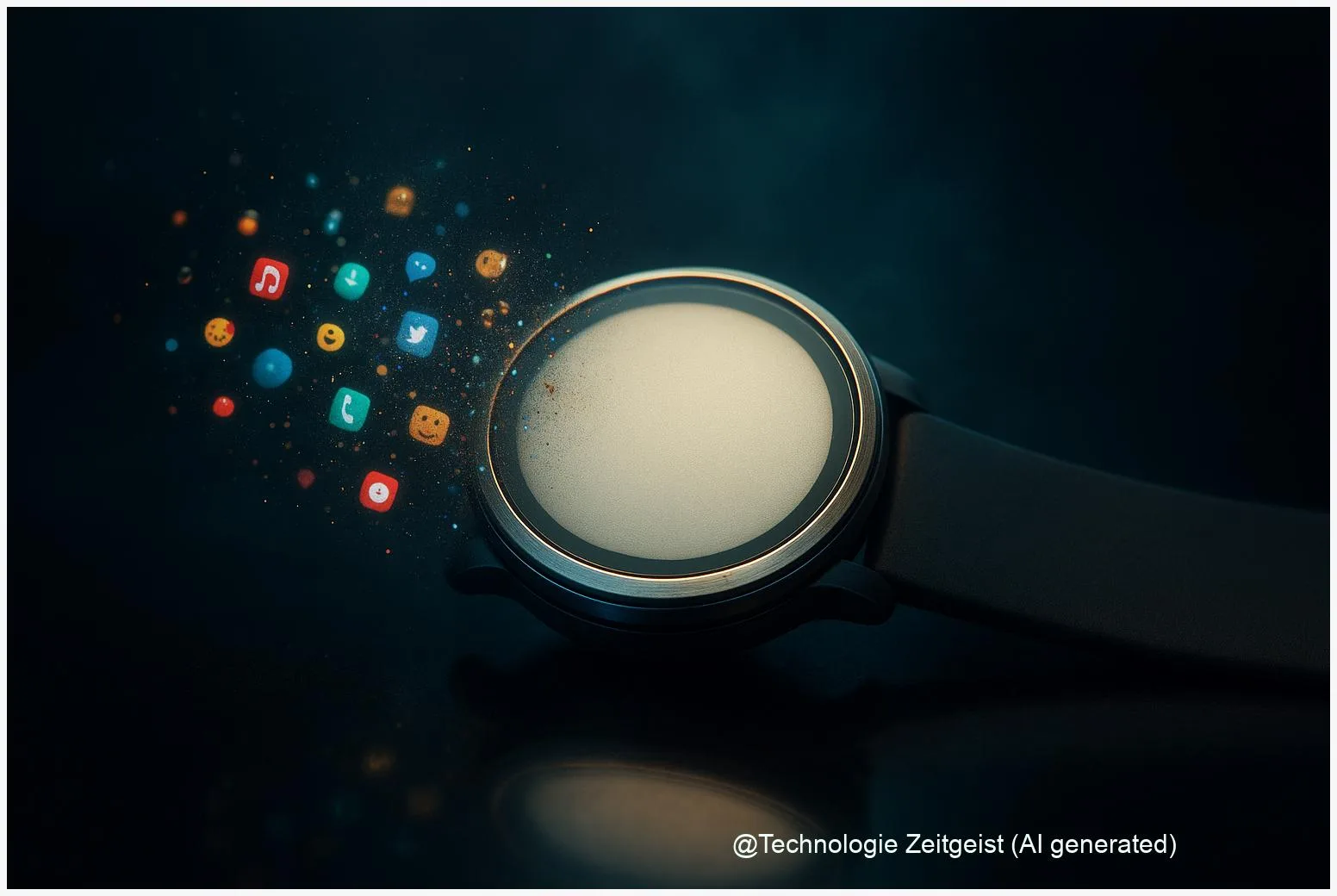
The Pebble Round smartwatch returned attention to plain, low‑distraction wearables at a time when many smartwatches tried to be tiny smartphones. It shows how a thinner case, an e‑paper display and a focus on basic notifications can keep a watch useful for days on a single charge. For readers curious about why simple wearables are back, this article places the Pebble Round in context and explains the trade‑offs that still matter for anyone choosing a less distracting wrist device.
Introduction
You’re trying to reduce screen time or simply want a watch that behaves like a watch — not a constant notification hub. Many modern smartwatches add health sensors, bright OLED screens and apps that demand frequent attention and daily charging. The question many buyers quietly ask is practical: can a wearable stay helpful without becoming another source of distraction or a battery chore?
The Pebble Round smartwatch, first sold in 2015, is a useful example because it deliberately scaled back features in favour of comfort, a thin profile and longer real‑world battery life. That trade‑off helps explain why, years later, several companies and designers revisit the same idea: simpler functionality, modest displays and clearer notification control. This article walks through what that design choice means technically and in everyday use, and why it remains relevant for people who want a watch, not a pocket computer on their wrist.
Pebble Round smartwatch: design and fundamentals
At first glance the Pebble Round looked like a conventional wristwatch: slim case, round face and a design written to fit under a shirt cuff. Under that surface it used a colour e‑paper display rather than an OLED. An e‑paper screen shows content with reflective light, like an e‑reader; it uses very little power when the image is static and thus helps a watch run much longer between charges. Because the display does not need continuous backlight for static content, short notifications and a persistent clock are efficient.
Key specifications announced at launch were compact: roughly a 38.5 mm case, about 7.5 mm thick and a display roughly 1 inch across. Pebble marketed the model as very light and thin compared with contemporaries, and the device kept core smartwatch functions — notifications, simple apps, a timeline‑style interface — while omitting energy‑hungry extras such as continuous heart‑rate sensing. The hardware also had a lower water‑resistance rating (commonly reported as IPX7, meaning splash resistant but not suitable for all swimming scenarios), which is an explicit trade‑off for the thinner design.
Pebble chose a minimal sensor set and an efficient display to prioritise comfort and battery life over advanced health features.
Several of these technical choices are worth a short glossary: an e‑paper display conserves energy because pixels hold their state without power; IPX7 is a water ingress rating that protects against immersion for short periods but is not the same as swimming approval. The Pebble Round also ran Pebble’s Timeline OS, a lightweight software layer focused on notifications and glanceable information rather than app ecosystems. Those basics explain why the watch resonated with buyers who wanted style and stamina from a wearable.
If a compact comparison helps: many full‑feature smartwatches in the same years offered always‑on bright OLEDs and continuous sensors, but typically needed daily charging; the Pebble Round commonly reached a real‑world runtime measured in days instead of hours, at the cost of fewer sensors and lower water‑resistance.
How simple wearables fit into daily life
Simple wearables aim to solve a few everyday frustrations: frequent charging, notification overload and the sense that a wrist device constantly demands attention. In practice that looks like a watch which shows the time, a short notification preview, and a few controls — and otherwise stays quiet. For many people the practical result is less interruption and a device they won’t remove at night because of battery anxiety.
Consider three concrete routines. First, for commuting the device can show travel alerts and call IDs without lighting a bright screen for every message. Second, at work a reduced notification set (for example, only calls and calendar items) prevents endless checking. Third, for sleep and charging habits, multi‑day battery life means fewer night‑charging rituals; a device that lasts 48 hours or more fits more easily into weekly routines.
These advantages are not theoretical. UX research on distraction‑reduction in wearables shows that fewer visual interruptions generally lower perceived burden and improve sustained focus in tasks that require concentration. The trade is information: a minimal wearable may not surface a health alert fast enough or show complex messages. For many users, that reduced stream of information is acceptable because the most urgent items — phone calls, navigation prompts — still arrive.
Designers and product teams often use simple wearables to target specific user segments: professionals who need reliable glanceability, users seeking digital‑wellness tools, and style‑oriented buyers who value classic watch proportions. The Pebble Round sits in that tradition: it made the point that a watch can be smart in limited, useful ways without becoming a pocket computer strapped to the wrist.
The trade‑offs: battery, apps and resilience
Simplicity is a series of deliberate compromises. The most visible trade‑off is capability: fewer sensors mean less continuous health tracking. The Pebble Round did not include a heart‑rate sensor, for example, which keeps power use down but removes a class of health data that some users expect today. App ecosystems are another limit: round or small displays require apps adapted to a different layout, so third‑party support can be weaker at launch.
Battery performance is the counterbalance. Reduced display power and limited sensors extend time on a single charge — but real‑world runtime varies with usage. Manufacturer claims often reflect ideal conditions; independent reviews from the model’s launch period measured runtimes ranging from about a day to multiple days depending on notification frequency and use patterns. That variance is typical across the category: vendors report optimistic numbers, while reviewers show a range that better maps to day‑to‑day life.
Durability and services matter, too. A thinner case often implies compromises in water resistance and sometimes repairability. Long‑term support is another issue: Pebble as a company stopped normal operations in 2016 and parts of its cloud services were discontinued in 2018. Community projects, like Rebble, stepped in to replace some online services, but those efforts are community‑maintained rather than company‑backed. This history shows a risk for buyers of niche devices: when a small platform loses commercial support, dependent features such as cloud‑based app stores or voice services can degrade.
In short, the reward for a quieter, longer‑running device is a slimmer feature set and increased reliance on local functionality. For many users those are acceptable trade‑offs; for others the missing sensors or uncertain long‑term cloud support are decisive negatives.
Where the minimalist trend may go next
Simple wearables are not a single market, but a cluster of ideas designers reuse: hybrid analog‑smartwatch designs, e‑paper or low‑power mini‑LEDs, and stronger on‑device notification filtering. Two technical directions stand out. First, low‑power displays and microcontrollers continue to improve; this allows more functionality without the old battery penalty. Second, software policies that let users choose notification rules at a finer grain reduce perceived distraction without removing safety‑critical alerts.
Business models will also matter. A sustainable minimal wearable needs a clear upgrade path and a service model that does not depend on fragile cloud backends. That can mean open standards for app packaging, community mirrors for legacy devices or integration with major ecosystems so essential services keep working even if a small vendor stops operating. The Pebble story illustrates both possibilities: an attractive hardware concept but a fragility in long‑term service continuity.
For readers who plan to buy: look for devices that balance battery life versus essential features, that document their service terms clearly, and that provide local‑first operation (core functions without required cloud access). In product roadmaps, expect more hybrids: watches that look classical but offer selectable smartness levels, and software that defaults to low‑distraction modes with optional escalation for urgent events.
Finally, the market for minimal wearables is likely to persist because it answers a simple human preference: people sometimes prefer tools that fit seamlessly into life rather than compete for attention. The Pebble Round smartwatch helped make that preference visible; the next iterations will refine the balance between usefulness and quiet presence.
Conclusion
Devices such as the Pebble Round smartwatch show that less can be more when the goal is a low‑distraction, comfortable wearable. The core benefits are clear: longer battery life, discreet notifications and a form factor closer to traditional watches. The costs are also clear: fewer sensors, possible limits in third‑party apps and dependence on service continuity. For many users the balance favours simplicity — especially if they value glanceability and battery freedom over continuous tracking and a large app ecosystem. Choosing a minimal wearable means deciding which features matter most in daily life, and how much resilience you want from the product’s support ecosystem.
Join the conversation: share your experience with simple wearables or a favourite distraction‑free watch and help others decide.




Leave a Reply