
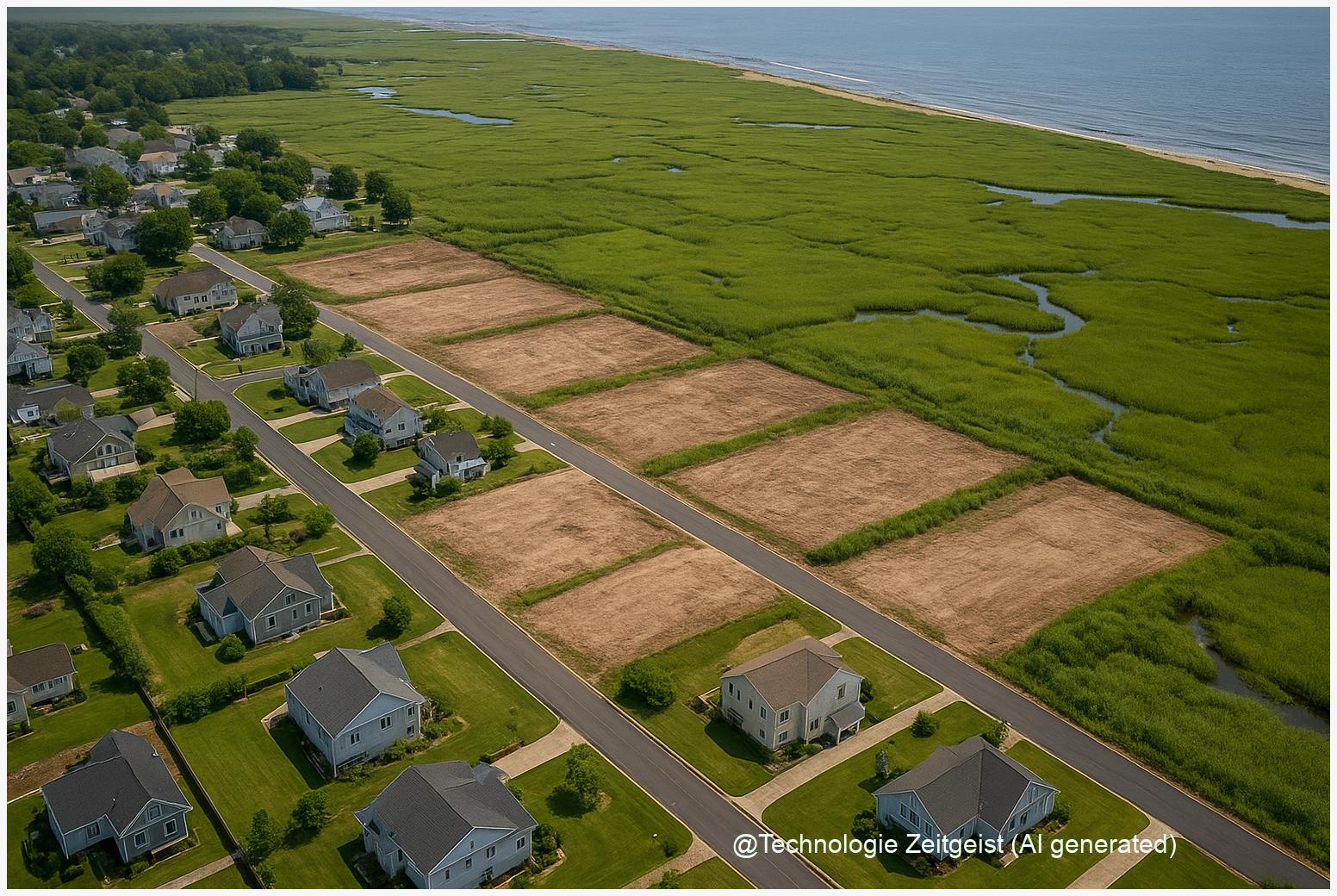
New Jersey’s Blue Acres program shows how a state-run flood home buyout program can reduce repeat losses and return floodplain land to nature while avoiding forced relocations. The program buys voluntary, repeatedly damaged properties and converts them to open space, cutting future repair bills for homeowners and public insurers. This article uses the New Jersey case to explain how these buyouts work, who benefits, and what trade-offs other climate‑vulnerable communities should expect.
Introduction
When a house floods repeatedly, owners face an unwinnable choice: keep repairing and hope for the best, or move and lose a lifetime of ties to place. New Jersey’s Blue Acres program offers a different path. It buys flood‑prone properties from willing owners at market value and converts the land to open space or wetlands. That stops future rebuilding on the site and reduces long‑term public costs.
For homeowners, a buyout avoids repeated damage and insurance uncertainty; for communities it is a tool to reshape coasts and riversides into places that can absorb water again. The program is voluntary, project‑by‑project, and depends on a mix of state and federal grants. Below, the basic mechanics are explained first, then concrete examples, followed by a sober look at opportunities, trade‑offs and what other communities can learn.
How a flood home buyout program works in New Jersey
A flood home buyout program is a formal process in which a government buys privately owned properties that have suffered repeated flooding and permanently removes homes from those sites. In New Jersey the Blue Acres program—managed by state environmental and land agencies with federal support—focuses on voluntary purchases and on restoring cleared parcels to natural floodplain functions.
The core idea is simple: remove the asset at risk, restore the land’s capacity to hold water, and stop the cycle of rebuilding and public payouts.
Key steps in the typical process are:
- Identification: municipal or state planners map repeat‑loss addresses and flood models to identify candidate parcels.
- Eligibility & outreach: owners are informed and offered participation—sales are voluntary; the program generally targets repeated claims or high‑risk elevation profiles.
- Valuation & offer: properties are appraised and an offer at or near market value is made; owners can accept or decline.
- Acquisition & demolition: on acceptance, the state or funder buys the parcel, removes structures, and clears titles to allow long‑term conservation or public use.
- Restoration & management: the land is returned to open space, parkland, or restored wetlands with protective easements to prevent future development.
Funding typically combines federal hazard‑mitigation grants—such as FEMA’s Hazard Mitigation Grant Program—with state funds. That mix determines how many buyouts are affordable in a given year and whether whole neighborhoods or only scattered parcels can be acquired.
If numbers help, three concise categories matter most:
| Feature | Description | Typical outcome |
|---|---|---|
| Eligibility | Repeated damage, high flood risk, local support | Voluntary sale |
| Funding | State grants + FEMA/HMGP awards | Project‑by‑project pacing |
| Aftercare | Conservation easement or public park | Permanent risk removal |
Across projects, the public finance question is straightforward: a one‑time purchase and demolition often costs less than repeated disaster payments, emergency responses and insured rebuilding over decades. For this reason, state programs like Blue Acres are framed as long‑term mitigation investments rather than short‑term relief.
What buyouts look like on the ground
On the street level a buyout can feel quiet and final. A family accepts an offer, moves—sometimes to a new home or a relative’s house—and the purchased lot is cleared. In New Jersey examples, cleared lots were seeded with native plants or combined into public open space. When several contiguous parcels are acquired, the result can be a restored floodplain or a small park that buffers remaining homes.
For residents the experience varies. Some homeowners use sale proceeds to buy safer housing nearby; others find that local housing markets constrain options. Municipalities that prepare by combining buyouts with housing counseling, relocation assistance or local housing programs see smoother transitions.
A common pattern in coastal and river communities:
- Initial outreach by town officials or state program staff to explain options;
- Appraisal and negotiation to arrive at a market‑based offer;
- Clearance and restoration funded by the same mitigation grants that supported the purchase;
- Long‑term protection through conservation easements or municipal ownership.
Buyouts can also be paired with other measures. For example, when buyouts target the lowest‑lying parcels, municipalities sometimes couple remaining shoreline elevation work or floodproofing for structures that remain. That hybrid approach—protecting some properties while removing the most exposed—reflects limited funding and competing local priorities.
Practical detail that matters: timing. Appraisals, grant approvals and environmental reviews take months to years. Homeowners weighing an offer must consider local housing availability and the time needed to relocate; programs that provide relocation counseling and clear timelines help maintain participation rates.
Opportunities, risks and tensions
Buyouts offer clear public‑finance advantages but bring social and governance tensions. One opportunity is fiscal: municipalities reduce future emergency and infrastructure repair costs, and insurers face fewer repeated claims for the same addresses. Environmentally, returned land can improve flood storage and biodiversity.
The risks are both personal and political. For households, selling a long‑held home—even at fair market value—can mean losing social networks, longer commutes and emotional ties. For places, if buyouts concentrate on lower‑value neighborhoods, outcomes can reinforce inequality unless programs explicitly address equity in outreach, valuation and relocation help.
Common tensions that New Jersey and other programs report:
- Valuation disputes: owners may disagree with appraisals, slowing or blocking sales.
- Funding limits: federal grants often require local matches and strict timelines, which can restrict which parcels are eligible.
- Community acceptance: some residents fear a loss of tax base or identity if buyouts are widespread; others worry buyouts will favor better‑connected owners.
Policy design can reduce these risks. Clear, transparent appraisal methods, early and culturally competent outreach, and coupling buyouts with affordable‑housing strategies reduce the chance that vulnerable households are left worse off. Independent monitoring—by universities or community groups—also helps reveal unintended patterns in who participates and who benefits.
One more practical note: buyouts can affect insurance premiums and eligibility only indirectly. Removing a structure from a high‑risk parcel reduces the likelihood of future claims at that location, which over time reduces local claim frequency. However, individual household insurance costs depend on the replacement home and broader market forces, so a buyout does not automatically lower a household’s insurance bill unless they move to lower‑risk housing.
What the Blue Acres experience suggests for others
Blue Acres illustrates a scalable, cautious approach: work parcel by parcel, prioritize voluntary participation, and bind purchased land to long‑term conservation. For other climate‑vulnerable communities, the lesson is practical rather than heroic. A program’s success rests on predictable funding streams, clear valuation and fair relocation support.
Three likely developments and implications:
- More blended finance. States will increasingly combine federal mitigation grants with state resilience bonds or local funds to scale buyouts beyond single projects.
- Stronger equity safeguards. Programs that monitor participant demographics and offer targeted relocation assistance can avoid concentrating buyouts on lower‑income households.
- Hybrid strategies. Communities will mix buyouts with targeted defenses and land‑use changes: buyouts remove the most exposed parcels while levees or elevation projects protect denser, economically vital zones.
For municipal planners, these implications suggest practical actions: map repeated‑loss properties transparently; develop companion housing strategies for sellers; and set up clear public dashboards for buyout progress and spending. The Blue Acres approach is not a one‑size solution, but it is a tested template that combines hazard reduction with ecological restoration—and it shows how hard policy choices can be made without coercion.
Conclusion
New Jersey’s Blue Acres buyouts show how a flood home buyout program can remove persistent risk from private property, restore floodplain function and reduce long‑term public spending on disasters. The approach works best when participation is voluntary, appraisals are transparent, and relocation assistance is available. Funding limits and social impacts remain the main constraints; meeting them requires deliberate equity safeguards and coordinated housing planning. For communities facing repeated floods, the Blue Acres model provides a grounded template: targeted acquisitions, restored landscapes and careful attention to who gains—and who might lose—during the transition.
If you have local experience with buyouts or questions about how they work in your area, share your perspective and pass this article to a colleague.



Leave a Reply