
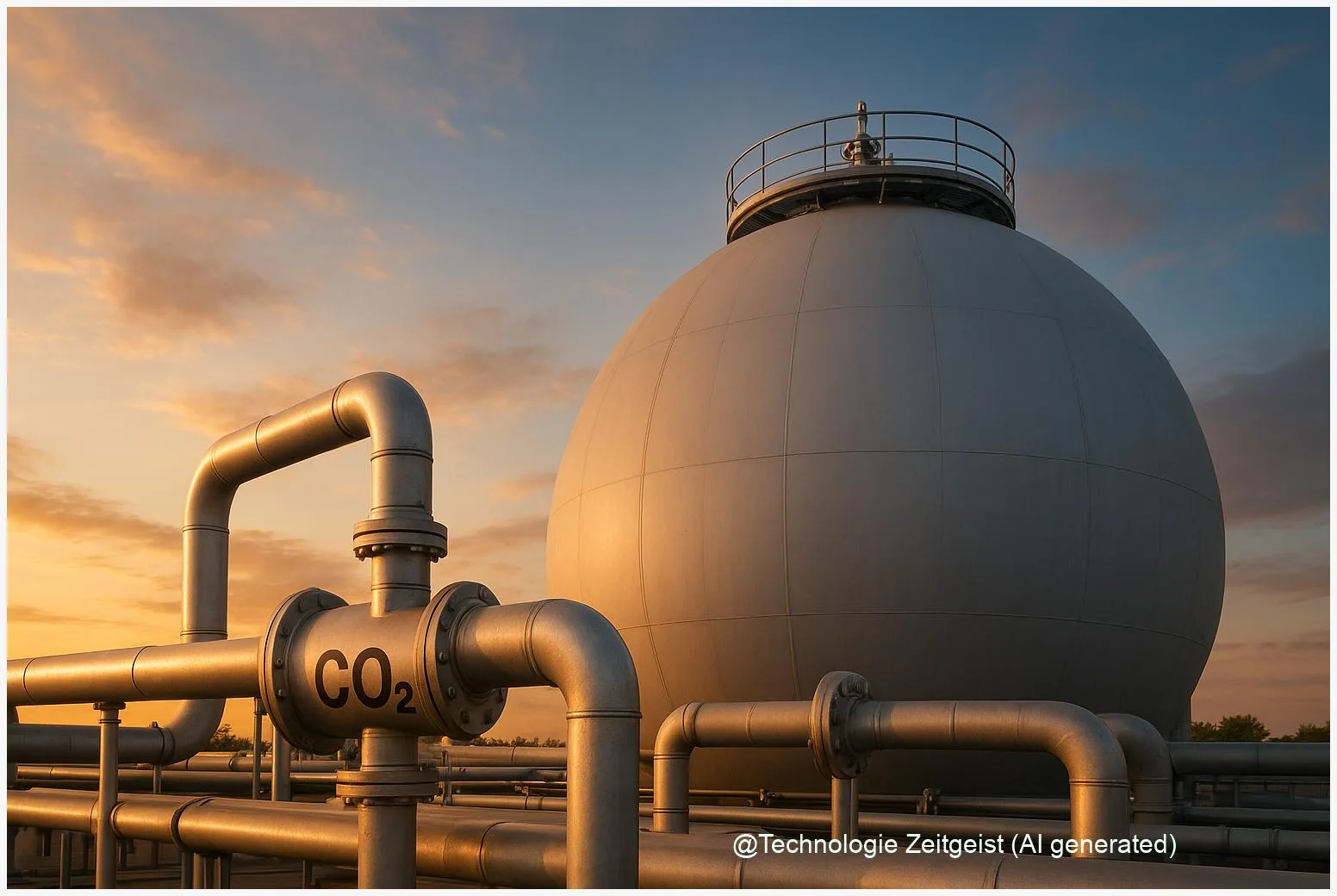
Liquid CO₂ energy storage offers a way to hold large amounts of excess electricity by turning carbon dioxide between liquid and gas under controlled pressure and heat. The concept promises compact, long‑duration storage that does not rely on lithium, and it can store renewable power for hours or days. Early studies and company projects report round‑trip efficiencies in the mid‑50s to mid‑70s percent range, but public field data remain limited.
Introduction
When wind and solar produce more power than the grid needs, that surplus must go somewhere. Batteries are widely used for short bursts, but storing energy for many hours or days remains expensive and space‑intensive. One alternative gaining attention is using carbon dioxide itself as the storage medium: the gas is compressed and cooled into a dense liquid for storage, then warmed and expanded to drive generators when electricity is needed. The method aims to be modular, use common materials such as steel and CO₂, and avoid scarce battery metals. At present the idea sits between laboratory models, simulation studies and a few early commercial projects; this creates a mix of technical promise and open questions about efficiency, costs, and safety.
How liquid CO₂ energy storage works
Liquid CO₂ energy storage stores electricity by changing state and pressure of carbon dioxide. Charging a system means running electric compressors that raise CO₂ pressure and reduce its temperature until it becomes liquid. That liquid is kept in a sealed, pressurised tank. To discharge, the liquid CO₂ is allowed to warm and expand; the expanding CO₂ drives a turbine or expander that generates electricity. The process is cyclic and enclosed: the same molecules are reused rather than consumed.
Two elements determine the system performance: thermodynamics of CO₂ near its critical point, and how well the system manages heat. CO₂ has a critical point at moderate temperature and pressure compared with many industrial fluids, which allows dense storage without extremely low cryogenic temperatures. Still, effective heat exchange and insulation are essential because liquefaction and evaporation move substantial heat. Engineers often add buffers — thermal stores or heat-exchangers — to recover and reuse process heat and cold, improving round‑trip efficiency.
The practical efficiency depends strongly on compression/expansion losses and the quality of heat recovery.
Comparing reported figures helps set expectations. Simulation and manufacturer claims vary; independent field records are scarce. The table below summarises typical reported metrics from recent sources.
| Source | Round‑trip efficiency | Scale / example | Notes |
|---|---|---|---|
| Peer‑reviewed simulation (MDPI, 2025) | ~65% | 10 MW model, 1 h cycle | Dynamical model; field data not included |
| Company claim (Energy Dome) | ≥75% (manufacturer) | Ottana project: 20 MW / 200 MWh | Commercial project announced; independent verification pending |
| Other literature | ~56–62% | Various models | Range reflects different assumptions |
Technical terms: “round‑trip efficiency” means the share of electrical energy you get back when you discharge, compared with what you put in during charging. “Critical point” is the temperature and pressure above which CO₂ cannot be liquefied by pressure alone; operating near but below that point lets designers exploit favourable density without extreme cooling.
Everyday use and practical examples
Think about a region with a lot of solar power and calm, windless nights. A liquid CO₂ system could take midday overgeneration, compress and store the CO₂, and deliver steady power into the evening peak that lasts several hours. Compared with lithium batteries, the footprint per stored megawatt‑hour can be smaller for multi‑hour uses because CO₂ stores densely in tanks. The technology is most attractive where operators need long discharge durations (six to ten hours or more) rather than second‑to‑minute response.
On a city scale, a stored 200 MWh plant could cover tens of thousands of households for a few hours; the same energy in short‑duration batteries would usually cost more or require much larger battery arrays. For network operators, such a plant acts like a large, schedulable generator: it can provide firm capacity, shift renewable output into demand peaks, and reduce curtailment (the waste of otherwise usable green power).
Real projects are starting to appear. One announced project is a 20 MW, 200 MWh installation described by its developer as suitable for 10‑hour discharge. Independent operational data from that site were not publicly available at the time of writing; many performance figures come from company releases or from model studies. Hence operators planning to adopt the technology should require measured performance and contractual guarantees rather than rely on headline claims alone.
Opportunities and risks
Opportunities are straightforward: liquid CO₂ energy storage could provide low‑material‑intensity long‑duration storage without lithium, scale to several tens or hundreds of megawatts, and pair with renewables to reduce curtailment and firm capacity needs. The potential modularity and reliance on common industrial components may lower supply‑chain risks compared with battery chemistries that depend on scarce metals.
Risks and tensions are practical. First, round‑trip efficiency depends on how well the plant captures and reuses heat created during compression and released during expansion. Poor heat management lowers efficiency and raises operating costs. Second, safety and regulation matter: handling pressurised carbon dioxide at scale requires pressure‑vessel standards, leak detection, and emergency procedures. CO₂ is non‑flammable but can displace oxygen in closed spaces, posing asphyxiation risks in case of leaks; established industrial rules reduce this risk but need to be adapted to energy‑storage sites.
Economics are uncertain. Publicly available cost figures are scarce; manufacturer estimates should be treated with caution until independent levelised cost of storage (LCOS) analyses and lifetime measurements appear. Another tension is environmental perception: because CO₂ is the storage medium, public messaging must avoid confusion with carbon capture or emission arguments; these plants do not sequester CO₂ long‑term by default — they reuse it within a closed cycle.
Looking forward: adoption and evidence needed
In the next few years the technology will either mature through verified pilots or remain a niche based on optimistic claims. What matters now is evidence. Key items that will determine adoption are: reliable operational data on efficiency and availability from MW‑scale plants; independent LCOS studies comparing the full system cost with alternatives such as pumped hydro, compressed air, and long‑duration batteries; and clear safety and permitting pathways for pressurised CO₂ tanks.
Researchers should publish measured round‑trip efficiencies over many charge/discharge cycles and report heat‑recovery performance. Grid planners should include realistic ranges for efficiency (literature suggests roughly 56–75% in current studies) and model how a plant behaves during variable grid duty cycles rather than only idealised one‑hour tests. Investors and procurement teams should require performance‑linked contracting: payments or milestones tied to verified metrics reduce the risk of unproven technologies being adopted on hearsay.
For communities and municipalities, small‑scale demonstrations linked to local renewables make sense as pilots: they provide real operating data, expose permitting and safety issues at a manageable scale, and create a base of local experience that larger projects can build on.
Conclusion
Liquid CO₂ energy storage sits between simulation promise and early commercial efforts. It uses familiar industrial methods—compression, liquefaction, thermal management—and aims to deliver long‑duration electricity without scarce battery metals. Published models and manufacturer claims place round‑trip efficiency in a broad band from roughly the mid‑50s to mid‑70s percent, and volumetric energy density can be favourable versus some alternatives. Yet public, independent performance data at scale remain limited, and heat recovery, safety standards, and cost transparency will determine whether the idea becomes a common tool on grids.
Share your local experiences or questions about long‑duration storage in the comments and share this article if you found it useful.



Leave a Reply