
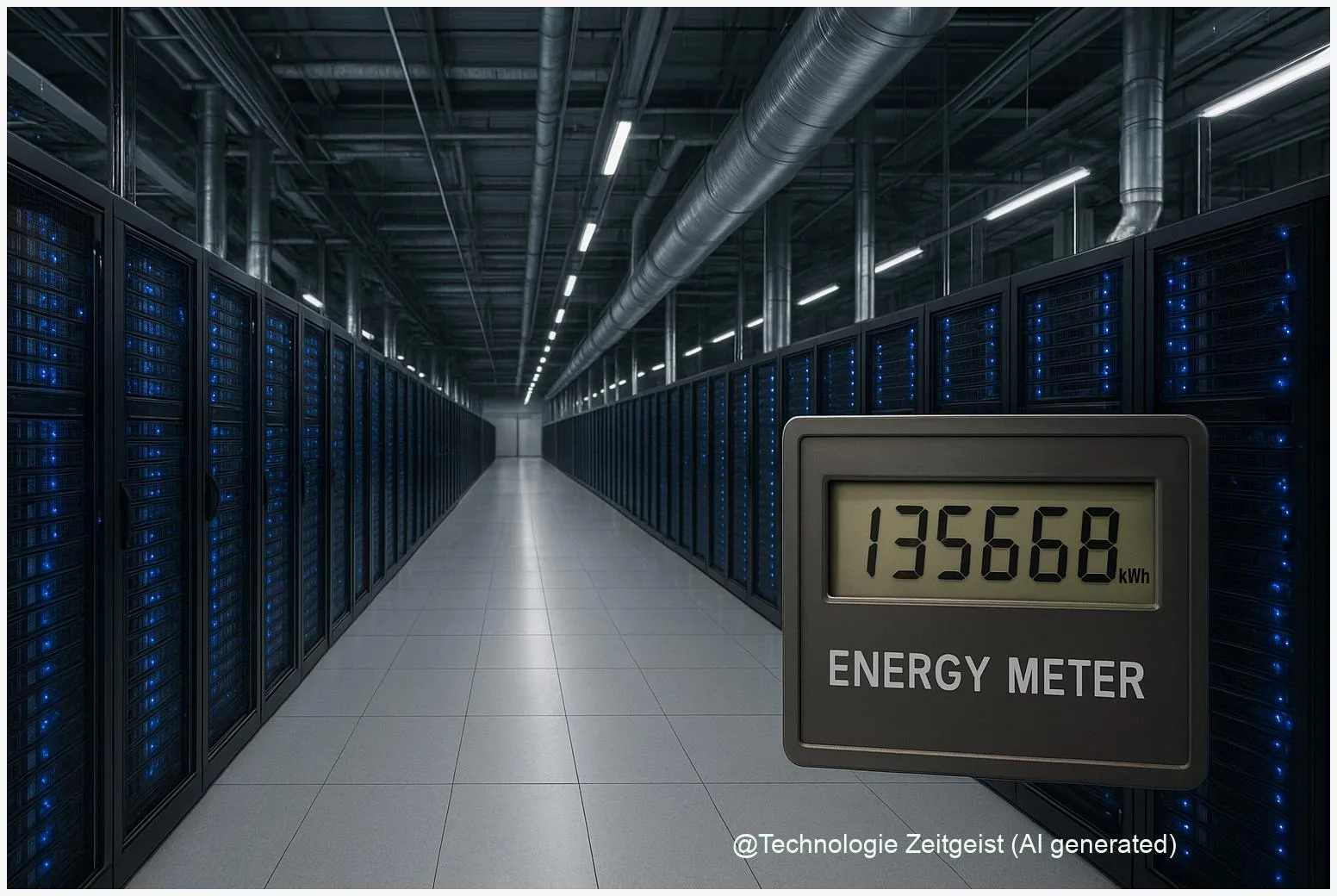
AI data centers are the facilities that run the large models behind services such as chatbots and image generators, and they now shape how much electricity clouds need. Operators and grid planners face a dual challenge: meeting rapidly rising compute demand while keeping costs and emissions under control. This article clarifies how much power these facilities use, where estimates come from, and which technical and policy choices reduce energy intensity without blocking useful AI applications.
Introduction
The costs and environmental footprint of large cloud providers have become a visible concern for cities, universities and companies that rely on AI services. At the root of those concerns are the physical buildings and the specialized hardware inside them: racks of GPUs, liquid‑cooled trays, backup power and the cooling systems that keep everything within safe temperatures. You do not see this when you use an app, but the machines behind it draw significant electricity for sustained periods.
Reliable public figures are scarce, because most estimates rely on models rather than direct metering. Still, consolidated analyses give a credible range: global data centers consumed around 415 TWh in 2024, roughly 1.5 % of worldwide electricity use, and analysts expect growth driven largely by AI workloads. The important point is not a single number but the levers that determine future trends: hardware efficiency, workload scheduling, cooling choices and how transparently providers report energy use.
How AI data centers consume energy
Data centers use electricity in two broad categories: IT load (servers, storage, networking) and facility load (cooling, power conversion, lighting). AI data centers are not a fundamentally different class of building, but the IT load profile shifts strongly toward compute‑intensive hardware such as GPUs and accelerators. GPUs (graphics processing units) and TPUs (tensor processing units) are accelerators designed for parallel numerical work. They can perform many operations per second but also draw hundreds to thousands of watts per unit under heavy load.
Power Usage Effectiveness, or PUE, is the standard metric for data center efficiency. PUE is the ratio of total site power to IT equipment power; a PUE of 1.2 means 20 % of the electricity goes to infrastructure rather than compute. Improving PUE reduces wasted energy but does not change how much energy the processors consume for a given workload.
The global context: consolidated estimates put data center electricity use near 415 TWh in 2024, with AI workloads an important and growing share.
Because many studies lack fine‑grained metering, researchers typically estimate consumption by combining reported compute capacity, assumed utilization rates, and measured energy per unit of computation. That approach creates uncertainty: small differences in assumed utilization or PUE produce large differences in total energy. A recent technical review highlighted these methodological gaps and called for workload‑level metering to improve precision.
If a concise comparison is helpful, the table below summarises the most cited ballpark figures and the key technical variables that change them.
| Feature | Description | Value |
|---|---|---|
| Global data center electricity | Consolidated estimate for all data centers | ≈ 415 TWh (2024) |
| AI‑specific estimate | Modeled share for AI training & inference (method dependent) | ~ 90 TWh (quoted as a 2026 estimate) |
| PUE typical range | Ratio of total to IT power; lower is better | ~ 1.1–1.6 |
| Projected trend | Main scenario outlook combining AI growth and efficiency gains | Data center demand could more than double by 2030 |
Everyday examples: training, inference and where the power goes
Two everyday technical terms help explain energy patterns: training and inference. Training is the one‑off process of teaching a model using massive datasets; it typically runs on many GPUs for days or weeks and is energy‑intensive. Inference is the ongoing use of a trained model to answer a query or produce an image; each request uses far less energy than training, but millions of requests add up quickly.
Consider a popular generative model: a single, large training run may consume as much energy as hundreds of thousands of inference queries. However, if that model serves millions of users every day, the accumulated inference energy can rival the original training cost over its lifetime. That balance varies by model size, how often the model is updated, and whether optimizations such as quantization (reducing numerical precision) or model distillation (making a smaller model that behaves similarly) are used.
On a local level, a university deploying a research cluster will see different patterns than a hyperscaler operating thousands of racks. Universities may run intense training jobs intermittently; hyperscalers run steady inference and scheduled training across many sites and use advanced cooling and scheduling to smooth power draw. For grid planners, the relevant issue is peak demand and predictability: tightly scheduled, simultaneous training jobs can create brief spikes, while steady inference imposes a continuous baseline load.
Hardware choices matter. Newer accelerators are more energy‑efficient per operation, and liquid cooling can increase packing density and lower cooling losses, improving PUE. Software choices also help: batching requests, lowering precision for inference, and shifting non‑urgent jobs to off‑peak hours all cut net electricity use.
Opportunities and tensions: efficiency, grids and transparency
There are clear opportunities to limit energy growth while meeting compute needs. Efficiency improvements in chips and datacenter design can reduce kWh per operation. Workload management — scheduling heavy training runs at night or when renewable output is high — aligns demand with cleaner generation. Some operators already sign long‑term renewable power contracts or locate facilities close to inexpensive renewable supplies.
Yet tensions remain. First, efficiency gains can lower the cost of compute and thereby stimulate more use — a phenomenon known as rebound effect. Second, locating data centers where cheap renewables are abundant can shift environmental and social impacts to specific regions; that raises questions about land use, water for cooling, and grid upgrades. Third, a lack of standardized, public reporting on workload energy makes policy and planning harder.
Transparency is a practical lever. Requiring aggregated workload‑level metrics, such as kWh per 1,000 inferences or kWh per training run, would let buyers and regulators compare services. These measures do not require revealing proprietary model details but create accountability and enable better network planning. Grid operators, too, benefit from predictable schedules and the ability to ask providers to shift non‑urgent jobs during stress events.
Overall, policy mixes that combine incentives for efficiency and clear reporting, together with technical measures like specialized chips and intelligent scheduling, reduce the likelihood of uncontrolled energy growth while preserving the social benefits of AI services.
What to expect next and how choices matter
Projections point to substantial growth: under scenarios that combine more AI models and expanding use, analysts estimate data center electricity could more than double by 2030 compared with 2024. That path is not inevitable; it depends on hardware innovation, software efficiency, location decisions, and whether providers adopt clearer reporting.
Near‑term technical developments will be decisive. Specialized AI chips that perform more operations per watt keep energy growth lower. Software methods such as pruning (removing unnecessary parts of a model) and quantization reduce the energy needed for inference. Advances in liquid cooling and waste‑heat reuse can change the facility‑side balance and even provide heat to nearby buildings in colder climates.
At the policy level, regulators can require standardized reporting for large providers, support grid reinforcement in regions hosting hyperscale facilities, and design time‑of‑use tariffs that encourage scheduling flexibility. For corporate and institutional users, procurement choices — asking vendors for energy metrics or preferring suppliers with renewables and transparent reporting — steer market behaviour.
Ultimately, choices by chip designers, cloud operators, grid planners and customers will determine whether AI growth raises electricity demand modestly or doubles it by the end of the decade. Practical measures exist to keep growth manageable without putting a brake on useful AI applications.
Conclusion
AI data centers are driving a noticeable shift in how much electricity the cloud sector needs, but the size of that shift depends on many concrete choices. Current consolidated estimates place global data center use near 415 TWh in 2024, with analysts warning of potential doubling by 2030 if AI workloads expand without offsetting efficiency gains. Improving chip efficiency, adopting better cooling and scheduling, and publishing standardized workload energy metrics are practical ways to limit growth. These measures make AI services more affordable and easier to integrate with low‑carbon power systems, which benefits both operators and communities.
Share your thoughts and practical experiences with AI services and energy — sensible discussion helps improve transparency and planning.


Leave a Reply