
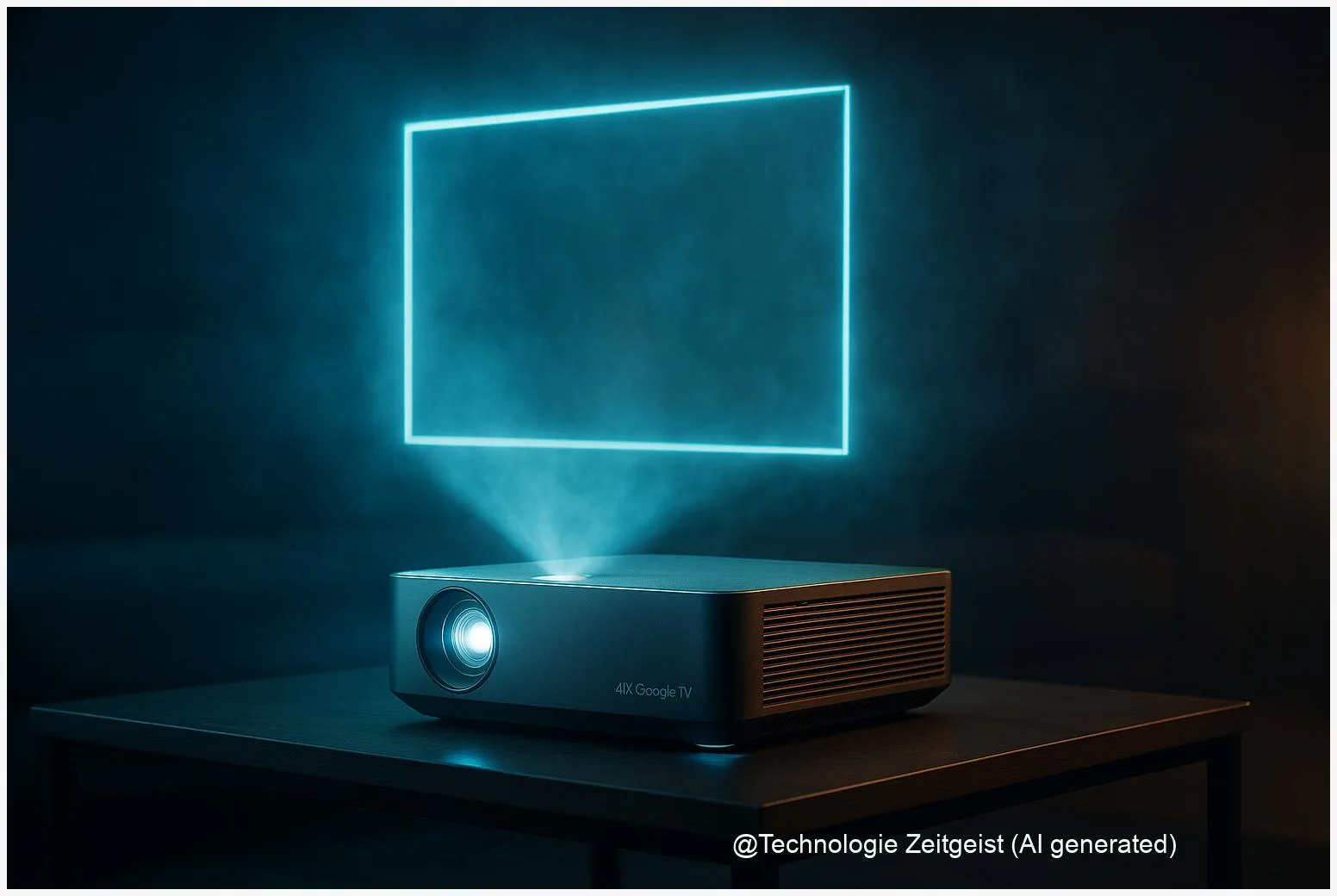
Many buyers ask whether a projector can replace a living‑room TV. This guide focuses on Google TV projectors and explains which technical and practical checks matter most when you consider swapping a TV for a projector. You will learn how the streaming platform, brightness figures, room light, and update policy affect daily use and long‑term value.
Introduction
When you want a bigger picture—say for weekend films or multiplayer games—picking between a large TV and a projector quickly becomes technical and confusing. Projector makers use different brightness measures, some smart projectors lack full app licensing, HDMI versions affect gaming, and room light often decides the outcome more than price.
This article concentrates on projectors that come with Google TV built in. Google TV is a streaming‑first interface that brings a unified watchlist, profile support and Google Assistant voice control to projectors the same way it does to smart TVs. The aim here is practical: give a checklist that helps you replace a TV without surprises and a clear sense of trade‑offs you will live with every day.
What Google TV projectors are and how they work
A Google TV projector combines a projector’s optics and light engine with Google TV software. Google TV is the user interface that organizes apps and streaming suggestions across services and includes Chromecast built‑in for easy casting and Google Assistant for voice control. In practice, this makes a projector behave much like a smart TV when it comes to searching, profiles and recommendations.
A key difference between models is not the label “Google TV” alone but how manufacturers pair that software with hardware: the processor, memory, certification for streaming apps and the stated brightness standard.
Two technical terms matter early:
SoC and RAM. The System on Chip (SoC) and memory determine how smoothly the Google TV interface runs; weak hardware can produce a laggy menu, slow app starts and choppy casting.
Brightness standards. Projector brightness can be advertised as ISO lumens, “LED” lumens or ANSI lumens. ANSI lumens is a well‑established nine‑point laboratory test and is most useful for direct comparisons; ISO or manufacturer figures can differ substantially. For colour scenes, also look for Color Light Output (CLO), which tells how bright colours will appear relative to white brightness.
If numbers help, the practical checklist starts here:
| Feature | Description | Why it matters |
|---|---|---|
| Smart platform | Google TV built‑in, Chromecast and Assistant | Controls apps and search; may affect which streaming services work natively |
| Brightness spec | ANSI vs ISO vs manufacturer “LED” lumens and CLO | Determines usable picture under ambient light |
| Light source | Lamp, LED, or laser (rated life in hours) | Affects maintenance, running costs and long‑term brightness |
Finally, app licensing matters: some streaming services require device certification to run native apps. A product labeled “Google TV” may still lack a specific service app unless the manufacturer obtained the required license.
How to set one up and what to expect in daily use
Setting up a Google TV projector looks simple on paper: plug in, connect the Wi‑Fi, sign into your Google account and your watchlist and profiles appear. In practice the room, screen choice and projector placement decide whether you can actually replace a TV.
Placement and throw ratio: every projector has a throw ratio that links distance to image width. Short‑throw models can sit close to a wall or on a cabinet; standard throw projectors need more distance or ceiling mounting. If you have limited depth, check the throw ratio carefully on the manufacturer page or product sheet.
Screen and ambient light: an ordinary wall works in a dark room, but many living rooms are not fully dark. An ALR (ambient‑light‑rejecting) screen can make a big difference by reflecting the projector’s light toward the audience while rejecting room light. If you cannot install a screen, you will need a much brighter projector to reach the same perceived contrast.
Brightness guidance: because manufacturers use different standards, compare only models with the same measure (ANSI or clearly specified ISO). Reviewers and measurement sites recommend using ANSI values for comparisons where available. As a rule of thumb, dim home‑cinema rooms need far fewer lumens than bright living rooms; if your room has windows that you cannot darken, plan to use an ALR screen or a high‑brightness (laser) projector.
Inputs and latency: gamers should check input lag measurements and HDMI versions—HDMI 2.1 support enables higher frame rates and variable refresh rates on compatible consoles. For streaming, Google TV provides most apps, but confirm that the services you use are available natively; otherwise casting from a phone or a separate Chromecast device remains an option.
Benefits and practical risks compared with a TV
Projectors offer large image sizes at lower cost per inch and a theatre‑like scale that a TV cannot match without a substantial budget. Google TV projectors add the convenience of a single interface, voice control and Chromecast integration—so the day‑to‑day experience can feel like using a smart TV.
On the risk side, projectors rarely match TV panels in peak brightness, black level and HDR delivery unless you move up to expensive laser models. That affects daytime viewing and the perceived pop of bright HDR highlights. Maintenance is another factor: lamp‑based projectors need occasional lamp replacements, while modern laser or LED engines advertise long lifetimes but often rely on manufacturer claims rather than long‑term field data.
Software support and security patches vary by maker. Google supplies the Google TV base and some platform services, but firmware updates, app licensing and long‑term support depend on the manufacturer. This can create a scenario where an otherwise capable projector loses app updates or fails to get security patches at the same pace as traditional TVs.
Costs beyond the box also matter: a quality ALR screen, ceiling mount, calibration and possibly a streaming soundbar add to the total. When you total those items over five years, the price gap with large TVs narrows. For many people the deciding factor becomes daily convenience: TVs are usually simpler to operate in bright rooms and require almost no maintenance.
Trends and sensible buying choices for the next years
Over the next few years expect brighter compact laser engines, broader Google TV certification among manufacturers and tighter attention to ANSI‑equivalent measurements. Manufacturers are increasingly listing ISO or other figures; insist on a clear statement whether the lumen figure is ANSI, ISO or a proprietary measurement.
When you compare models, check these points in this order: 1) Confirm the device actually runs Google TV (not only “Android TV” or a vendor skin). 2) Ask whether major streaming apps you use are certified for that model. 3) Request the lumen standard (ANSI preferred) and, if available, a Color Light Output number. 4) Note the SoC and RAM if you want a snappy interface. 5) Look for HDMI 2.1 if gaming at high frame rates matters. 6) Check the warranty and published update policy for at least two years.
There is also a pragmatic fallback: if you like the projector hardware but worry about software updates or missing apps, you can use an external “Chromecast with Google TV” or another streaming stick. That keeps the projector as a large display while giving a separate, easily replaceable smart interface that manufacturers update independently.
In short, the choice is moving toward modular thinking: pick a projector for optics and light engine, and consider the streaming module as a replaceable component if long‑term app support is a priority.
Conclusion
A Google TV projector can replace a TV for many users, but only when hardware, room and software line up. The projector’s light source and a clear brightness standard decide how well it works in a living room with daylight. The Google TV software brings convenience and familiar controls, yet native app licensing and manufacturer update practices determine whether that convenience lasts.
Use the checklist above to make a confident choice: verify the lumen standard, confirm app certification, check the SoC/RAM and HDMI support, and plan for a suitable screen. If any of these points are uncertain, an external Chromecast device gives an easy escape hatch—keeping the projector for size and the stick for smart features.
Share your experience with Google TV projectors or ask a question—comments and tips are welcome.

Leave a Reply