
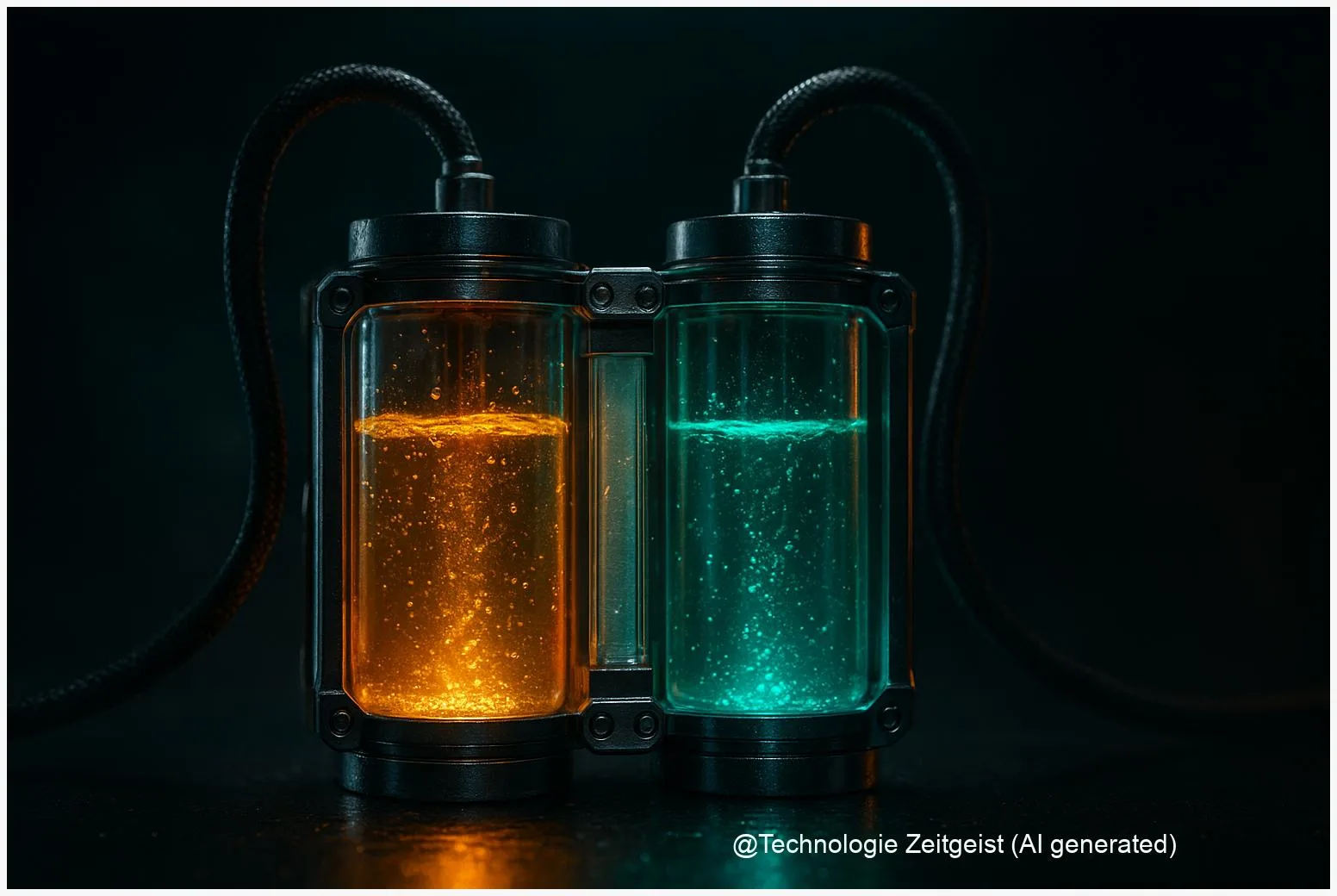
Flow batteries provide long-duration energy storage that scales energy (kWh) independently from power (kW), making them a practical option when solar and wind produce more than the grid can use at once. They store active chemicals in tanks and run electrochemical stacks only when charging or discharging. For multi‑hour services — typically 3–12+ hours — flow batteries can lower cycle costs and extend calendar life compared with many short‑cycle technologies. Flow batteries are therefore a candidate for firming renewables and supporting grid stability as systems add more intermittent generation.
Introduction
You may have noticed that rooftop solar peaks in the middle of the day while household demand is highest in the evening. Wind farms can produce large amounts for hours at a time and then fall silent. The technical puzzle for grids is not just storing power for minutes but holding it reliably for several hours or more. Flow batteries address that by separating how much energy you can store from how much power you can deliver.
That architectural choice matters for systems that need multi‑hour storage without the fast‑cycle economics of lithium-ion batteries. The rest of this article explains the basic design, shows how flow batteries can work with solar and wind in everyday situations, outlines the main opportunities and risks, and points to the milestones that suggest whether the technology will become a standard tool for clean grids in the coming decade. Technical terms are explained where they first appear.
How flow batteries work: the basics
A flow battery (often called a redox flow battery) stores energy in liquid electrolytes that sit in external tanks. The active chemicals flow through an electrochemical cell stack when the system charges or discharges. Two simple consequences follow: energy capacity (kWh) is set by tank size, and power (kW) is set by the stack area and number of cells. This separation is the core reason flow batteries suit longer discharges.
A redox flow battery is an electrochemical system where charge is stored in dissolved chemical species; when those species are oxidised or reduced in the stack, current flows through the external circuit. It is helpful to think of the tanks as fuel and the stack as the engine. Examples of chemistries include vanadium redox (vanadium on both sides), iron‑chromium, zinc‑bromine and a growing set of organic and hybrid solutions. Each chemistry has different costs, safety profiles and maturity.
Flow batteries make multi‑hour storage simpler to scale because adding energy simply means enlarging tanks, not multiplying stacks.
Typical technical ranges in public analyses illustrate trade‑offs (figures are rounded or shown as ranges because systems, assumptions and dates differ):
| Characteristic | Typical value or range | Meaning |
|---|---|---|
| Round‑trip efficiency (AC–AC) | ~65 – 75 % | Losses in pumps, stack, power electronics (typical report ranges) |
| Usual discharge duration | 3–12+ hours | Good for multi‑hour and long‑duration services |
| Installed system cost (example) | ~320–450 USD/kWh (ranges vary by study) | Depends on chemistry, plant scale and year |
Note on dates and uncertainty: some foundational DOE and laboratory studies are older than two years and provide the engineering baseline; newer cost and market work from national labs (for example PNNL) and international agencies updates specific chemistries and supply issues. The precise cost path depends on stack power density, membrane improvements and electrolyte pricing. See the sources for detailed reports and scenario ranges.
Everyday use with solar and wind
How might a flow battery look on a typical solar or wind project? Two simple examples show typical roles. For a solar farm, a 1 MW stack with a 4 MWh tank set (4‑hour duration) can capture midday excess generation and discharge it into evening peaks. For an onshore wind site that produces prolonged high output, a multi‑hour flow system can shift that energy to times of higher market value or provide firm capacity during calm periods. These are practical services rather than momentary balancing.
Compared with lithium-ion, flow batteries become more attractive the longer the required discharge. Lithium‑ion is efficient and cheaper for short, high‑power cycles; flow batteries reduce the need to oversize power electronics and batteries when the goal is many hours of supply. A common mental rule: for regular discharge times beyond roughly six hours, a flow approach often improves the $/kWh economics because the energy component (tanks) costs less to scale than multiplying stack area to reach the same energy with short‑cycle cells.
Operational details matter. Flow systems require pumps, plumbing and periodic electrolyte maintenance. They also need controls that coordinate charging from variable renewables and dispatch to the market or local load. Aggregators and grid operators increasingly value predictable degradation and long calendar life — virtues where some flow chemistries offer an advantage because they avoid repeated thermal stress and high‑rate cycling that accelerate ageing in some solid‑electrode batteries.
If you want a deeper technical comparison on battery roadmaps and production challenges, TechZeitGeist has context on advanced battery formats in our piece on solid‑state batteries and production readiness. For household‑scale interactions with solar markets, see our article about selling surplus rooftop energy and community options at solar power trading 2026.
Opportunities, risks and trade‑offs
The main opportunities are long life, modular energy scaling and chemistry choices that avoid scarce battery metals. Vanadium systems, for example, recycle the active species and can offer long calendar life; iron‑ and zinc‑based chemistries use abundant raw materials and may reduce supply risk. Business models such as electrolyte leasing (where the electrolyte is owned and serviced by a third party) can lower upfront capital costs and help cash flows for early projects.
Key risks include cost uncertainty, supply concentration for some materials, and technical hurdles such as membrane crossover (where active species cross between half‑cells), which reduces efficiency and may require rebalancing. Field data remain limited compared with mature lithium‑ion deployments; many long‑duration claims rely on pilot projects and lab cycles. That creates financial risk for projects that depend on optimistic lifetime assumptions.
Safety and operations are different, not necessarily simpler. Flow electrolytes are often aqueous and non‑flammable, lowering fire risk. But systems add mechanical complexity (pumps, pipes, tanks) and may need procedures for electrolyte handling and recycling. Standardised test protocols, transparent field monitoring and open demo data will be decisive in building investor confidence and bankability.
For system planners the practical tension is this: flow batteries can deliver multi‑hour services reliably, but their value depends on markets that pay for duration and for avoided grid upgrades. Many regulatory frameworks are adapting to recognise long‑duration storage value, but national rules and market designs still vary, so project economics must be modelled with realistic price scenarios and conservative lifetime assumptions.
Where the technology could go
Near‑term progress will likely be iterative: better membranes, higher stack power density (so fewer stacks are needed for the same power), improved electrolyte formulations and manufacturing scale‑up to lower unit costs. Research and national lab roadmaps emphasise membrane selectivity, electrode engineering and reducing balance‑of‑plant costs as the largest levers.
Commercial scenarios to watch through the late 2020s include a) pilot clusters demonstrating stable 10+ year calendar life with predictable O&M; b) financing models such as electrolyte leasing and performance contracts to reduce upfront risk; and c) regulatory recognition of multi‑hour grid services so projects can monetise firming, capacity and avoided network reinforcement. Successful pilots that publish standardised KPIs — yield, degradation per year, rebalancing frequency, and round‑trip energy efficiency — will speed market adoption.
For communities and distribution grids, flow batteries can be a flexible tool: they can act as local firming devices, defer T&D upgrades and participate in aggregated market offers. For investors and policymakers the practical checklist is simple: fund pilot demonstrations with open data, require standardised test procedures, and create market rules that reward long‑duration services rather than only short, high‑power cycles.
Overall, flow batteries are not a single silver‑bullet chemistry; they are a set of engineering choices that fit particular grid roles. Whether they become a mainstream option depends on material supply strategies, manufacturing scale, regulatory frameworks and transparent, independent performance data from field projects.
Conclusion
Flow batteries offer a clear architectural advantage for long‑duration storage because energy capacity is defined by tank size while power is set by the stack. This makes them well suited for shifting several hours of solar or wind generation, for grid firming and for applications where calendar life and safety matter. The most important practical requirements are improved membranes and stack power density, reliable supply chains for chosen chemistries, and standardised field data from pilot projects. Those elements determine whether flow batteries will move from promising pilots to bankable, widely deployed assets that support deeper renewable integration.
Have experience with long‑duration storage or questions about a local project? Share your thoughts and practical tips — constructive comments are welcome.


Leave a Reply