
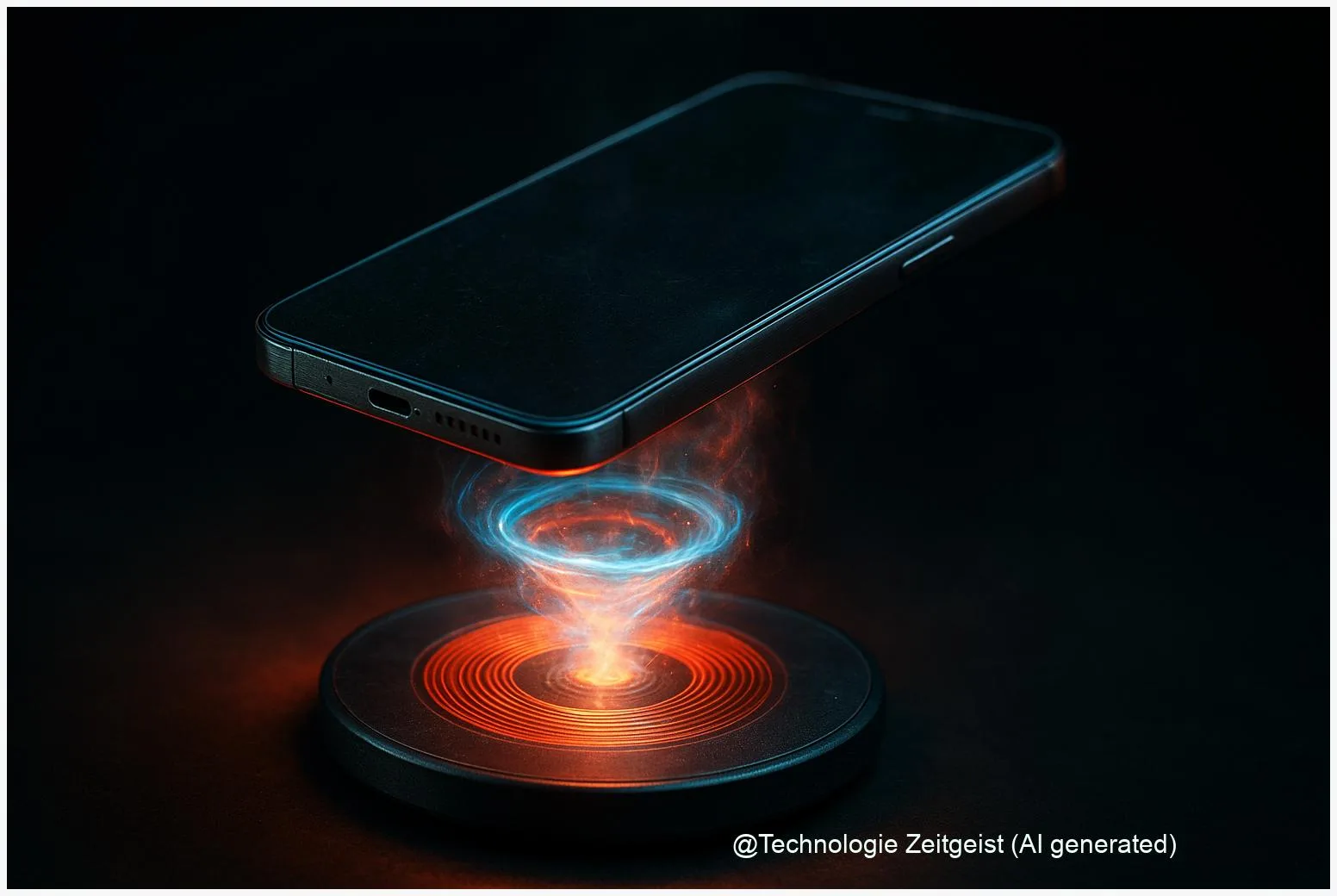
Fast wireless charging removes the need to plug a cable into your device, but it also changes how energy moves and how efficient charging can be. This article looks at the physics and the standards behind fast wireless charging, explains why a 15 W wireless pad can deliver noticeably less battery energy than a wired charger, and offers practical guidance for choosing chargers and reducing heat and energy loss.
Introduction
When you set a phone down on a wireless charger, most of the visible action happens at the surface: a light comes on, the screen may show a charging icon. Underneath, coils, magnetic fields and control electronics coordinate to move energy across an air gap without a metal connector. That invisible transfer is governed by simple physical limits and by design choices: coil shape, alignment, distance, shielding and the converter electronics that turn alternating magnetic coupling into steady battery current.
Fast wireless charging, now standardized up to 15 W in the Qi2 ecosystem, brings a level of convenience closer to wired fast charging. Yet real-world measurements show that the energy drawn from the wall and the energy stored in the battery can differ significantly. The difference matters for battery temperature, charging time, and the device’s electricity use over months and years.
Fast wireless charging fundamentals
Wireless charging for phones is usually inductive: a transmitter coil in the pad generates an alternating magnetic field; a receiver coil in the phone converts that field back into an electrical current. The basic physics term is inductive coupling — the more tightly the coils couple, the more efficient the transfer. Two other technical words are useful: coil‑to‑coil efficiency, which describes losses between the transmitter and receiver coils, and end‑to‑end efficiency, which measures energy from the wall socket down to the battery.
Coil placement and distance often decide how much of the transmitter’s energy actually arrives in the battery.
Standards have begun to address alignment because it is one of the biggest practical loss sources. Qi2 introduced a Magnetic Power Profile that uses magnets to help position compatible phones and pads so the coils line up reliably at the right distance. That profile specifies up to 15 W for certified devices (the Qi2 specification was published in 2023; this document is more than two years old and remains relevant for basic limits and alignment rules).
Two short facts help put efficiency into perspective: coil‑to‑coil measurements in carefully optimized lab setups can report transfer efficiencies well above 80–90 percent; system end‑to‑end numbers measured with real phones and wall power connected are often in the 50–70 percent range for wireless. The gap between those values comes from converter losses, standby electronics, thermal throttling and the inefficiencies of protecting and conditioning power for the battery.
If numbers are easier to read in a table, the most relevant factors are:
| Feature | Description | Effect on Efficiency |
|---|---|---|
| Alignment | How well transmitter and receiver coils overlap (magnets help) | High misalignment → significant loss |
| Air gap / case thickness | Distance between coils, increased by phone cases or metal | Larger gap → lower coupling and lower efficiency |
| Electronics & thermal | Converters, control chips, and heat management | Poor design or heat → reduced delivered power and throttling |
Everyday experience: phones, cases and heat
In practical terms, fast wireless charging changes the user’s relationship to the charger: instead of plugging and unplugging you place and collect. That ease comes with constraints. Tests that measure energy from the wall to the battery show that a 15 W wireless pad often transfers noticeably less usable energy than the equivalent wired fast charger. For one measured phone model, a wired charge delivered about 70 percent end‑to‑end efficiency while a branded magnetic wireless solution delivered roughly 54 percent. These are system‑level numbers: they include conversion losses in the pad, the phone’s power management, and any standby draw while the system negotiates charging.
Phone cases, credit card holders and metal attachments reduce coupling. A thick protective case may increase the air gap by several millimetres and drop charging speed or cause the pad to reject fast profiles. Heat is another visible sign: wireless charging tends to create higher surface and battery temperatures, which in turn cause devices to throttle charging power to protect the battery. Frequent high‑temperature charging can accelerate battery aging.
Not all fast wireless claims are equal. The Qi2 standard guarantees an interoperable 15 W magnetic charging profile for certified chargers and receivers, but there are proprietary solutions that advertise 30 W or 50 W wireless charging. Independent, peer‑reviewed end‑to‑end measurements for those higher mobile power classes are still scarce; manufacturers sometimes publish their own lab numbers, but those are not always measured under identical conditions.
For daily use, certified Qi2 pads with magnetic alignment reduce the most common losses: they make correct placement a one‑step action and keep the air gap consistent. That lowers the chance of repeated heat spikes and reduces wasted wall energy compared with a misaligned pad.
Opportunities and trade-offs
Removing cables changes more than convenience. For product designers and building operators, wireless charging affects power budgets, thermal design and safety checks. In public spaces, a bank of wireless chargers will draw continuous standby power unless the system can hibernate when unused. That incremental draw matters at scale: multiple pads in airports, cafes or offices multiply a per‑pad standby loss into a measurable annual electricity cost.
On the user side, advantages are straightforward: fewer connectors that wear out, less exposure of ports to moisture and dust, and a more seamless routine for quick top‑ups. For accessory makers, standardization around magnetic alignment eases ecosystem choices — cases and mounts can be designed to preserve alignment windows and thermal paths.
At the same time, there are trade‑offs. Wireless charging still converts energy several times between AC, DC, AC (in the coil), and DC for the battery; each conversion loses a portion of power. Higher advertised power levels can mask lower end‑to‑end efficiency if converters or thermal limits are weak. Safety checks are also more complex: foreign object detection (FOD) must reliably stop heating when a metal object is trapped between coils, and electromagnetic compliance needs stricter testing when more power is pushed through open coils.
Regulatory and environmental questions arise, too. If many users switch to wireless pads that are less efficient than wired chargers, total electricity consumption for charging could rise unless designs improve. That is a systems question: convenience can increase usage frequency, and small efficiency losses per charge add up across millions of devices over a year.
Where the technology is headed
Expect incremental progress rather than a single breakthrough. The Qi2 magnetic profile is a major step because reliable alignment reduces one of the largest real‑world losses. Beyond that, engineers pursue several improvements: multi‑coil transmitter pads that create a larger, evenly covered surface; better coil geometries and materials that reduce resistive losses; GaN‑based power electronics that cut conversion losses; and smarter firmware that adapts power to temperature and battery state to avoid throttling.
Higher power wireless charging for phones (25–50 W) appears in product announcements and vendor whitepapers. Those solutions aim to reduce session durations and better compete with wired fast charging, but independent end‑to‑end efficiency data for mobile 30–50 W systems remain limited. Until multiple independent labs publish comparable measurements, buyers should treat higher wattage claims with cautious interest rather than certainty.
Standards bodies and test labs are working to improve measurement protocols so that reported efficiencies are comparable. For consumers and IT managers, the practical implication is simple: choose certified products, prioritise magnetic alignment where available, and check independent reviews that report AC‑in to battery energy. For manufacturers, transparent end‑to‑end curves (efficiency versus alignment and gap) will become a competitive differentiator.
Conclusion
Fast wireless charging makes plugging in unnecessary and brings convenience closer to wired charging — but it also exposes inefficiencies that matter in daily life and at scale. Physical factors such as coil alignment, air gap and heat determine how much of the wall power ends up in the battery. Standards like Qi2 reduce alignment losses by adding magnetic attachment and a defined 15 W profile, but end‑to‑end efficiencies remain lower than typical wired charging in many real tests. The best practical choices are certified chargers with magnetic alignment, thin cases or case‑friendly designs, and attention to thermal behaviour during charging sessions.
Join the discussion: share your experience with wireless chargers and which models kept your phone cool while charging.

Leave a Reply