
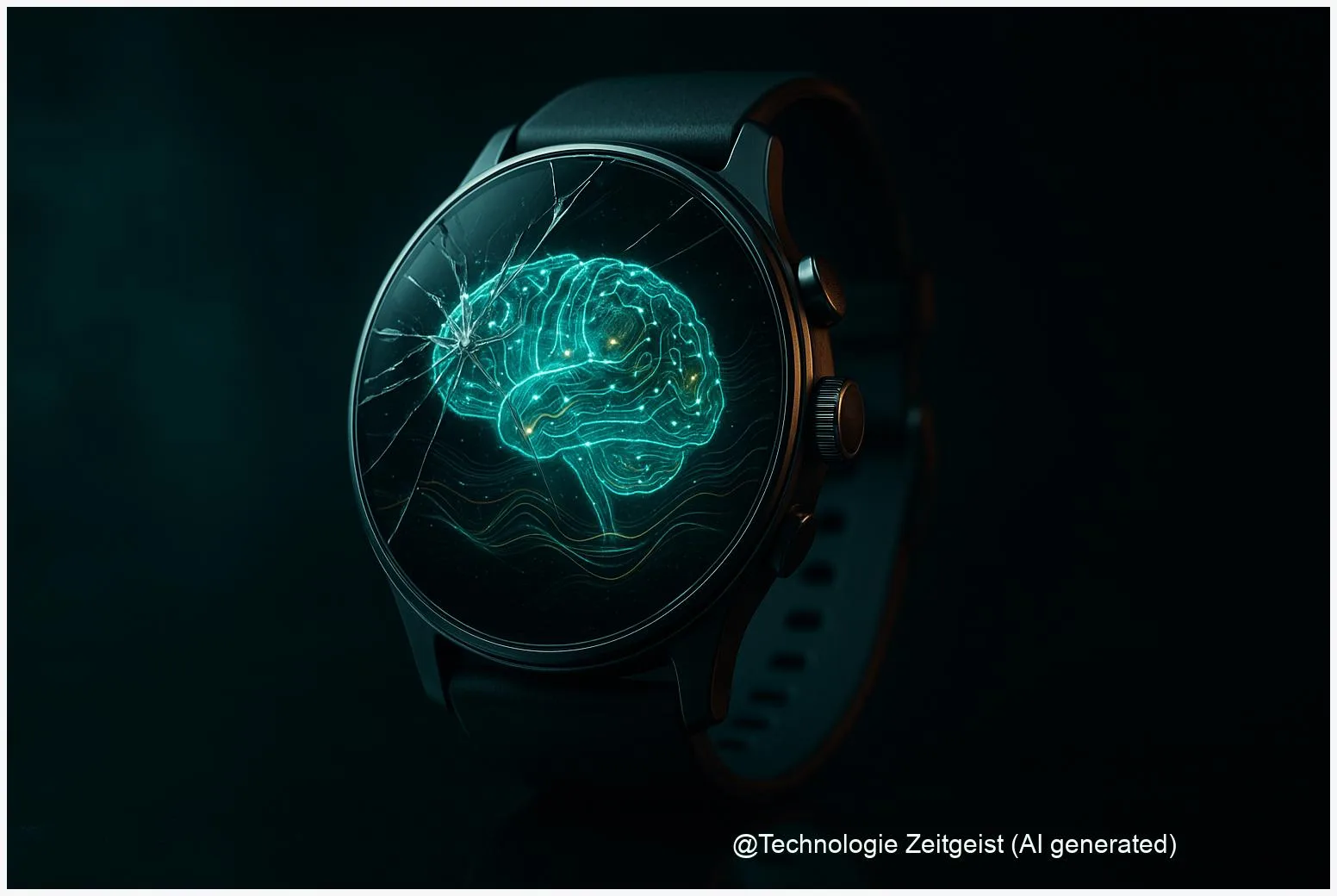
Smartwatches and other wearables are beginning to contribute useful signals for dementia detection by tracking movement, typing and sleep patterns. Passive measures such as gait speed variability, keystroke timing and sleep fragmentation can signal early changes long before daily life is obviously affected. This article summarizes how these digital markers work, what evidence exists in 2025, and what the limits are for real-world use.
Introduction
Many people worry about memory lapses and slower thinking with age, and clinicians use tests to look for mild cognitive impairment. Consumer wearables now collect continuous streams of movement, heart-rate and usage data that can reflect subtle changes in behaviour. For example, walking patterns measured by a wrist sensor can show slower pace or more variable steps; passive typing on a phone can reveal longer pauses between keystrokes; night-time restlessness appears in sleep summaries.
These signals do not diagnose a disease by themselves. Instead, they create “digital biomarkers” — consistent measurements captured over days or months that can flag change earlier than occasional clinic visits. The central question is which signals are reliable enough, broadly validated, and respectful of privacy to be useful for people and clinicians. The next sections explain the fundamentals, everyday examples, the main tensions, and what to expect in the coming years.
Dementia detection: How wearables sense early signs
Wearables capture time‑stamped measurements: acceleration from motion sensors, gyroscope rotations, touch events on screens, and physiological signals such as heart rate. Researchers transform these raw streams into features that reflect behaviour: average walking speed, variability of step timing, duration of pauses while typing, or number of night awakenings. Changes in those features over weeks to months are more informative than one single reading.
Small, repeated differences in everyday behaviour can accumulate into a clear pattern when observed continuously.
Studies in 2023–2025 show consistent categories of digital markers with meaningful discriminatory power for cognitive decline. Laboratory gait tests and passive daily gait measures both indicate that reduced speed and greater variability often appear in people with mild cognitive impairment. Keystroke timing on smartphones has produced surprisingly strong differences in some clinical samples, while sleep fragmentation measured by wrist actigraphy is a robust group-level marker.
If numbers help, the short table below summarizes typical digital biomarker categories and approximate performance ranges reported in peer-reviewed studies. These are group-level findings; individual predictions require careful validation.
| Biomarker | Description | Typical reported performance |
|---|---|---|
| Gait (wrist/IMU) | Pace, stride variability, dual‑task cost | AUC often ~0.75–0.90 in studies |
| Keystroke dynamics | Hold/flight time between key events on phones | Some studies report AUCs up to ~0.99 (small samples) |
| Sleep/actigraphy | Sleep fragmentation, circadian regularity | Group differences reported across many studies |
Everyday measures a smartwatch can collect
Smartwatches are practical because people wear them for many hours. Typical sensors and the behavioural signals they enable include:
– Accelerometer and gyroscope: these detect walking and posture. From them, algorithms extract step counts, walking speed, and variability between steps. When combined with a simple cognitive task (dual‑task walking), small attention lapses become measurable as extra variability or slower pace.
– Touch and typing logs (on paired smartphone): passive timing of key presses and pauses can indicate slower motor planning and execution. Researchers measure “hold time” (how long a key is held) and “flight time” (pause between keys). In controlled studies these metrics often correlate with cognitive screening scores.
– Heart rate and sleep estimates: long-term trends in nocturnal restlessness, fragmented sleep, and altered day–night activity rhythms appear more often in people who later develop dementia. These changes do not identify a cause but add context to other markers.
– Voice and short speech samples (where consented): subtle changes in phrasing, hesitations, and reduced variability in pitch have shown associations with early cognitive decline in research settings.
Importantly, all these measures are probabilistic. A watch reporting a change is a prompt to evaluate further — it is not a diagnosis. Quality depends on device placement, how long it is worn, and algorithms trained on diverse populations. Many studies that report strong accuracy do so on limited samples or internal validations; broader replication is still needed before clinical use becomes standard.
Opportunities, limits and ethical trade-offs
Wearable signals offer clear advantages: continuous observation, low marginal cost, and the possibility of catching trends earlier than occasional clinic visits. For health systems, early flagging could mean earlier testing, lifestyle interventions, or planning. For individuals, a non‑invasive monitor may provide reassurance or an early nudge to seek professional assessment.
However, there are important limitations and tensions. First, many high‑performing results come from small studies or internal model validation; external, multi-centre replication is less common. That raises the risk of overestimating how well a model generalises across ages, device models, countries and daily habits.
Second, false alarms are a practical concern. A device that flags decline too often can increase anxiety, unnecessary clinic visits, and healthcare costs. Conversely, missing true decline would delay care. Any practical tool must balance sensitivity and specificity and be transparent about uncertainty.
Third, privacy and consent matter especially for continuous, potentially sensitive signals like typing or speech. Good practice includes local processing where possible (so raw data does not leave the device), clear consent options, and the ability to pause or delete data. Regulatory pathways for software‑as‑a‑medical‑device require external validation and clear clinical benefit.
Lastly, equity issues appear when devices or models are trained on narrow populations. Algorithms that work well in one region or age group may perform worse elsewhere, potentially amplifying health disparities. Researchers now emphasise diverse cohorts, device‑agnostic features and pre-registered study designs to reduce such risks.
Where research and products are heading
Research in 2023–2025 increasingly points to multimodal approaches: combining gait, typing, sleep and voice features gives more stable predictions than any single signal. Large, prospective cohorts with external validation are emerging but still comparatively rare. Many experts call for coordinated standards so that sampling rates, sensor placement and feature definitions are comparable across studies.
On the product side, a few pilot projects have shown that consumer smartwatches can be used for longitudinal monitoring with good adherence. Still, clinical adoption requires clear evidence that early detection through wearables improves meaningful outcomes — for example, by enabling interventions that slow decline or improve quality of life.
For people interested now: choose devices with transparent privacy policies, prefer options that process sensitive signals locally when possible, and discuss any concerning flags with a clinician rather than acting alone. For researchers and clinicians, priorities are larger, diverse cohorts, reproducible pipelines, and early involvement of regulators and ethicists.
Progress will be incremental. In some areas such as keystroke dynamics, single studies report very high accuracy but need replication at scale. Gait and sleep markers are better replicated across studies, making them strong candidates for early integration into clinical research. Expect steady improvement in algorithms, but also growing emphasis on explainability and fairness.
Conclusion
Smartwatches and related wearables can collect meaningful signals that contribute to dementia detection, but they are not standalone diagnostic tools. Current evidence in 2025 shows promising digital biomarkers—particularly gait, keystroke timing and sleep patterns—that often correlate with clinical tests. Stronger evidence requires larger, diverse, prospective studies and independent validation of algorithms. Privacy, clarity about uncertainty, and equitable design are as important as raw accuracy. Treated responsibly, wearable monitoring can become a useful part of earlier detection and ongoing care planning.
If you found this article helpful, share your experiences or questions about wearable health monitoring and cognitive screening.


Leave a Reply