
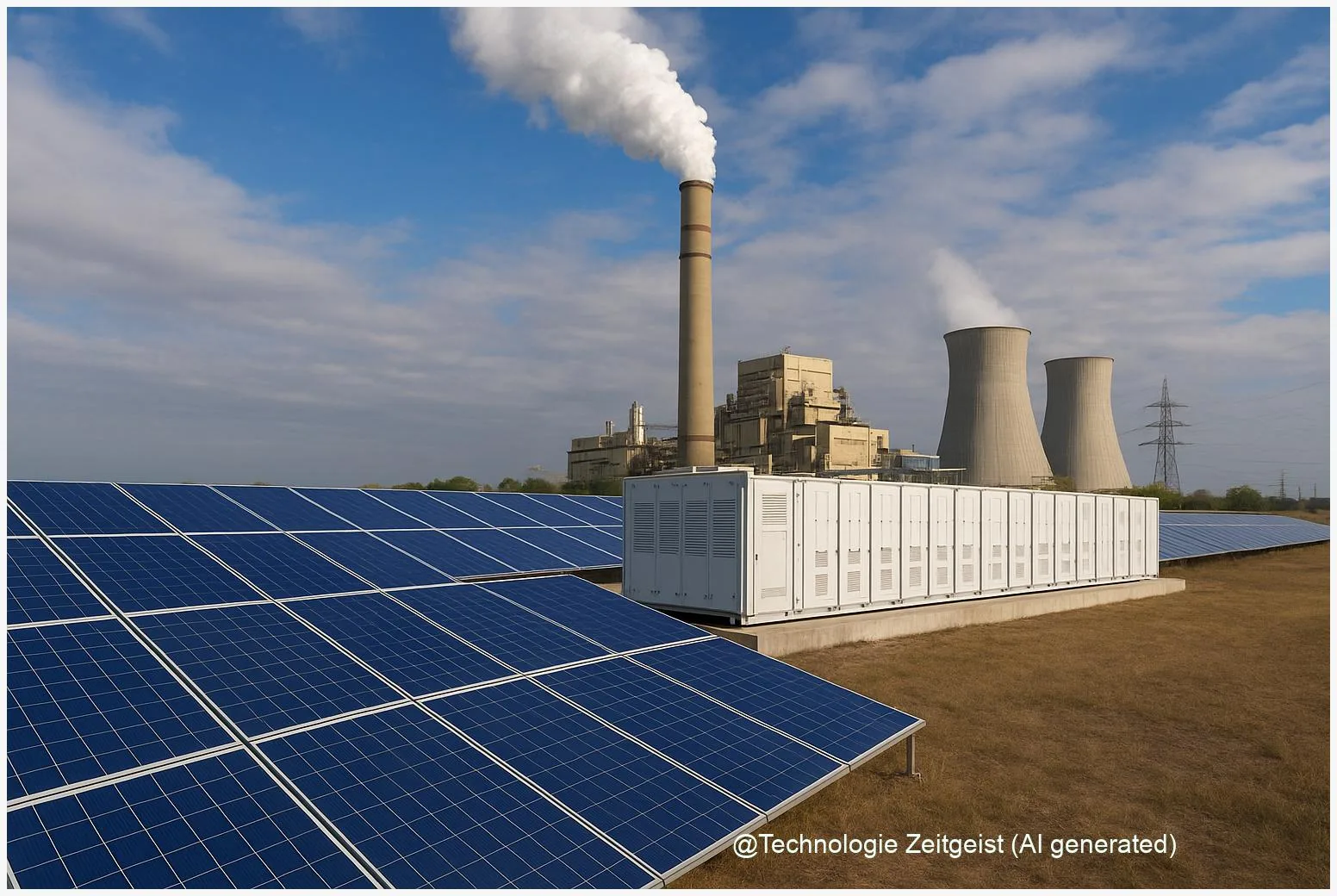
A utility-scale solar plus storage plant can substitute many services that coal and natural gas plants provide, but “utility-scale solar plus storage” does not automatically equal full replacement. The technical capacity value of solar paired with batteries depends on storage duration, when the sun shines, and how operators dispatch the system. Across regional studies, 4‑hour batteries often cover daily peaks while longer durations or additional measures are needed for multi-day or seasonal reliability.
Introduction
Fossil plants are valued not only for the energy they produce but for the firm capacity and flexibility they reliably supply at night, during cold snaps, or when weather reduces renewables. Replacing that with a single, massive installation that combines solar panels and grid-scale batteries is attractive on paper: solar provides cheap daytime energy and batteries shift some of that energy into the evening. But whether a large solar-plus-storage installation can stand in for coal or natural gas depends on several measurable things: how long the batteries can discharge continuously, how often long low-solar periods occur, and how the system is managed.
Technical studies from agencies and system planners show a consistent pattern: short-duration batteries (around 4 h) do a good job handling daily peaks; longer-duration storage raises the share of firm capacity that can be replaced. Economics, grid rules and extreme weather years change the picture further. This article looks at the technical logic, concrete sizing examples, systemic tensions and plausible next steps for planners and citizens.
How solar plus storage delivers power when the grid needs it
Two concepts matter first: energy and capacity. Energy is the electricity delivered over time (measured in MWh); capacity is the instantaneous ability to deliver power (kW or MW). Coal and gas plants score highly on both when fuel is available: they can run many hours and meet peak demand. Solar generates strongly during daylight hours but not at night. Adding battery storage converts some solar energy into capacity at later hours.
Planners use Effective Load Carrying Capability (ELCC) to translate a resource into a capacity contribution toward system reliability. ELCC asks: how much additional load could the system serve because we added that resource while keeping the probability of supply shortfall the same? ELCC is not fixed; it changes with storage duration, regional demand profiles and the existing mix of generators.
ELCC shows that the same battery looks very different in a sunny, daytime‑peaking grid than in a winter‑evening‑peaking grid.
Several authoritative studies provide practical ranges. National and regional analyses find that 4‑hour lithium‑ion battery systems typically capture a large portion of daily peak needs but leave exposure to multi‑day low‑solar periods. Longer durations—8 h or more—raise the capacity value, sometimes substantially. The ranges below are indicative across multiple studies and depend on assumptions about dispatch, weather and how extreme years are treated.
| Storage duration | Typical role | Representative ELCC range |
|---|---|---|
| 4 hours | Daily peak shifting, evening ramps | ~65–85 % |
| 8–12 hours | Longer evening coverage, multi‑day resilience | ~80–95 % |
| >24 hours | Seasonal bridging or long calm/sunless periods | Varies widely; model‑specific |
Sources behind these ranges include system studies by the US National Renewable Energy Laboratory (NREL), regional regulator reports and independent studies such as those by The Brattle Group. NREL describes typical reference systems using 4‑hour batteries as a baseline and emphasises that ELCC varies by region and operational rules. Some CPUC and TSO reports show similar percent ranges for incremental capacity value. Note: some detailed studies referenced here are from 2023 and are therefore more than two years old; they remain useful for method and range but must be updated for a specific grid and year.
Sizing and examples: what a plant actually looks like
Turning theory into numbers requires choosing a target to replace: peak capacity (MW), annual energy (MWh), or firm capacity for reliability planning. Consider three simplified examples, using round numbers that mirror recent project proposals and public studies.
Example A — Replace a 300 MW gas peaker that typically runs 4 h per event: a direct option is 300 MW of batteries with 4 h duration, i.e. 1,200 MWh of storage, paired with 300–400 MW of solar to recharge during the day. This matches the peaker’s instantaneous power and its typical energy use for short events.
Example B — Replace a 500 MW coal unit used as baseload: coal often runs many hours, so matching annual energy would require much more storage — potentially multiple GWh — or alternative seasonal solutions. A hybrid approach uses solar+4–8 h batteries to cover daily needs and retains a smaller dispatchable plant or additional long‑duration storage for rare long events.
Example C — Grid planning target: if a utility needs 1 GW of capacity at evening peak, studies indicate a portfolio with 700–900 MW equivalent of firm capacity from solar+storage might be feasible if storage durations include several 8–12 h assets and if the system permits some managed demand flexibility. Exact numbers are site‑specific and require ELCC analysis with local load and weather data.
Costs and lifecycle matter too. NREL and market reports show that the common reference in recent years is a DC‑coupled solar array combined with 4‑hour batteries for utility projects, because that delivers favorable capital cost per MWh today. For longer durations, cost per MWh rises; however, longer duration yields higher capacity credit and may be more economical than keeping older thermal plants running in some grids.
Opportunities and limits: where gaps remain
Solar-plus-storage removes several roles of conventional plants: it shifts solar energy into higher‑value hours, reduces fuel dependence, and can respond quickly to changing demand. But three structural limits remain.
First, duration and extremes. Short-duration batteries handle daily cycles well; they struggle with multi‑day low‑sun events or prolonged cold periods. Studies that ignore extreme weather years can overstate how much firm capacity a portfolio provides. Regulators increasingly ask planners to include stressed years in ELCC calculations to avoid underestimating needed capacity.
Second, charging availability. Batteries paired with solar depend on daytime generation to recharge. If many resources must be charged from the grid during stressed times, the apparent benefit is reduced and the system may still need dispatchable backup. Some planners model a mix of solar charging and limited grid charging to improve reliability, but that changes economics.
Third, market and operational rules. Capacity markets, procurement rules and reserve definitions were often written around thermal plants. Adapting market rules to value the specific services of batteries — fast response, frequency control, and varying durations — is necessary to make replacement practical. Transmission constraints also limit how much a single large plant can help across a region; local bottlenecks can require more distributed solutions.
Finally, lifecycle and replacement costs. Batteries degrade with cycles and calendar age; many cost models now include a mid‑life module replacement or partial refurbishment. Those assumptions change the long‑term economics compared with fuel‑based plants, where fuel markets and plant life have different cost structures.
Where policy and markets matter next
Decisions that determine whether solar-plus-storage can replace fossil plants are rarely purely technical. Regulators, system operators and procurement agencies set the tests for reliability and payment. Three practical policy directions are emerging from recent research and regulatory practice.
1) Use ELCC and scenarios rather than single-number substitutions. Authorities increasingly require incremental ELCC studies across multiple storage durations (2, 4, 8, 12+ h) and stressed weather years. That provides a surface of capacity values instead of a single conversion factor.
2) Value duration and flexibility explicitly. Capacity payments and procurement rules should reflect that an 8‑hour plant provides more reliability than a 4‑hour plant in some systems. Contracts that allow updates as technology costs and operational experience evolve can reduce risk for both utilities and developers.
3) Combine solutions: grid upgrades, demand flexibility and diversified storage portfolios. Transmission investment reduces the need for local firm capacity; managed demand and sector coupling (for example, using flexible industrial loads or heat storage) can replace some functions of thermal plants at lower cost than very large batteries alone.
In short, replacing coal or gas with a single massive solar-plus-storage plant is feasible for some roles — especially peaking and many evening peak needs — but full replacement of all services requires a portfolio of technologies and policy changes. Analysts recommend pilots and phased procurement to learn what works locally before retiring large conventional units.
Conclusion
Utility-scale solar plus storage can replace significant parts of what coal and natural gas plants provide, notably daily peak capacity and fast response. Short-duration batteries, typically 4 h, are efficient at shifting daytime solar into the evening. To supply firm capacity equivalent to large baseload plants or to cover rare multi‑day low‑renewable stretches, grids need longer-duration storage, grid reinforcements, or retained dispatchable backup. Planners should use ELCC‑based capacity accounting with stressed weather years, model a mix of storage durations, and update procurement rules to reflect how batteries actually perform in operations. In many regions, a pragmatic path is phased substitution: acquire solar-plus-storage where it clearly reduces fuel use and costs, while keeping controlled reliability margins until the full portfolio is proven in operation.
Share your views or local examples below — practical experience helps shape better planning.



Leave a Reply