
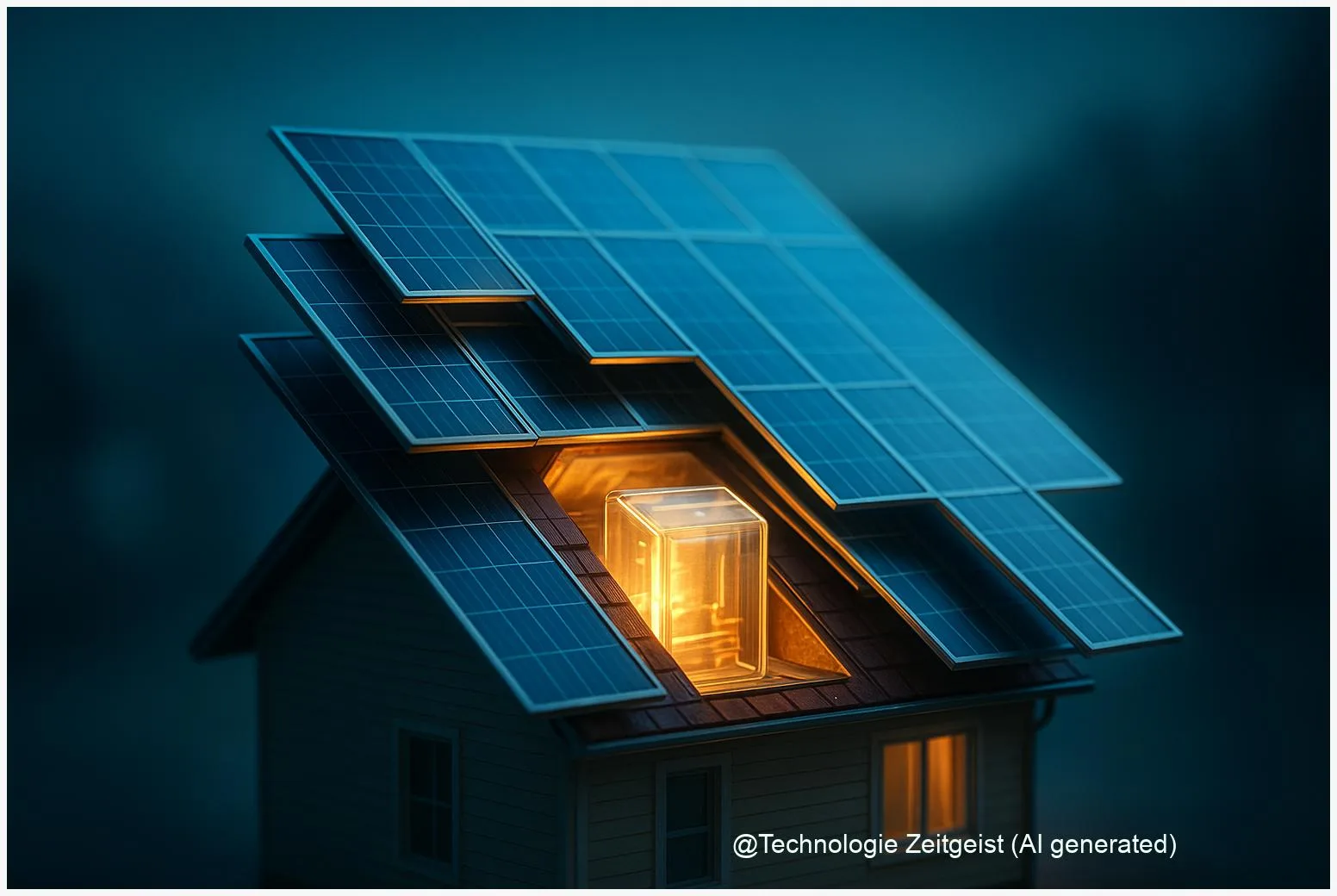
Rooftop solar is growing in size on ordinary houses because households now use more electricity at home and panels and batteries cost less. Installing a larger system raises the share of self‑consumed power, supports home EV charging and heat pumps, and often pays back faster than smaller arrays. This article looks at the economic and technical reasons behind larger home systems and what homeowners and local planners should expect.
Introduction
Homeowners planning solar used to ask only how many panels fit on a roof. Today the question more often is: how large should the array be to cover my electric car, a heat pump and everyday household use? A typical family that adds an EV and a heat pump will roughly double annual electricity demand. At the same time, module prices and battery costs have fallen enough that adding extra capacity is economically sensible in many places.
The result is a clear shift: systems sized to match daytime consumption are now complemented by larger arrays intended to increase self‑consumption, charge EVs at home, and fill batteries for evening use. That change affects installation practices, permitting, and how distribution networks plan for decentralised generation.
Why rooftop solar systems are growing
The core drivers behind larger home systems are economic and behavioural. First, the price of modules and inverter equipment has declined substantially over recent years, reducing the incremental cost per watt. Second, electrification of transport and heating raises household electricity demand, so the optimal system size grows too. Third, falling battery costs make pairing larger PV arrays with storage attractive: the marginal cost of producing extra kWh on the roof is often lower than buying it from the grid at retail prices.
Larger arrays make sense when they increase the share of self‑generated power used directly at home, rather than exported at low rates.
Other technical changes also matter. New module formats and higher efficiencies mean more watts per square metre, allowing bigger nominal capacities on the same roof area. Bifacial modules and improved cell technologies boost energy yields, so a 6 kW nominal system today can produce noticeably more than a similarly rated system from a few years ago.
If numbers help, a compact table compares common household needs and typical system sizes.
| Feature | Description | Typical value |
|---|---|---|
| Average pre‑EV household | Electricity mainly for appliances and lighting | 3–5 kW system |
| Household with EV & heat pump | Higher annual kWh need; benefits from more daytime and evening generation | 6–12 kW system |
How larger systems work in everyday homes
For many homeowners, the attraction of a larger system is simple: more of the electricity you use comes from your roof instead of the grid. During sunny hours a bigger array can supply household appliances, run a heat pump, and charge an EV simultaneously. Excess midday production can charge a home battery, which then supplies power in the evening when solar output stops.
Consider a household that consumes about 4,000 kWh per year before electrifying transport. Adding an EV might raise that to 7,000–9,000 kWh a year, depending on driving habits. Installing a larger rooftop array — for example moving from 4 kW to 8 kW — can double the rooftop generation and substantially increase the fraction of the home’s electricity demand met by local solar.
Two practical points matter when sizing a system. First, roof area and orientation limit how many modules can be installed; modern, higher‑efficiency panels help fit more capacity. Second, grid rules and local feed‑in tariffs influence the economics: where exported excess is paid at very low rates, households often prefer to oversize PV plus add storage to increase self‑consumption.
Installation and wiring also change: bigger systems sometimes need stronger inverters, upgraded connection hardware, or coordinated approval from the distribution system operator. Good installers will model yearly production and household load profiles to find the size that balances cost, roof constraints, and future electrification plans.
Opportunities and trade-offs
Bigger rooftop systems bring clear benefits: lower long‑term electricity bills, reduced exposure to retail price increases, and the convenience of home EV charging. They can also improve local resilience during short grid outages if paired with batteries. On a community level, higher residential generation can reduce demand peaks on the transmission system.
Still, trade‑offs exist. Large oversizing without storage can create midday exports that offer little financial return where feed‑in payments are low. At a grid level, rapid, concentrated growth of rooftop generation can create local voltage or congestion issues if distribution networks are not upgraded or managed with smart inverters and demand flexibility.
Environmental considerations matter too. While manufacturing emissions per panel have fallen, more capacity means more materials and, eventually, more end‑of‑life modules to recycle. Policy that encourages module recycling and longer lifetimes helps keep larger deployments sustainable.
Finally, equity and access are concerns: homeowners with suitable roofs can benefit earlier, while tenants or flats may have limited options. Community solar schemes and better leasing or financing models can broaden access and avoid deepening an inequality in who captures the benefits of decentralised generation.
What the near future will bring
Looking ahead, three developments are likely to shape rooftop solar sizes. First, continued module efficiency gains and lower costs make larger arrays more cost‑effective per produced kWh. Second, falling battery prices enable more households to combine significant PV capacity with storage, smoothing daily supply and increasing evening self‑consumption. Third, changes in tariffs and grid services — for example time‑varying prices or payments for local flexibility — will alter the optimal economic size.
For planners and homeowners this implies a different set of priorities. Regulators will need clearer rules for connection and for exporting energy, and grid operators will design incentives for batteries and smart charging to stabilise networks. Installers and finance providers will increasingly offer bundled PV+battery+charger packages that factor in future demand for EV charging.
At a practical level, households planning installations should think beyond the next year: factor in likely EV adoption and whether a heat pump might follow. In many cases, modest oversizing now avoids costly upgrades later and increases the value of on‑site storage. Where roof space is limited, choosing higher‑efficiency modules or combining rooftop PV with small ground‑mounted arrays can achieve higher capacities.
Conclusion
Falling equipment costs, higher home electricity needs from EVs and heat pumps, and improving batteries explain why rooftop solar systems for ordinary houses are getting bigger. The change is not only technical: it affects household finances, grid planning and recycling strategies. For a homeowner, the right move balances roof constraints, likely future electricity use, and local rules on export and storage. For communities and regulators, the task is to enable larger, well‑managed deployments that remain economically and environmentally sensible.
Join the conversation: share your experience with home solar sizing and local bottlenecks, or post a question to continue the discussion.



Leave a Reply