
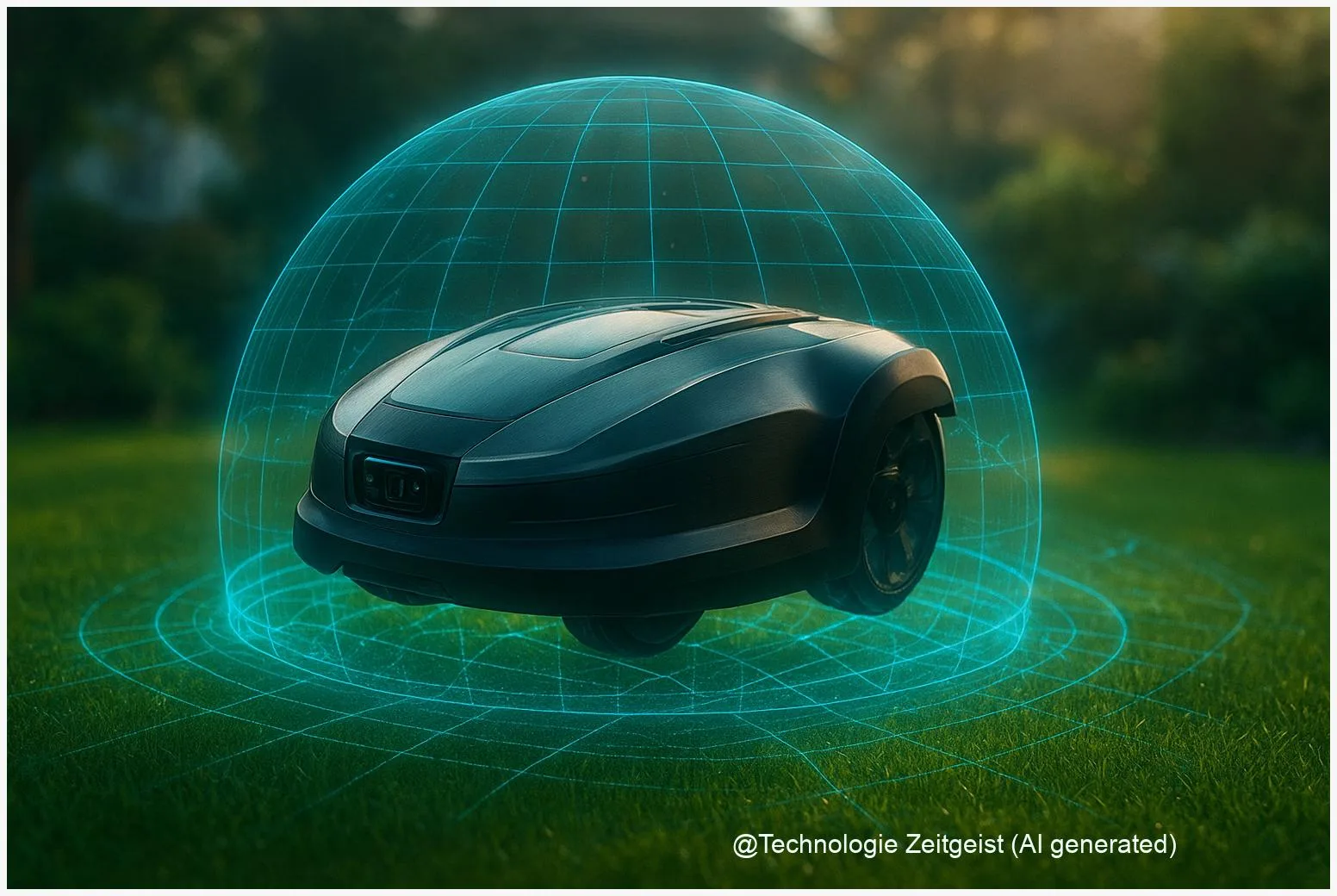
Drop-and-mow systems remove the need for buried wires and let a robot learn a garden’s shape using satellites, cameras or LiDAR. Robotic lawn mowers that use these methods can create virtual boundaries, cut autonomously and return to base without physical perimeter cables. This article clarifies how drop-and-mow mapping works, what it means for everyday gardens, and where the technology is robust or still limited.
Introduction
If you have a lawn and an hour of free time each weekend, you know the appeal of a mower that runs by itself. Removing the buried boundary wire changes more than convenience: it changes how these machines find their place. Drop-and-mow refers to devices that are placed in a garden and then map it without requiring a physical perimeter cable. Several technical approaches make this possible: precise satellite positioning with RTK corrections, vision and LiDAR-based mapping often called SLAM, or a fusion of those sensors. Each approach has clear strengths and clear limits for real yards—especially where trees, hedges or garden structures interfere with signals or sightlines.
How drop-and-mow mapping works
Most drop-and-mow systems use one of three navigation strategies, or a combination of them. RTK (real-time kinematic) is a satellite-based method that applies correction signals so a GPS receiver can report its position with centimetre-level accuracy. In practice, RTK needs either an internet correction service or a local reference station to reach that precision. SLAM stands for simultaneous localization and mapping; here the mower builds a map as it moves using cameras or LiDAR (a laser distance sensor). Sensor fusion combines RTK for an absolute position and SLAM for local detail and resilience when satellite signals are weak.
RTK gives a stable absolute position; SLAM fills gaps where satellites fail.
Each method has trade-offs. RTK is strong in open lawns and—when paired with a local reference station—can approach manufacturer claims of around 2 cm accuracy. That accuracy depends on a clear sky view and correct setup. SLAM works where satellites do not, for example under trees or close to buildings, but it needs visual or geometric features to latch on to; a homogenous, featureless lawn can cause gradual drift. Combining both reduces single-mode failure and is the current practical best practice.
If numbers help, manufacturers currently quote figures like “down to approximately 2 cm” for RTK-based virtual-boundary systems on certain models, and examples of capable machines list service areas of several thousand square metres. Independent, reproducible field tests are still sparse, which means user experience and local validation remain important when a precise boundary is required.
If a quick comparison makes clarity easier, this simple table summarizes common setups:
| Feature | Description | Typical value |
|---|---|---|
| RTK (satellite) | High-precision GNSS with correction signals | ≈2 cm (manufacturer claim) |
| SLAM (vision/LiDAR) | Builds map from camera or LiDAR data | Variable; robust in feature-rich yards |
| Sensor fusion | Combines absolute and local positioning | Most resilient in mixed conditions |
Robotic lawn mowers in everyday gardens
For a typical garden, drop-and-mow systems promise easier setup and more flexible zone management. Instead of laying a buried wire around flowerbeds and ponds, you use a phone app or a short calibration routine. In larger or irregular yards, RTK-based systems can define accurate virtual boundaries so the mower follows a planned area without repeated manual adjustment. In shaded or obstacle-rich yards, camera or LiDAR-based SLAM helps the mower avoid trees, furniture and dog toys.
Practical examples help illustrate differences. A suburban lawn with open sightlines and few trees is an ideal environment for RTK-only operation: the mower quickly acquires correction data and maps reliably. A garden with dense hedges and a gazebo benefits from a fusion approach; RTK provides a global reference, while SLAM keeps the robot aware of local obstacles. Some contemporary models advertise service areas of about 5,000 m² and run times of an hour or more per charge; real-world performance depends on grass density, slope and how often the mower must avoid obstacles.
Users should pay attention to three practical details. First, installers may recommend a local reference station for improved RTK stability in critical areas. Second, visual sensors require maintenance: dirty lenses or muddy LiDAR faces reduce mapping quality. Third, software updates matter; manufacturers continually refine mapping and fusion algorithms, so a mower’s behavior can improve over time without hardware changes.
Practical use: examples and maintenance
Everyday operation is where strengths and weaknesses become visible. In routine use, the robot maps a garden during initial runs and then follows that map. In RTK-enabled machines, the mapping session often includes a calibration where the system receives correction signals via mobile data or a local station. For SLAM systems, the first passes record visual landmarks—patio edges, trees, fences—that the mower later recognises.
Maintenance affects long-term reliability. Clean sensors are essential: wipe the camera lens and LiDAR window periodically and remove grass buildup from wheels and odometry sensors. For RTK systems, check that the reference connection (cloud or local base) is functioning and that firmware is up to date. Many failures reported in field notes concern simple issues: blocked sensors, low battery health, or obstructed charging stations.
Safety and fallback behaviour are also important. Good systems detect when positioning confidence falls below a threshold and then either revert to a safe boundary routine (for example, move back to a known docking location) or stop until human intervention. Users should review the mower’s settings for lift/tilt shutoffs, perimeter fallback options and alarm features. When buying, prioritise brands that publish clear guidance on failure modes and that offer accessible support.
Opportunities, risks and likely next steps
Drop-and-mow removes an installation obstacle and can widen adoption, especially for renters or owners who dislike digging in their lawns. For professional landscaping and municipal use, the ability to reassign virtual areas quickly can save time and reduce recurring labour. Sensor fusion and improving edge compute mean machines will become better at handling mixed conditions.
Risks remain. Satellite-based accuracy degrades near tall trees and buildings; SLAM struggles in monotonous or visually changing scenes (for example, when seasonal plants lose leaves). Both systems depend on a reliable software and service ecosystem: cloud corrections, firmware updates and support channels. Newer market entrants may offer attractive prices but variable long-term support; that affects maintenance and security updates.
For the technology to mature, independent field benchmarking is necessary. Tests should measure positioning error, area coverage, energy use and failure rates across scenarios such as open lawns, dense trees, slopes and narrow passages. From a consumer perspective, buyers should ask sellers for documented field data, service terms and update policies rather than relying solely on marketing claims. Hybrid RTK+SLAM systems are the pragmatic path forward: they combine absolute position with local mapping, reducing single-mode failures and improving reliability across more garden types.
Conclusion
Drop-and-mow mapping changes the user experience of lawn care by replacing buried wires with software-defined boundaries. Where open sightlines exist, RTK can deliver near-centimetre precision; where satellites fail, SLAM and LiDAR provide local awareness. Combining these systems reduces the chance of a complete failure and makes autonomous mowing practical for more gardens. Buyers should weigh local conditions, maintenance needs and the vendor’s update and support policies. A modest amount of validation—such as a short trial run and a look at failure-mode documentation—will often reveal whether a given model fits your yard.
Share your experiences with drop-and-mow systems or ask a question to help others choose—comments and social posts welcome.

Leave a Reply