
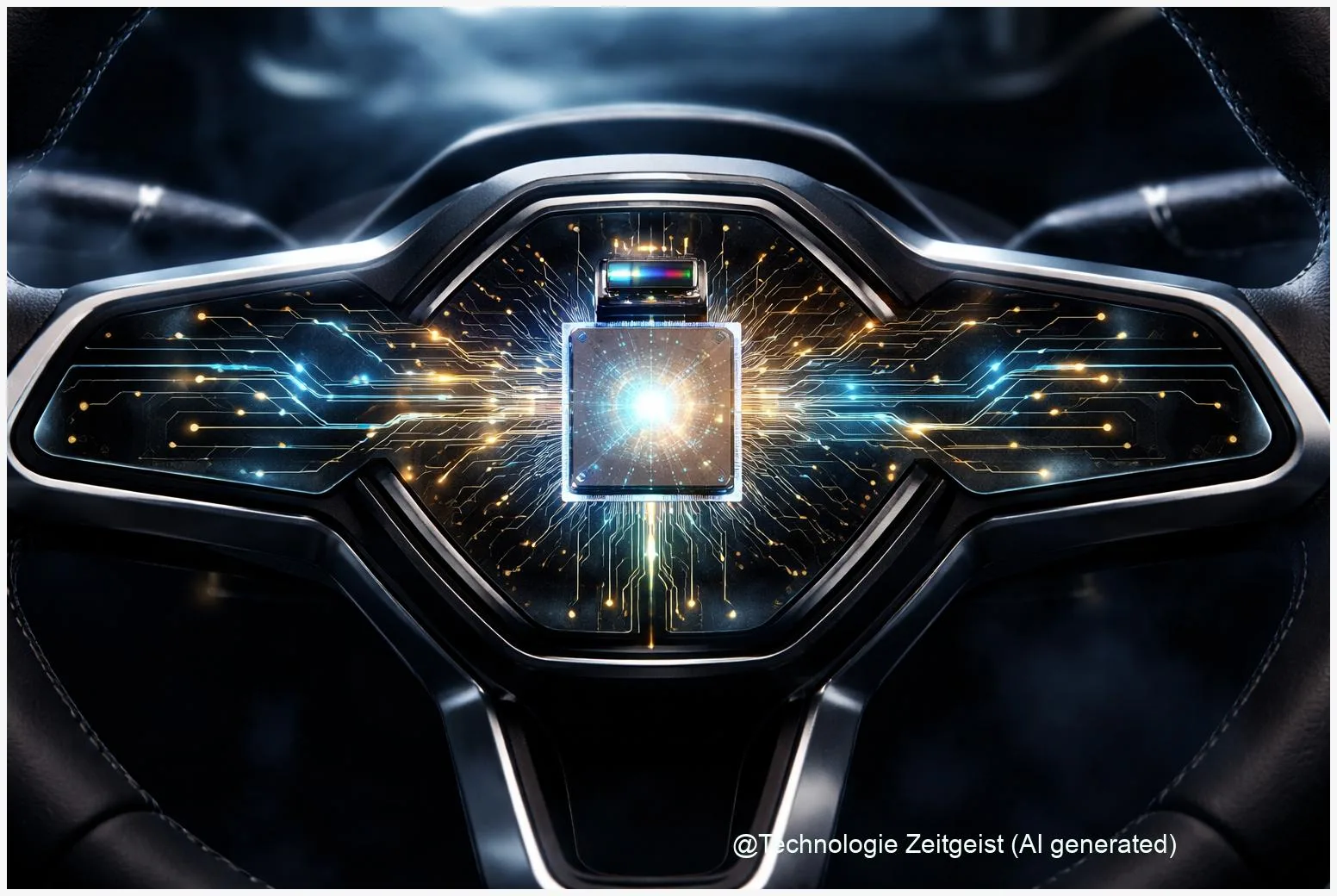
Physical AI is about software that senses, decides and physically acts in the world; in cars this means on‑board systems that tie perception, planning and control together. For drivers and manufacturers the change is practical: functions once limited to warning or logging can now intervene, adapt and be updated over the air. The term Physical AI appears in research and industry reports from 2024–2025 and signals a shift beyond traditional autopilot features toward tightly integrated, safety‑focused on‑vehicle intelligence.
Introduction
Many modern cars already use software to assist steering, braking and lane keeping. Those systems mostly sense the environment, make narrow decisions and ask the human driver to act when limits are reached. Physical AI takes the next step: it closes the loop so the vehicle itself senses, reasons about options and executes physical actions while maintaining safety evidence. That change matters because it shifts where the intelligence runs (on the vehicle instead of in the cloud), how manufacturers validate behaviour, and how drivers experience control.
Two practical consequences are visible today. First, more processing moves to specialized chips inside the car — neural processing units (NPUs), which are chips optimized for running machine learning models on the edge. Second, simulation and so‑called sim‑to‑real validation become core to showing a system behaves reliably in the physical world. Regulatory bodies and standards, notably ISO 21448 (SOTIF), already require documented validation strategies; recent UNECE discussions (2024) also consider virtual testing as part of approval evidence.
What is Physical AI in cars?
Physical AI describes systems that combine sensing, decision‑making and direct physical effect. In automotive terms that means perception (cameras, radar, lidar and their software), planning (deciding a trajectory or an avoidance manoeuvre) and control (sending commands to steering, brakes and throttle). The focus is on closed‑loop behaviour that must operate reliably in the messy, variable conditions of real traffic.
The defining difference is action: Physical AI does more than infer or predict, it issues and executes commands that change the physical state of the vehicle.
Key pieces that make Physical AI practical are: on‑board compute optimized for machine learning (NPUs), digital twins and high‑fidelity simulation used during development, and operational monitoring once a function is live. “Sim‑to‑real” is the term engineers use for training and testing in simulation and then checking whether the results hold in the real world; it remains a technical challenge because sensors and environments differ between simulation and reality.
If the list format is clearer, the table below summarizes core components and their role.
| Feature | Description | Role |
|---|---|---|
| Perception | Sensor fusion of camera, radar, lidar and ultrasonic signals | Detect objects, lane geometry and road features |
| Planning & Decision | Algorithms that select trajectories and responses under constraints | Choose safe, comfortable actions in complex scenes |
| Control & Actuation | Low‑level commands to brakes, steering and torque management | Execute decisions with timing and redundancy for safety |
These components must be validated end‑to‑end. Standards such as ISO 21448 (SOTIF) provide a framework for addressing risks that arise from intended functionality, but ISO 21448 is from 2019 and therefore older than two years; it remains a central reference for safety arguments. Recent industry reports (2024–2025) use the “Physical AI” label to highlight how these pieces are being combined in practice.
How Physical AI changes car systems
At human scale the change is subtle but meaningful: drivers will see systems that adjust more smoothly, intervene earlier in hazardous situations and learn from fleet data through over‑the‑air updates. Technically, three shifts matter most.
First, compute moves to the edge. Running heavy perception and planning on the vehicle reduces latency and dependency on continuous network connectivity. Edge inference means the car does the heavy lifting locally; that is essential for time‑critical actions. Some industry analyses compare cloud vs edge latency for voice tasks and find cloud round‑trip times measured in the low seconds versus edge operation in the hundreds of milliseconds; lower latency is not just convenience — it affects whether a vehicle can brake or steer in time.
Second, hardware specialization increases. NPUs and domain‑specific SoCs optimize energy use and throughput for neural networks. Those chips let manufacturers run larger, more capable models within the car’s power and thermal limits, a constraint especially relevant for electric vehicles where power budget affects range.
Third, development workflows mature. Digital twins and high‑fidelity simulators create large scenario libraries for training and validation. Engineers use the sim‑to‑real cycle to reduce risk before road tests: train models in many virtual variants, then verify behaviour in instrumented test vehicles and closed tracks. Regulators are increasingly open to virtual evidence, but they still expect hybrid validation plans that include real‑world tests.
Opportunities and risks on the road
Physical AI promises better lane keeping in poor visibility, adaptive responses to complex traffic and smoother driver assistance that reduces fatigue. For fleets, the ability to push verified model updates over the air means continuous improvement without costly recalls. For city planners and mobility operators, vehicles that act predictably can be easier to integrate into coordinated traffic systems.
At the same time, risks are clear and technical. The sim‑to‑real gap can hide edge cases where a model performs well in virtual scenarios but fails under unexpected sensor degradation or unusual lighting. Safety standards and regulators therefore insist on traceable validation — documented scenario coverage, auditable test results and field monitoring after deployment.
Operational monitoring is vital: once a Physical AI function is live, telemetry must reveal when model confidence drops or inputs differ from training distributions. That permits staged rollouts, rapid rollback and focused real‑world tests to close uncovered coverage gaps. Privacy and data governance also matter when fleets send telemetry to manufacturers; robust anonymization and purpose‑limitation are necessary to satisfy legal and public expectations.
Finally, there are non‑technical tensions. Updating vehicle behaviour over the air can outpace existing type‑approval processes; uneven regulatory approaches across regions may slow wide deployment. That is why many manufacturers work with regulators to show hybrid validation strategies that combine simulation, laboratory testing and targeted field trials.
Where the technology is headed
Over the next few years expect incremental, measurable progress rather than instant autonomy. Manufacturers will focus on well‑scoped Physical AI features — for example, low‑speed urban collision avoidance, highway lane management with supervised handover, and in‑cabin safety monitoring tied to actuation limits. These use cases are easier to bound for simulation and testing.
Chipmakers will continue delivering more efficient NPUs and SoCs, and software platforms will standardize deployment, monitoring and rollback. This reduces the cost of maintaining many vehicle variants and supports OTA‑driven improvements. At the regulatory level, UNECE work in 2024 signalled growing acceptance of virtual testing as part of approval evidence; still, virtual evidence is treated as complementary to real tests.
For drivers and fleet operators the practical advice is to look for transparent validation claims: manufacturers should be able to explain which scenarios were tested, how simulation informed field tests and what monitoring is in place after release. For engineers the priorities are readable safety cases, quantified sim‑to‑real error budgets and robust telemetry.
In short, Physical AI will expand the set of actions cars can take autonomously, but wider deployment depends on solving energy, compute and validation constraints in a way acceptable to regulators and to the public.
Conclusion
Physical AI shifts automotive intelligence from passive sensing and cloud‑based inference to integrated, on‑vehicle systems that sense, reason and act. This brings clear benefits — faster responses, tailored behaviour and continuous improvement — along with technical demands: edge compute, careful sim‑to‑real validation and ongoing operational monitoring. Standards such as ISO 21448 (SOTIF, 2019) remain a central reference for safety arguments, and UNECE discussions since 2024 show regulators are preparing to incorporate virtual testing into approval evidence. Overall, the path ahead is steady iteration and measured evidence, not sudden, universal autonomy.
Join the discussion: share your experience with advanced driver assistance or questions about vehicle AI on social channels and with local mobility forums.




Leave a Reply