
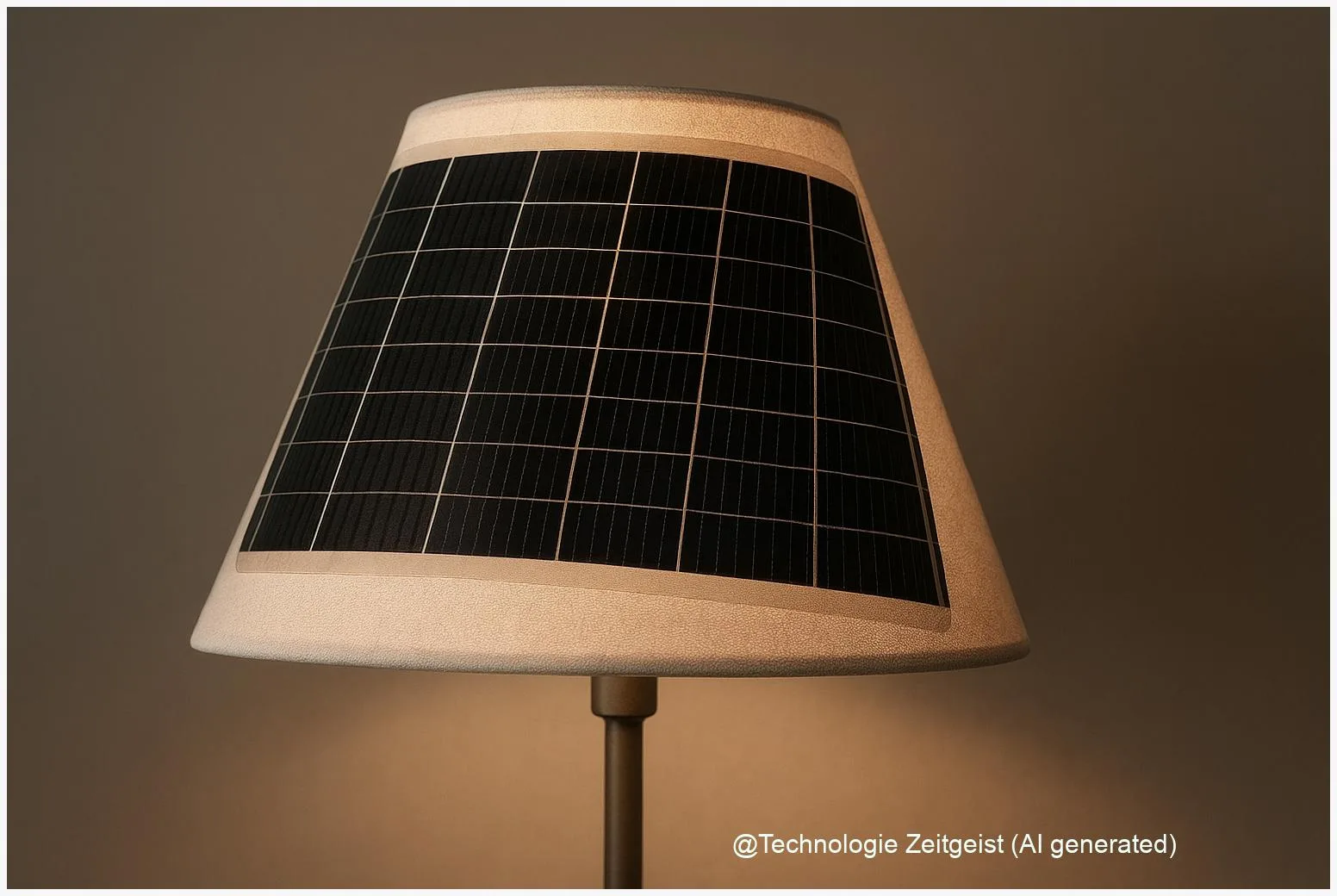
Small, flexible photovoltaic films can keep sensors and simple devices running under room lighting. organische Photovoltaik (OPV) performs especially well with LED spectra and low lux levels, making it a practical option for battery‑free indoor sensors, building‑integrated accents and low‑power IoT. The technology trades some rooftop performance for light‑weight form factors and easier integration, while long‑term field data and standard test routines are still catching up.
Introduction
Are you changing batteries in small sensors more often than you want? That daily or monthly maintenance is exactly the practical problem organic solar cells aim to reduce. These thin films are made from carbon‑based semiconductors that harvest light where standard rooftop panels are inefficient: under LED lamps, on curved surfaces, or inside fixtures where space and weight matter.
Indoor photovoltaic use is growing because many connected devices need only tiny average power — tens to hundreds of microwatts — but still rely on disposable or rechargeable cells. By matching material chemistry and layer design to indoor light spectra, OPV can provide steady trickle energy for long periods. However, lab records and module reality differ: small laboratory cells report high efficiencies under LED light, while full‑scale, encapsulated modules show lower values after packaging and scaling. Understanding those differences is essential when planning a product or retrofit.
The next sections explain the technical basics in plain language, then show concrete indoor examples, weigh benefits and limits, and close with practical guidance for anyone considering OPV for sensors or building integration.
Organische Photovoltaik (OPV): Basics and how they work
Organic photovoltaic cells are built from thin organic (carbon‑based) semiconductor layers rather than crystalline silicon. When light hits these layers it creates excitons — bound electron‑hole pairs — that must be separated at the interface between two materials, commonly called the donor and acceptor. After separation, charges travel through dedicated transport layers to the electrodes and then into your device or storage capacitor.
Three aspects make OPV particularly suited to indoor light. First, the active layers can be chemically tuned so their absorption matches the visible spectrum of LEDs rather than the broad solar spectrum. Second, the layers are extremely thin (hundreds of nanometers), so manufacturing by roll‑to‑roll printing is possible and the final product is flexible. Third, non‑fullerene acceptors (NFAs) and improved interface layers have raised internal efficiencies and reduced some degradation pathways that used to limit lifetime.
Material choice and optical tuning make a bigger difference for indoor efficiency than for rooftop panels.
One technical caveat: efficiency numbers quoted for indoor light are not directly comparable to standard “one‑sun” metrics used outdoors. Indoor tests report power conversion efficiency (PCE) relative to the much lower irradiance indoors, under a specific LED spectrum and lux level. Lab micro‑cells can show PCEs well above typical outdoor figures when measured at ideal LED spectra, but scaling to large, encapsulated modules generally reduces the practical PCE.
In short: OPV trades peak rooftop numbers for better performance in low, engineered light and for form factors traditional PV cannot offer.
| Feature | Description | Value |
|---|---|---|
| Active layer thickness | Typically a few hundred nm | ~100–500 nm |
| Indoor PCE (lab cells) | Optimized for LED spectra at 300–1000 lux | ~20–33 % (cells, lab) |
Practical uses: indoor power and IoT examples
The most immediate, practical use for OPV today is powering low‑energy electronics that otherwise run on replaceable batteries. Think of temperature sensors, door or window contacts, environmental beacons, and small Bluetooth transmitters. Many of these devices average between a few dozen microwatts and a few milliwatts, depending on reporting interval and radio technology.
How much area do you need? Under a typical office light (300–500 lux) modern indoor‑optimized OPV can provide on the order of 10–40 µW/cm². In brighter or closer integrations — for example, mounted inside a lamp shade or on a bright shelf — available power rises and a 10–40 cm² patch can sustain sensors that send only intermittent updates. At 1000 lux, well‑tuned cells can reach tens of µW/cm² to low mW/cm², depending on materials and packaging.
Integration matters. Flexible films allow placement on curved luminaires, on furniture edges, or as thin strips behind transparent surfaces. Several real‑world tests and product prototypes show practical batteryless operation for door sensors and presence beacons. For examples and prototype data from a recent practical review, see the TechZeitGeist overview on integrated indoor OPV and the separate case study on devices without a fixed power outlet, which include performance measurements and deployment notes.
These small‑area use cases are where OPV is most competitive today. Charging a smartphone remains out of reach because of the device’s high peak power and required storage; OPV is best thought of as a reliable trickle source combined with a small buffer (supercapacitor or rechargeable micro‑battery) and a power manager that wakes the device only to transmit or sense.
Opportunities, risks and tensions
OPV brings several advantages: light weight, flexible form factors, low material use, and the potential for low‑cost roll‑to‑roll production. Environmentally, lower energy input in manufacturing and the ability to avoid rare raw materials help, provided modules last long enough in the field.
Risks concentrate on stability and measurement consistency. Organic materials are more sensitive to oxygen, humidity and certain wavelengths of light. Encapsulation that lowers water vapor transmission rates is therefore essential. Many research groups report substantially improved stability under indoor LED lighting, but those results are often from small cells under tightly controlled conditions. The gap between lab cells and commercial, encapsulated modules is the main uncertainty: scaling introduces losses and can reveal degradation pathways not seen in tiny samples.
Standards are another tension. Because indoor performance depends on light color temperature and lux level, comparing products is meaningful only when manufacturers report results against agreed test spectra and intensities. The field still needs broadly adopted indoor test protocols for modules (defined LED spectra at 200, 500 and 1000 lux, MPP reporting, and long‑term operation logs).
Sustainability claims are more reliable when supported by life‑cycle analysis that uses real module efficiency, regional electricity mixes and measured lifetimes. Some industry reports indicate short energy‑payback times for OPV in certain conditions, but results vary with assumptions about lifetime and installation. Independent field data and transparent LCA parameters make claims defensible.
Looking ahead: tests, scale and what to watch
In the next years the most important developments will be in three areas: standardized indoor test protocols, module‑level field trials, and manufacturing scale‑up that preserves lab performance. Standardized test methods should fix LED spectra and lux levels, report maximum power point (MPP) yields and include medium‑term endurance runs under typical indoor duty cycles.
Product teams should insist on module‑level data, not only small‑cell records. A helpful pilot plan includes: 1) independent module verification under 200/500/1000 lux LED spectra, 2) a pilot installation logging energy production and device uptime over several months, and 3) a simple LCA using measured module yield and lifetime assumptions. These steps close the cell‑to‑system gap and provide numbers useful for procurement or product design.
On the manufacturing side, roll‑to‑roll printing remains the most promising route to low cost. The challenge is keeping interface quality and barrier performance during fast processes; advances in encapsulation materials and vacuum‑free barrier laminates are therefore significant to watch. For consumers and buyers, look for transparent warranties and independent test data rather than headline efficiency numbers alone.
Finally, OPV’s best early markets will be those where form factor, low weight and indoor performance matter more than raw rooftop efficiency: integrated lighting, smart furniture, wearable patches for low‑power trackers, and distributed sensor networks in buildings.
Conclusion
Organic solar cells make practical sense where small, distributed devices need a dependable trickle of energy without frequent battery swaps. By tuning molecules and device stacks to LED spectra and by using thin, flexible substrates, OPV delivers energy in places standard panels cannot. Lab records under indoor light demonstrate the technology’s potential, and early module products prove the concept; the remaining work is about robust encapsulation, standard module‑level verification and transparent lifetime data.
For product teams and planners the recommendation is concrete: require independent module tests at realistic indoor illuminations, plan pilot deployments that log real energy yields, and design energy buffering and power management into the device architecture. That combination turns a promising lab result into a useful, low‑maintenance product.
Share your experiences with indoor solar power in the comments and pass this along to colleagues who manage sensor fleets or building retrofits.

Leave a Reply