
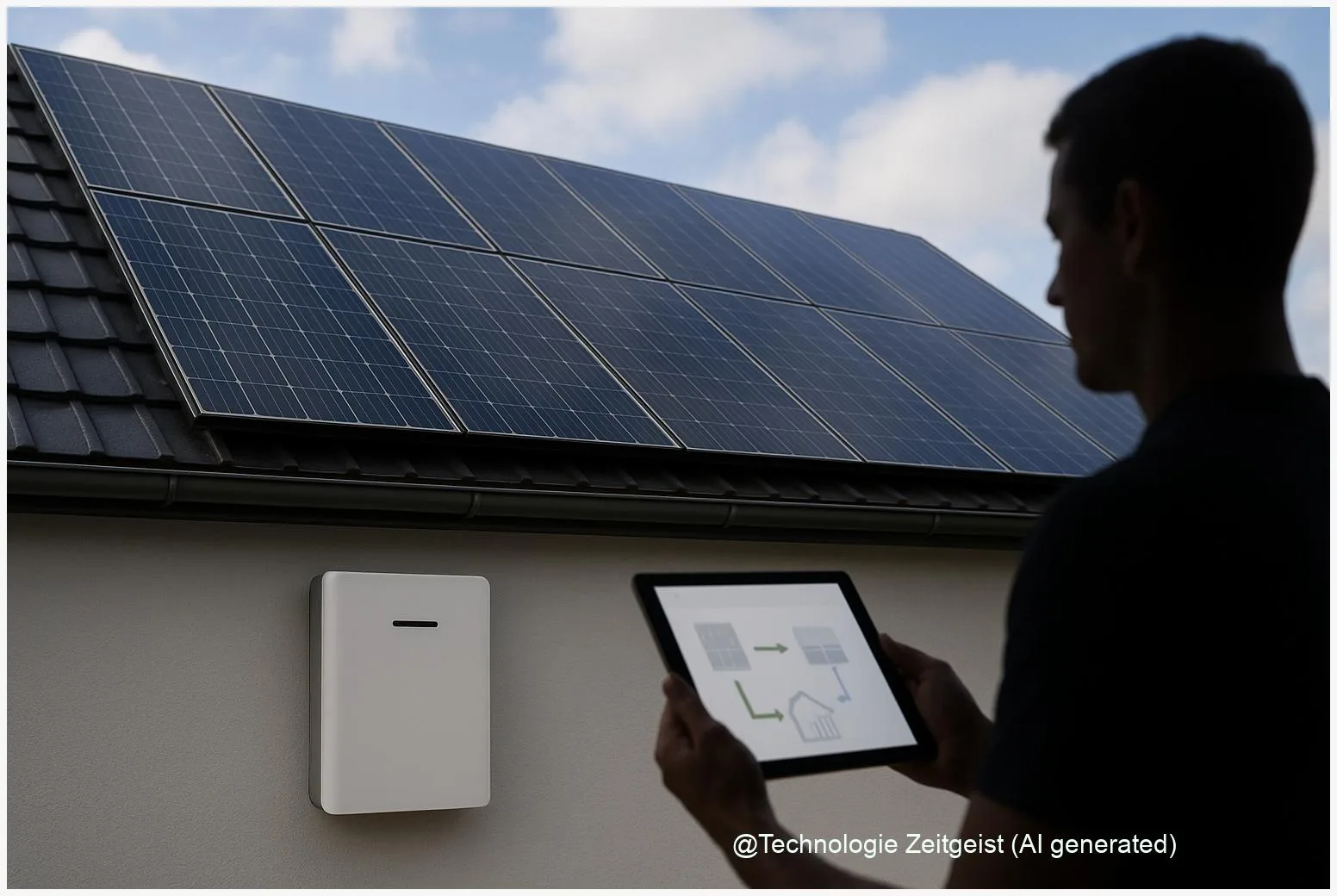
Choosing the right Heimspeicher (home battery) changes how much solar power you actually use and how a household copes with power cuts. This guide shows what a Heimspeicher realistically delivers: typical usable capacity, likely costs, and the role of backup (Notstrom). It highlights the technical facts households need to compare offers and the economic trade-offs that determine whether a battery pays off.
Introduction
Most households considering solar now also look at a home battery. The core question is not only “how big” but what problems the battery solves: higher self-consumption of rooftop solar, lower bills during expensive hours, and limited backup in outages. Sellers often quote nominal kilowatt‑hours and glossy payback numbers; the real value depends on usable capacity, system efficiency, and how you use electricity day-to-day.
This article walks through the practical figures and trade‑offs that matter for European households in the coming years: the likely size ranges for a typical family, the typical cost bands and a worked example for payback, technical minimums for safe backup operation, and the system-level tensions—among household benefit, grid needs and regulations—that will influence future offers.
Heimspeicher basics: capacity, efficiency and costs
Three simple numbers matter when comparing batteries: usable capacity (kWh you can actually draw), round‑trip efficiency (energy returned as a share of energy stored) and total system cost (€/kWh including inverter and installation). In practice, advertised capacity is often “nominal”. Usable capacity is lower because manufacturers reserve part of the battery to protect lifetime. Typical new home systems sold in recent years have usable capacities in the range of about 6–12 kWh; HTW Berlin found that many installations in 2023 averaged around 8.6 kWh usable capacity for household systems (this figure is from 2023 and therefore more than two years old).
Choose the usable kWh and the system efficiency as your baseline when you compare offers; they determine how much of your solar power is actually available at night.
Round‑trip efficiencies for current household systems typically sit between roughly 85 % and 95 %. The variation depends on cell chemistry, the battery management system and the inverter design. A DC‑coupled system (battery directly connected to the PV inverter side) typically loses less energy than some AC‑coupled setups. Fraunhofer ISE modelling uses broad CAPEX ranges to reflect this spread: typical model inputs for battery CAPEX vary roughly from 400 to 1,000 EUR/kWh (system figures include BOS and inverter add‑ons). These ranges matter because they drive the levelized cost of stored electricity.
Table: Typical sizes and what they mean in practice
| Battery size (usable) | Typical household effect | Indicative annual self‑consumption rise |
|---|---|---|
| ~4–6 kWh | Small evening topping; smart for low‑consumption flats | ~5–10 % |
| ~8–10 kWh | Common family setup; covers evening peak usage | ~15–30 % |
| ~12–20 kWh | Larger autonomy; better for homes with EV charging | ~30–50 % |
Costs: a simplified example helps to see the economics. Using a mid‑range assumption of about 600 EUR/kWh for the battery pack, an 8.6 kWh usable system implies a pack cost near 5,200 EUR before installation and BOS items. Adding inverter, mounting and installation can raise the system total by around 15–30 %, depending on local conditions and whether a hybrid inverter is needed. That arithmetic is simplified, but it explains why even a modest change in EUR/kWh assumptions shifts payback times significantly.
Everyday use: how batteries change household energy flows
How much benefit you get depends on when your household uses electricity compared with when your panels produce it. A typical rooftop system generates most of its energy between late morning and mid‑afternoon. Without a battery much of that energy is fed to the grid if you are not home. A battery stores part of that midday surplus to use later in the evening, increasing your self‑consumption and reducing imports from the grid.
Two everyday examples clarify the point. In a weekday household with a working couple and children, peak evening loads (cooking, heating water, lighting) happen after solar generation falls. An 8–10 kWh Heimspeicher can cover a large fraction of that evening demand and raise self‑consumption by a noticeable margin. In a household with an electric car that typically charges overnight, a larger battery paired with smart charging shifts more daytime solar into the vehicle and reduces charging from the grid.
Crucial operational terms: depth of discharge (DoD) is the share of nominal capacity you can use in each cycle; warranty conditions often specify guaranteed cycles (e.g., a number of full equivalent cycles or a remaining capacity after a set number of years). Higher guaranteed cycles mean a longer useful life and better economics. System controllers also offer scheduling options: you can prioritize cost (charge only when PV is available), self‑consumption (keep battery topped for evening use) or grid services (if you join a virtual power plant or demand response).
Financials depend on local electricity prices. With high retail prices, each kWh shifted from the grid to stored solar saves more money. Fraunhofer model results show that the levelized cost of PV+storage for small systems can fall into a broad band—some scenarios give costs comparable to retail prices, others remain more expensive—so individual household circumstances and local tariffs determine whether a battery shortens bills enough to reach payback within the warranty period.
Backup (Notstrom): what a battery can — and cannot — do
Backup capability is one of the main reasons homeowners buy a battery. But “backup” is not automatic: to supply your house safely during a grid outage, the system needs special hardware and approvals. Regulations and technical guidance in Germany (VDE‑FNN guidance updated in 2024) require an all‑pole isolation between the house and the public grid during islanded operation and clearly documented anti‑islanding functions. That means a certified changeover device or inverter mode that physically isolates the home so no energy flows back into the grid.
Practically, this has three consequences. First, a battery that offers backup will usually reserve a portion of its capacity for emergency use, reducing the usable capacity for everyday shifting. Second, the inverter and switching hardware must support rapid and safe transfer to island mode; not every low‑cost system includes it. Third, you must coordinate with your distribution network operator before installation to confirm requirements and receive any necessary approvals.
How much backup you can expect: a typical 8–10 kWh usable system can run essential circuits (fridge, lights, router, limited heating control) for many hours, but full household operation—electric heating, EV charging, and heavy appliances—requires much more stored energy or a generator. Simulation and field reports show households often choose selective backup: a small sub‑panel with critical loads is kept during outages rather than the entire house.
Insurance, safety and legal compliance matter. The VDE‑FNN guidance asks for documented test protocols and proofs that the system behaves safely in islanding. If you value backup highly, pick systems with certified islanding capability, ask for documented switching behavior and have the installer coordinate the technical dossier with the grid operator.
Opportunities and risks for buyers and the grid
On the opportunity side, home batteries give households more control over when they use solar and can support grid stability if aggregated into demand response programs or virtual power plants. System‑level studies find substantial value for large, well‑managed storage when it helps avoid peak generation shortfalls or reduces expensive redispatch actions. For a homeowner, joining such programs can produce extra revenue or lower operating costs, but it typically requires communication standards and interoperability that not every system supports today.
The risks are practical and regulatory. At the product level, buyers face opaque offers that mix nominal capacity, usable capacity and power limits. Compare guaranteed cycles, DoD, and round‑trip efficiency rather than only headline kWh. At the regulatory level, rules on how to allocate charges and taxes for electricity that is temporarily stored and later consumed are evolving; European and national frameworks have moved in 2024–2025 to clarify some of these points, but local practice still varies.
Another tension is feature vs. longevity. Systems that permit frequent deep cycling typically degrade faster; warranties define how much capacity remains after a given number of cycles. Some newer chemistries (including sodium‑based alternatives) may offer lower dependence on critical raw materials, but lab tests suggest they currently deliver lower efficiency or power density compared with mainstream lithium‑ion cells — a trade‑off that buyers should watch as field data accumulate.
For buyers: insist on clear, comparable figures in offers; check whether the system supports standard interfaces (ISO15118, OCPP or EEBUS) if you plan to join grid services; and ask for documented proof of islanding and protection functions if backup matters. For policy and grid actors, standardizing performance metrics and test protocols makes systems comparable and helps markets develop without confusing consumers.
Conclusion
Choosing a Heimspeicher requires looking beyond headline kilowatt‑hours. Usable capacity, round‑trip efficiency and system cost per usable kWh determine how much solar you actually capture for later use. Backup functions are valuable but need certified islanding hardware and coordination with the network operator, and they often reduce the capacity available for daily savings. Economic returns depend on local electricity prices, household load patterns and installation costs; typical mid‑range systems often show payback periods that make financial sense only in favourable cases.
Well‑informed buyers compare usable kWh, efficiency, guaranteed cycles and documented islanding behavior. Where possible, choose systems with clear interoperability and standardized performance data so the battery can participate in future value streams beyond household savings.
Share your experience with home batteries and technical questions — constructive comments are welcome.

Leave a Reply