
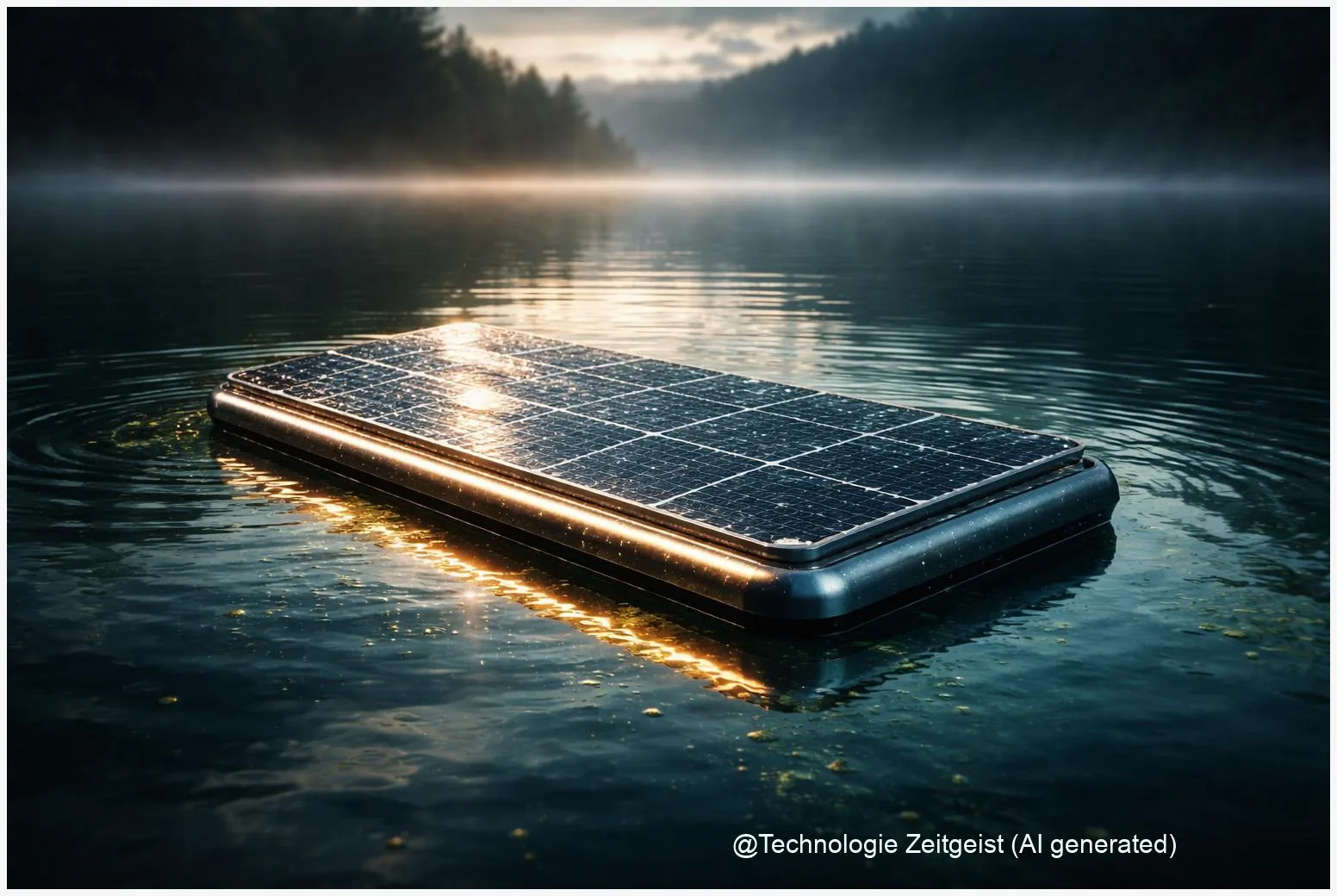
Floating solar is an approach that places solar panels on water surfaces to generate electricity while saving land. It can raise energy yield slightly because modules run cooler, and it opens new sites for solar—reservoirs, lakes, and irrigation ponds. For communities and grid planners, floating solar offers a practical way to add clean capacity without using farmland. This article explains how floating solar works, where it makes sense and what trade-offs matter for cost, environment, and long-term operations.
Introduction
Many water surfaces are unused but well suited for solar arrays: lakes behind dams, drinking-water reservoirs, cooling ponds at industrial sites and even large irrigation basins. Floating solar adds panels to those surfaces on modular pontoons. That reduces competition for land and can increase annual energy production compared with an identical array on land because the water cools the modules. The technical term for these installations is floating photovoltaic (FPV); the most common panels are crystalline silicon modules, the same type used on roofs.
The choice is not only technical. Local rules on water use, water-quality protection, and grid connections decide whether a project becomes feasible. The rest of the article walks through the basic physics, concrete project examples, the practical trade-offs developers and communities face, and likely developments in the next few years.
Floating solar: how it works
A floating solar system consists of solar modules mounted on pontoons, connected by walkways, anchored with mooring lines and linked electrically to an onshore inverter and grid connection. The central technical benefit is lower module operating temperature. Solar panels lose efficiency when hot; water below the array helps carry heat away so modules can deliver slightly more power for the same sunlight.
Two other physical effects matter. First, soiling—dust and dirt on panels—tends to be lower on water if the site is remote from roads and agricultural dust. Less soiling reduces cleaning frequency and small losses. Second, albedo (reflectivity) of the surface affects how much light reaches the panels. Open water usually reflects less than bright ground surfaces, which in some orientations can slightly lower irradiance on tilted panels; the cooling benefit generally outweighs this in many climates.
Floating arrays often run about 4–6 °C cooler than comparable ground arrays in measured studies, which accounts for much of the typical energy gain.
A few brief technical terms: capacity factor is the share of time a generator runs at full power on average (expressed over a year); temperature coefficient measures how much module output falls per °C above standard test conditions; LCOE is the levelised cost of energy, a way to compare the average long-term cost per kilowatt-hour.
When numbers help, evidence from multiple field studies and handbooks shows typical annual energy gains for floating vs. comparable ground-mounted PV of around 3–6 percent in temperate climates and larger gains in hot regions. These gains come from cooling and reduced soiling combined; exact results depend on tilt, local wind, water temperature and system design.
If numbers are shown clearly, a simple comparison helps:
| Water body | Typical depth | Common constraint | Best value |
|---|---|---|---|
| Reservoir (drinking water) | 10–50 m | Strict water-quality rules | Land-saving near cities |
| Storage dam / hydropower reservoir | variable, often deep | Hydrology and multi-use coordination | Hybrid operation with hydro |
| Irrigation pond | 1–5 m | Seasonal water-level change | Low-cost local generation |
| Industrial cooling basin | shallow | Access and heat interactions | Co-located site value, backup power |
Practical examples and real projects
Several large demonstrations make the concept concrete. Japan’s Yamakura Dam project, often cited in practitioner literature, is an early commercial-scale floating installation of roughly 13.7 MW (commissioned in 2018). It was built on a reservoir footprint and reported annual generation in the mid‑tens of gigawatt‑hours, demonstrating that modular pontoons can be combined at utility scale.
International handbooks and data collections—such as the World Bank / SERIS floating solar handbook—collect lessons from such projects. They show that engineering attention to anchors, cabling and electrical sealing is critical; these items cause a notable portion of incremental costs compared with ground arrays. NREL’s cost benchmark (2021) estimates an installed-cost premium on the order of about +25 percent for a 10‑MW fixed-tilt floating system versus the same system on open ground, driven by floats, moorings and specialized installation.
Measured performance datasets from recent studies support the modest yield gains: in temperate sites the annual uplift commonly falls in the single-digit percentages, while sites in hotter climates sometimes show higher relative gains because cooling prevents more pronounced temperature-related losses. For comparison, a 5 percent yield gain is often valuable but not always enough to offset a 25 percent cost premium without additional value (for example avoided land cost or high local power prices).
For readers following broader energy topics, floating solar often pairs well with other local measures: coupling FPV with hydro reservoirs can smooth daily generation, and nearby battery storage can use floating output more effectively. Those interactions tie into wider discussions about grid flexibility and household storage; see our coverage of battery storage in Germany for how local storage changes when electricity is used.
Opportunities and risks
The upside of floating solar is clear in specific situations: when land is scarce or expensive, or where shaded reservoirs already exist near demand centers. The technology can reduce evaporation from open water—helpful in dry regions—and it avoids some land‑use conflicts. Cooling-driven yield gains and lower soiling can improve production over lifetime.
The trade-offs require careful attention. First, cost: floats, anchors, and marine‑grade electrical systems add CAPEX and O&M complexity. NREL’s 2021 benchmark remains a useful reference for the typical installed‑cost premium and the main cost drivers. Second, durability and maintenance: cables and connectors near water need robust sealing and material choices because humidity, splash and, in coastal settings, salt can accelerate wear. A laboratory study flagged cable submersion as a realistic failure mode when materials are not chosen for the environment.
Third, environmental and regulatory constraints matter. Drinking-water reservoirs often have tight rules on materials, cleaning agents and shading of the surface. Fish and bird habitats must be evaluated. In agricultural settings seasonal water-level changes can strain moorings and require flexible float layouts.
Fourth, grid and market value: modest yield gains matter most where grid access is nearby, local power prices are favourable, or where floating arrays reduce other local costs (for example replacing expensive urban land). In places with constrained grid capacity, the permitting and connection timeline may be the decisive barrier.
What to watch next
Costs for floats and anchoring are the single biggest lever for wider uptake. Standardised float platforms, economies of scale, and clearer component standards would reduce the CAPEX premium reported in benchmarks. Expect incremental cost declines over the next five years as manufacturing concentrates and designers optimise materials and logistics.
Integration with other assets is another trend to watch. Floating solar paired with hydro reservoirs allows slightly different dispatch patterns—hydro can fill gaps when panels underproduce—and co‑located batteries increase the usable value of on‑site generation. Regulatory pilots that allow distributed assets to sell flexibility or participate in local balancing markets will change project economics and could accelerate deployment.
For communities and planners deciding whether to support floating solar: assess actual grid connection prospects, local rules on water use and the environmental baseline, and whether the site’s water‑surface characteristics favour cooling gains. If a project relies on higher yield estimates, insist on multi‑year measurement or model validation.
For curious readers, floating solar is not a universal fix but a strong option where land is costly, water use allows it, and the grid context is favourable. It also points to a broader practical question: how can existing infrastructures—dams, industrial basins, canals—be repurposed to host low‑emission generation without undermining the other services those water bodies provide?
Conclusion
Floating solar expands the places where photovoltaics can be built and typically adds a small but useful energy advantage because cooler modules lose less power. The technology works best where land is constrained or where co‑located services—hydropower, industry, or urban proximity—raise the value of on‑site generation. The main obstacles are higher up‑front costs for floats and mooring, environmental and water‑quality constraints, and the need for durable, marine‑grade electrical design.
In practice, each project should be evaluated on three practical questions: who manages the water use, how firm is the grid connection, and what is the realistic yield uplift at the site. When these align, lakes and reservoirs can become reliable local power plants that save land and add renewable capacity to the grid.
Join the conversation: share practical experiences or questions about floating solar and how it could fit in your region.



Leave a Reply